
Globalization as a Trigger for Emerging New Diseases? Contestations on Chronic Kidney Disease of Unknown Etiology in Sri Lanka
Kalinga Tudor Silva1 
1Department of Sociology, University of Peradeniya, Sri Lanka .
http://dx.doi.org/10.12944/CRJSSH.3.1.06
Copy the following to cite this article:
Silva K. T. Globalization as a Trigger for Emerging New Diseases? Contestations on Chronic Kidney Disease of Unknown Etiology in Sri Lanka . Current Research Journal of Social Sciences and Humanities. 2020 3(1).
DOI:http://dx.doi.org/10.12944/CRJSSH.3.1.06Copy the following to cite this URL:
Silva K. T. Globalization as a Trigger for Emerging New Diseases? Contestations on Chronic Kidney Disease of Unknown Etiology in Sri Lanka . Current Research Journal of Social Sciences and Humanities. 2020 3(1). Available from: https://bit.ly/2C8QO9t
Download article (pdf) Citation Manager Review / Publish History
Introduction
Globalization and nationalism are often seen as rival epistemologies that are critical of each other. Globalization advocates identify nationalism as an effort to limit the thinking of people and a harbinger of a frog-well mindset (Kupamanduka), an old Sanskrit adage adopted by Amartya Sen (2000) to label narrow-minded anti-globalists. On the other hand, nationalists see globalization and its conceptual ally neoliberalism as serious threats to traditional cultural values, sustainable livelihoods and local ecosystems.
Global capital has made inroads into every imaginable aspect of life in the periphery of the world system. These effects include changes in food habits, transitions in livelihoods, increased labour migration, development and increased utilization of land and water resources, mining and relocation of industries whereby relationship between capital and labour is reorganized with a view to enhancing returns to capital.
Against this background, the nationalist critique of global capital has tried to identity and expose negative impacts of globalization in areas such as environmental degradation, global warming, human smuggling, super exploitation of labour, deterioration of health services and the emergence of new disease burdens. The current paper elaborates the nationalist critique of the emergence of a chronic kidney disease of unknown etiology (CKDu) in selected farming communities in Dry Zone Sri Lanka in order to illustrate how globalization processes impinge on the livelihoods in the periphery and lives of people in the margins as perceived by local scientists, including the nationalists among them. What is presented is a discourse analysis where nationalist discourse has challenged the scientific discourse on the disease for siding with the agrochemical lobbies in their effort to conceal the adverse effects of heavy use of agrochemicals (chemical fertilizer and pesticides) under the green revolution policies introduced since the 1960s.
CKDu is a new disease also reported in farming communities in central America, Balkans, Egypt, India and several other countries (Lopez, Barahona and Guerra, 2018). This in turn indicates that this disease may be related to the long-term impact on farming populations not only the heavy use of agrochemicals but also other global macro processes such as global warming and its possible impact on heat stress and dehydration.
Because of its chronic impact on the patients and their families in the tropics, adverse impacts on poverty, development of human capital and farming systems in general, CKDu has received attention from the angle of public health as well as development. The disease set in motion socio-economic processes harmful to social development in the long run. Referring to these socio-economic outcomes Elledge et al. (2014) noted “(t)he impact is traumatic on patients and their families, as the ability to work declines, and families are often unable to pay the high cost of renal dialysis treatments”. They also identified it as an unfolding global public health concern with numerous short-term and long-term impacts.
Methodology of the Study
The paper sketches the natural history of the disease in affected areas using available evidence from media reports, creative writings and scientific writings. Reports in selected Sinhala newspapers and some creative writings in Sinhala exploring the triggers and impact of the disease are used to understand how the disease is perceived by the local intelligentsia in relation to changes in lifestyle, livelihoods and cultural and technological flows from outside. A selection of scientific writings on the disease is used to sketch the effort to isolate causative agents within the bio-physical environment without relating them to larger historical processes and contextual factors. While scientific and nationalist approaches tapped in this essay present counter arguments relating to the etiology of the disease and its possible remedies, their epistemologies are not necessarily independent or distinct from each other because of heavy infiltration of nationalist thinking into some of the scientific writings as well as some of the agricultural development activities in the country such as the colonization schemes and Mahaweli Development Scheme without necessarily recognizing it as such (Moore, 1985; Woost, 2009, Silva 2014).
A Social History of the Rajarata Kidney Disease
First reports of “a mysterious kidney disease” came from the remote Padaviya DS Division in the Anuradhapura District in early 1990s. This was recognized as a mysterious kidney disease because it did not present itself together with the hypertension, diabetes, obesity or other conditions that normally accompany regular kidney disease. For this reason, the disease was identified as CKD of unknown etiology (CKDu) from 1996. Much of the vernacular media in Sri Lanka, however, started referring to the disease as ‘Rajarata Kidney Disease’ in view of its initial geographic spread in this historic Dry Zone region with ancient ruins and hydraulic work of great antiquity, seen as the heartland of ancient Sinhala civilization. With the establishment of a Nephrology Unit in Anuradhapura Teaching Hospital, identification and follow up of CKDu patients became more systematic. The visibility of CKDu as a serious public health problem as well as a social problem affecting the farming communities in selected areas in North Central Region increased after 2000 due to wide publicity given in mass media, activism of some health workers, government officials and researchers, increase in research on the disease since 2003, end of civil war that killed many lives from 1983 to 2009 and its replacement in Sinhala areas by frequent deaths caused by CKDu and higher mortality associated with the onset of the fourth and fifth stages of CKDu in many patients in more recent years. Endemic areas have reported a CKDu prevalence of 15 to 20% among working age adults, 30 to 60 years of age (Jayatilake, Mendis, Maheepala & Metha, 2013). Following the typical paradigm in biomedical and natural sciences, the research so far has sought to isolate the active agent(s) interfering with kidney functions.
The research community is deeply divided on what causes this kidney disease with arsenic, cadmium, lead, fluoride content in drinking water, alcohol, poisonous algae in inland waters and a range of other natural or introduced agents being identified as possible nephrotoxic substances responsible for this life threatening degenerative disease (Chandrajith et al., 2010; Chandrajith et al., 2011; WHO, 2012; Jayatilake, Mendis, Maheepala & Metha, 2013; Dissanayake & Chandrajith 2019). The heavy metals of arsenic and cadmium are directly seen as outcomes of heavy use of agrochemicals over a long period in the affected areas, while fluoride content in water, algae and lotus roots point to indigenous substances and specifics in the local ecosystems, geochemistry and human lifestyles that may be implicated in the disease causation. Several studies have sought to isolate pesticide residues in food as a possible cause of kidney damage with the implication that certain chemicals introduced through the food chain as a possible cause of the disease (Jayasumana, Gajanayake, & Siribaddana 2014; Jayalal et al., 2019). Others sought to identify cantaminated water as the source of kidney damage whether the contamination is due to seepage of pesticides, weedicides or any other chemicals such as flouride into ground water (Dissanayake & Chandrajith, 2019; Wanigasuriya, Peiris-John,Wickremasinghe & Hittarage, 2007; Illeperuma, Dharmagunawardhane, . & Herath, 2009). The following statement by Jayasumana, Gajanayake and Siribadana point to the nature of contestations about the etiology of the disease.
In a recent study published by the National Project team on chronic kidney diseases of unknown origin in Sri Lanka, we believe there to be flaws in the design, analysis, and conclusions, which should be discussed further. The authors wanted to emphasise Cadmium as the major risk factor for chronic kidney disease of unknown etiology in Sri Lanka while undermining the importance of Arsenic and nephrotoxic pesticides. To arrive at predetermined conclusions, the authors appear have changed and misinterpreted their own results. The enormous pressure applied by the agrochemical industry on this issue may be a factor. Herein, we discuss these issues in greater detail. (Jayasumana, Gajanayake. & Siribaddana, 2014, p. 124).
While agrochemicals may be an important factor in the etiology of CKDu in Sri Lanka there are many places in Sri Lanka where there is heavy use of agrochemicals without the disease being present. Similarly, the timing of the emergence of the disease and its relation to introduction of green revolution technology in Sri Lanka in the 1960s require further reflection. On the other hand, fluoride content in water or eating of lotus roots or fresh water fish cannot be identified as factor responsible for the emergence of a new disease unless we argue that these food items or drinking water themselves became contaminated due to some environmental changes preceding the emergence of the disease. In any case a historically-informed analysis is necessary in relation to the relevance of potential disease causing agents in the respective areas.
The name of the disease itself has been subjected to much debate in the light of these contestations. For instance, Saroj Jayasinghe proposed that the disease reported in Sri Lanka and several other countries be officially designated as ‘Chronic Agrochemical Nephropathy’ in view of its wider prevalence in farming areas in all the countries it has been reported and suspected implication of agrochemicals in the causation of the disease (Jayasinghe, 2014). In contrast, Wimalawamsa (2016) identified the disease as Chronic Kidney Disease of Multi Factorial Origin (CKDmfo), preferring not to implicate agrochemicals alone on the basis of limited available evidence.
As can be expected agrochemical lobbies have come forward to deny the possible impact of agrochemicals in causing the epidemic (Bandarage, 2013). For people in the affected areas, the epidemic has caused ‘a moral panic’ because of its life threatening character, severe impact on their livelihoods, widespread stigma associated with the disease and most of all dreaded fears about the food they eat, water they drink, alcohol they consume and even the air they breathe (Ranasinghe & Ranasinghe 2015; de Silva 2017). The asymptomatic nature of the disease in early stages of its development in the human body has added to the mass panic, fear and the anxiety that one may discover it only too late to respond to the disease in a way they can recover from it or contain its progression. Epidemiologically speaking the reported case load in a population may only be ‘the tip of the iceberg’ (Wijeratne et al., 2019, p. 55).
The government of Sri Lanka commissioned the WHO to undertake a study aiming to isolate the cause. The results of this study, released in 2013 after a long delay, pointed to the heavy metal theory with those diagnosed with abnormal kidney impairment by comparison with a control group reporting cadmium and arsenic levels in urine above the reference levels with possible nephrotoxic effect (WHO, 2012; Jayatilake et at. 2013). The WHO study recommend banning several agrochemical products considered to be harmful to health and the authorities decided to ban only some of them initially in order to ensure that weed and pest management in agriculture is not hampered by immediate withdrawal of all the relevant products (Wijesekera, 2014). While the WHO study was conducted by some eminent scientists and health administrators from Sri Lanka, it has come under considerable criticism from the local researchers and practitioners who worked on this problem for many years due to the problematic procedures used in drawing the study samples, concerns about validity and reliability of the study findings and conclusions drawn and lack of sufficient dialogue with local researchers with a long track record in CKDue investigations (Jayasumana, Gajanayake. & Siribaddana, 2014; , Ranasinghe & Ranasinghe 2015).
Geographic Distribution of the Disease
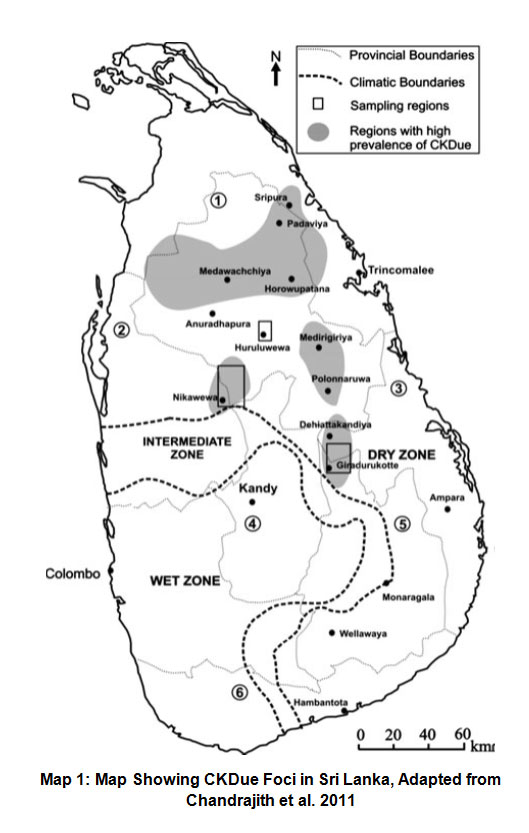 |
Map 1: Map Showing CKDue Foci in Sri Lanka, Adapted from Chandrajith et al. 201 |
The geographical distribution of CKDu foci in Sri Lanka as of 2012 is shown in Map 1.
On the basis of the number of cases identified there are three major foci and three emerging foci as described below. The three major foci are as follows:
- Padvi-Sri Pura
This foci was first diagnosed in early 1990s. Administratively this area was first included in the Anuradhapura District and it has been designated as part of the Mulaitivu district after the end of the war. The total number of CKDu cases identified by 2012 was 1500 with nearly 500 deaths attributed to the disease. The bulk of this region comes under a colonization scheme established in 1956 for colonists from the Sinhala South who suffered greatly due to LTTE attacks during the war with state sponsored Sinhala colonization schemes in the so-called border areas being a well-known target of LTTE attacks. Rice farming is the main economic activity in the area followed by employment in the security forces and civil defense force (Personal Communication with Dr. Palitha Bandara 2013).
- Madawachchiya
This DS Division is adjoining Padavi-Sri Pura. Similar to the latter division in Madwachchiya too rice farming and employment in the security forces play a significant role in the rural economy. Unlike Padvi-Sripura, however, Madavachchiya area is characterized by Purana (ancient) villages served by cascades of small irrigation tanks reportedly built by ancestors of the village communities. High density of cascades of small tanks is one prominent feature of the landscape in this region. In addition to rice farming, highland cultivation of commercial crops like chilies and onions using agro wells has become increasingly important during the past two decades among the more enterprising families also often drawing a supplementary salary income from security forces. Like Padavi-Sri Pura, many villages in this division too became victims of brutal LTTE attacks during the war drawing them into this armed conflict as foot soldiers as well as innocent victims. The CKDu was first discovered in this area around 1994 and by 2012 a total of 2800 patients had been diagnosed and the total number of deaths attributed to CKDu was 600.
- Girandurukotte
This is a new settlement established in early 1980s under the Accelerated Mahaweli Development Project, one of the largest multi-purpose development projects to be implemented in the country. The settlers consisted of resettlers displaced from the local area due to the establishment of the scheme, relocates from upstream areas (e.g. Teldeniya and Rantambe) that came under the head works of the Mahaweli project and new settlers selected from among land-hungry Sinhala peasants from other areas. The main economic activity is irrigated rice cultivation in two crop seasons (yala and maha) per year. The disease was first recognized in the area around 2000 and by 2012 an estimated 2300 patients were living in the area with an unknown number deaths attributable to CKDu.
In addition to these main foci, three smaller foci of CKDu had also been identified by 2013. They consist of the following:
- Madirigiriya in the Polonnaruwa District
This is also leading colonization scheme started in late 1950s. Most of the settlers originally came from congested regions in Kandy, Matale and Kegalle Districts in the Wet Zone. The main economic activity is irrigated rice cultivation with poorer households also supplementing their income from working as wage labourers. The CKDu problem in this area came to limelight in late 1990s. By 2012 an estimated 2000 CKDu patients were living in this area.
- Nikaweva
The population in this area belong to purana villages served by a multiplicity of small tanks. The CKDu problem in the area came to limelight around 2000. According to one estimate around 600 CKDu patients from the area visited CKDu clinics in Anuradhapura and Kurunagala.
- Wilgamuwa
This is an emerging foci identified around 2010, but not indicated in Map 1. As of October 2019, the reported total number of confirmed patients in the area was 1,239 in a population of 25,283 (4.9 patients per 100 population). This is agricultural area opened up for local purana villages and new settlers from outside under the Minipe scheme in 1964-1965 (Vlahos et al., 2018). Rice cultivation is the main crop with a number highland crops as subsidiary food crops. Sand mining in the river bed is an important livelihood particularly among the poorer section of the population. During the off-season, many manual workers from the area move to Colombo and other areas to be engaged as hired laborers in the construction industry, road work and farm work.
In each of these places, once a foci was identified by the doctors from CKDu clinics in Anuradhapura and Kandy conducted monthly mobile clinics in order to identify patients and provide treatment and advice. The identified patients were advised to visit the regular clinics but the attendance was not all that satisfactory. For instance, in the Girandurukotte, of 2000 patients diagnosed since the disease was first discovered in the area around 2000, only about 1000 regularly attended clinics with others opting to go for alternative therapies or not doing anything at all in spite of the rapid progression of the disease if palliative care was not pursued.
The 6 CKDu foci already identified and characterized by some researchers as “geographic hot spots of CKDu” (Elledge et al., 2014) had some important similarities among them. First and foremost, they were all Dry Zone regions with common agro-ecological features. Second, rice cultivation was the main economic activity in all of them even though highland cultivation of other field crops (OFCs) was also important in some of them. Third, heavy use of agrochemicals was evident in all of them clearly indicating the implication of the agrochemicals used in rice cultivation in particular in the pathogenesis of the disease. Another common feature in all the foci was that the primary source of drinking water in all of them was ground wells usually in their own homesteads. While many of the inhabitants in some of the sites were natives in purana villages, the new settlers in colonization and Mahaweli settlement areas had lived in these areas for long periods having originally come from outside the areas under state sponsored human resettlement schemes.
The Nationalist Discourse on the Disease
Even though there are a few emerging CKDu hotspots in minority areas such as Vavuniya and Mulatitivu, the disease has primarily affected the Sinhala farmers in Rajarata, identified as the heartland of Sinhala Buddhist Civilization. In post-independence Sinhala nationalist perceptions, the peasantry (independent small holder farmers) are perceived as the food producers for the nation and the key bearers of the Sinhala Buddhist culture (Moore 1989, Woost 2009). According to epidemiological accounts, men who are 40 years and above are three times more likely compared to the same age cohort among females to be positive for CKDu, with the result that the disease often hit the main breadwinner of farm households (Wanigasuriya, 2012). Most development activity in post-independence Sri Lanka involved irrigation development in order to sustain and preserve the Sinhala peasantry, understood as the core of Sinhala Buddhist nation (Silva, 2014; Moore 1985). The disease has already killed many farmers and their family members and the epidemic has posed a real threat to farming as a livelihood and a development approach anchored in the preservation of the peasantry (Moore 1985; Woost 2009; Silva 2014). This has added to the agrarian distress in the affected areas also reflected in indebtedness among farmers, marketing problem about farm produce, farmer suicides and flight of labour away from farming areas (Silva et al. 1999; Dunham & Edwards 1997).
In the same way farmer suicides have been identified as the face of agrarian distress in India (Deshpande, 2002; Revathi 1998), Rajarata Vakugadu Rogaya (CKDu) has been identified as the face of acute agrarian crisis in Sri Lanka. The political class in Sri Lanka has long projected themselves as spokespersons for the small farmers and CKDu has all the makings of a national crisis with a high powered presidential task force being set up with representatives of the agricultural sector, health sector, social services sector, water supply sector, researchers and the academic community to identify possible policies and interventions for dealing with the problem (Presidential Task Force, 2018). Among other bilateral and multilateral donors, China is in the process of setting up a state of the art laboratory at University of Peradeniya to test water, food and other substances for the presence of pesticide residues and other nephrotoxic substances and already helped establish a fully-fledged kidney hospital in Polonnaruwa town located in an affected area and important site of Sinhala nationalist imaginations of the state and the public.
Some sort of a nationalist front consisting of some researchers initially led by Nalin de Silva, politically active Buddhist monks led by Reverend Rathana of the Jathika Hela Urumaya (Sinhalese, Heritage Party), journalists, a section of western medical practitioners, Ayurveda scholars and indigenous medical practitioners, poets and novelists, selected television channels and intellectuals in general has been formed in order to create a public opinion about the disease and attack what they perceive as ‘agrochemical lobbies’ and advocates of green revolution. In their view, as a cumulative outcome of over a half century of indiscriminate use of agrochemicals in Sri Lanka water resources, soil and food have been contaminated to a crisis point and sustainable agriculture practices by past generations of Sri Lankan farmers (‘our ancestors’, to use a term widely used in the print and electronic media) have been abandoned for the sake of increasing productivity and enhancing profitability of farming. According to them agrochemicals (disparagingly referred to as mahitel, substances to kill insects) in Sinhala, have introduced vasavisa (vasa refers to artificial poisons and visa (e.g. sarpa visa) refers to natural toxins such as venom of snakes) in the environment causing cancer, CKDu and other serious health problems in the countryside. Vasavisa is a broad concept covering agrochemicals, artificial food, synthetic medicines, alcohol, chemical perfumes and many other substances. The nationalist critiques see agrochemical industry also employing many scientists to develop new products all the time as squarely responsible for the miserable condition of the affected communities.1 For instance, in the Sinhala novels ‘Wehibittara’ (lifegiving rain) and ‘Diyaholmana’ (the ghost emanating from running water) CKDu is understood as an outcome of an overall environment crisis caused by damage to a pristinely pure natural environment and community life in the Sri Lankan countryside. Their campaigns have sought to ban selected agrochemicals from use in Sri Lanka, promote organic farming, integrated pest control, promote the consumption of pesticide free food (vasavisen thora ahara) and expand health services for the CKDu patients in the periphery and facilities for early diagnosis of the disease. The agrochemicals recently banned in Sri Lanka include Glyphosate. While this nationalist upsurge does not involve an outright rejection of western science and technology, it tends to attribute environmental degeneration, epidemic of non-communicable diseases, including emergence of CKDu and cancer as leading public health problems in the country to the changes in food habits, consumerism and indiscriminate use of potentially toxic substances, including those produced by the food industry, agrochemical industry, pharmaceutical industry and IT industry all emanating from western influences (Silva, 2014; Bandarage, 2013; Weerasekere, Withanachchi, Ginigaddara & Ploeger, 2018).
The Sinhala nationalist campaign has brought CKDu to the limelight of national politics, created public awareness about the disease, the impact of agrochemicals in society, highlighted the need to revisit the policies introduced in the name of green revolutionand contributed to policy changes geared to evolve a sustainable agriculture in Sri Lanka. This is very much in line with Sustainable Development Goals that drive the global policy landscape. The nationalist discourse on CKDu in Sri Lanka, however, has a number of serious limitations in identifying suitable remedies for addressing CKDu and other similar problems. First, while CKDu may be attributed to the larger environmental impact of generations of agrochemical use, CKDu does not occur in all areas where heavy agrochemical use is practiced (e.g. tea and vegetable growing areas in the central highlands) and some analysts have proposed several other explanations for spatial clustering of the disease such as the presence of fluoride deposits in some of the affected areas. Similarly, a substantially higher prevalence of the disease among males cannot be fully explained in terms of a higher exposure to agrochemicals as both men and women work in rice fields and both men and women in a given area eat the same food and drink the same water.
It is quite possible that the underlying causes of CKDu are multifactorial where exposure to agrochemicals may be interacting with other possible complicating human behavioural factors such as dehydration among farm workers, their consumption of illicit intoxicants on a routine basis and non-use of protective devises while applying insecticides (Vlahos et al., 2018). While the nationalist lobby cannot be blamed entirely for the neglect of other factors besides agrochemicals that may contribute to kidney damage in farming communities, the tendency among the nationalist thinkers to brand researchers investigating other possible causes of CKDu as sympathizers or even agents of the agrochemical industry has not helped the situation. Finally, the nationalist group has not managed to organize and empower the kidney patients themselves and have merely shown a paternalistic attitude towards the people with kidney disease not trying to help develop their agency and potential to fight for their rights as patients, demand quality services and seek to counter the agrochemical lobbies and at the same time bring about behavioural changes among farmers and their family members that help reduce their exposure to the disease. Just like many of the scientific community doing research on CKDu, the nationalist thinkers too tend to fight on behalf of CKDu affected communities without necessarily engaging them on a systematic basis.
In summary while the nationalist critique of globalization has made a significant contribution towards drawing attention to the negative impact of globalization and the plight of the ‘victims of globalization’, so far they have failed to either overcome the scientific biases of the natural science community nor mobilize the victims of globalization in the struggle against the corporate sector or for overcoming their own high-risk behaviours.
Conclusion
Scientific studies on CKDu in Sri Lanka have drawn attention to a wide variety of potential triggers of the CKDu epidemic in Sri Lanka without specifying historical circumstances in which these factors have come into operation. On the whole the current knowledge point to a multifactorial (a mix of environmental, technological and behavioural) origin of the disease in selected dry zone regions in Sri Lanka. The nationalist discourse has raised some important issues relating to the possible impact of corporate capital and commercial drivers and environmental triggers of the epidemic but to the extent human behavioural factors and local environmental triggers are totally excluded from this analysis and it is driven by dogmatic views and untested philosophical assertions rather than valid empirical investigations it does not provide a way out of the current crisis. Both scientific studies and nationalist assertions must strive to understand and transcend the limitations within which they try to understand the triggers of the CKDu epidemic and how to overcome them within the current global context.
Acknowledgements
The author acknowledges with thanks the help received from Sameera Handapangoda and W.M.K.B. Wickramasinghe in preparation of the paper.
Funding
This study was conducted using literature review and it was not funded by any agency.
Conflict of Interest
There is no conflict of interest in conducting this study or writing this essay by the author.
References
- Bandarage, Asoka.(2013).Political economy of kidney disease in Sri Lanka, Sage Open, http://sgo.sagepub.com/content/3/4/2158244013511827 .
- Chandrajith R., Seneviratna S., Wickramaarachchi K., Attanayake T., Aturaliya T. N. C. & Dissanayake C. B. (2010). Natural radionuclides and trace elements in rice field soils in relation to fertilizer application: study of a chronic kidney disease area in Sri Lanka. Environmental Earth Sciences, 60, 193-201.
- Chandrajith, R., Nanayakkara, S., Itai, K., T . N. C. Aturaliya, T.N.C., Dissanayake, C.B., Abeysekera, T., Kouji Harada, K., Watanabe, T., & Koizumi, A.. (2011). Chronic Kidney Diseases of Uncertain Etiology (CKDue) in Sri Lanka: geographic distribution and environmental implications. Environ Geochem Health 33, 267–278.
- Deshpande, R.S. (2002)Suicide by farmers in Karnataka: agrarian distress and possible alleviatory steps. Economic and Political Weekly 37 (26), 2601-2610.
- De Silva, M.W. A. (2017).Bio-media citizenship and Chronic Kidney Disease of Unknown Etiology in Sri Lanka. Medical Anthropology 37 (3), 221-235.
- Dissanayake, C.B. & Chandrajith, R. (2019).Fluoride and hardness in groundwater of tropical regions - review of recent evidence indicating tissue calcification and calcium phosphate nanoparticle formation in kidney tubules. Ceylon Journal of Science 48 (3), 197-207
- Dunham, D. & Edwards, C. (1997). Rural poverty and agrarian crisis in Sri Lanka, 1985-95: making sense of the picture. Colombo: Institute of Policy Studies.
- Elledge, M.F., Redmon, J.H., Levine, K.E.,Wickremasinghe, R.J., Wanigasariya, K.P. & Peiris-John, R.J. (2014). Chronic Kidney Disease of Unknown Etiology in Sri Lanka: Quest for Understanding and Global Implications. RTI Press, Research Brief.
- Illeperuma, O. A., Dharmagunawardhane, H. A. & Herath, K. R. P. (2009) Dissolution of aluminium from substandard utensils under high fluoride stress: a possible risk factor for chronic renal failures in the North Central province, Journal of the National Science Foundation of Sri Lanka, 37(3), 219-222. DOI: https://doi.org/10.4038/jnsfsr.v37i3.1217
- Jayalal, A., Bandara, T.B.J., Mahawithanage, T.W.M.A., Wansapala, S.T.C. & Galappaththi, M.A.J. (2019). A quantitative analysis of chronic exposure of selected heavy metals in a model diet in a CKD hotspot in Sri Lanka. BMC Nephrol.. 20(1), 208. doi: 10.1186/s12882-019-1371-5.
- Jayasinghe, S. (2014). Chronic Kidney Disease of Unknown Etiology should be renamed ‘Chronic Agrochemical Nephropathy’. MEDICC Review 16 (2), 72-74.
- Jayasumana, C., Gajanayake, R. & Siribaddana, S. (2014). Importance of Arsenic and pesticides in epidemic chronic kidney disease in Sri Lanka. BMC Nephrology 15, 124.
- Jayatilake, Nihal, Mendis, S., Maheepala P. & Metha, F.R. (2013).Chronic Kidney Disease of Uncertain Aetiology: prevalence and causative factors in a developing country. BMC Nephrology 14, 180 (http//www.biomedcentral.com/1471-2369/14/180.
- Levine, K.E., Redmon, J.H., Elledge, M.F., Wanigasuriya, K.P., Smith, K., & Munoz, B. (2016) Quest to identify geochemical risk factors associated with Chronic Kidney Disease of Unknown Etiology (CKDu) in an endemic region of Sri Lanka-a multimedia laboratory analysis of biological, food, and environmental samples. Environmental Monitoring and Assessment 188 (10), 548.
- Lopez A.A.V., Barahona K, & Guerra E.H.C. (2018) .Epidemiology of endemic nephropathy of unknown etiology in Latin America: a review on morbidity and mortality. J Kidney 4, 167.
- Moor, M. (1985). The state and the peasant politics in Sri Lanka. Cambridge: Cambridge University Press.
- Moore, M. (1989). The Ideological history of the Sri Lankan 'peasantry’. Modern Asian Studies 23 (1), 179-207.
- Ranasinghe, H. & Ranasinghe, M. (2015). Status, gaps and way forward in addressing the chronic kidney disease Unidentified (CKDu) in Sri Lanka. Journal of Environmental Professionals Sri Lanka 4 (2), 58-68.
- Revathi, R. (1998). Farmers' suicide: missing issues. Economic and Political Weekly, 33 (20), 1207.
- Sen, Amartya (2000).Social exclusion: concept, application and scrutiny. Social Development Paper, No, 1. Manila: Asian Development Bank.
- Silva, K.T. et al. (1999). No future in farming? The potential impact of commercialization of non-plantation agriculture on rural poverty in Sri Lanka. Kandy: CICHS.
- Silva, K.T. (2014). Decolonisation, development and disease: a social history of malaria in Sri Lanka. London: Orient Blackswan.
- Vlahos, P., Schensul, S.L., Nanayakkara, N., Chandrajith, R., Haider, L., Anand, S., Silva,
- K.T., & Schensul, J.J., (2018). Kidney progression project (KiPP): protocol for a longitudinal cohort study of progression in Chronic Kidney Disease of Unknown
- Etiology in Sri Lanka. Glob. Public Health. 10, 1–13
- Wanigasuriya, K. P., Peiris-John, R. J., Wickremasinghe, R. & Hittarage, A. (2007) Chronic renal failure in North Central Province of Sri Lanka: an environmentally induced disease, Transactions of the Royal Society of Tropical Medicine and Hygiene,101(10), 1013-1017. DOI: https://doi.org/10.1016/j.trstmh.2007.05.006
- Wanigasuriya, K. (2012) Aetiological factors of chronic kidney disease in the North Central Province of Sri Lanka: A review of evidence to-date. Journal of the College of Community Physicians in Sri Lanka 17 (1), 15-20.
- WHO (2012). Investigation and evaluation of Chronic Kidney Disease of Uncertain Etiology in Sri Lanka: Final report (RD/DOC/GC 06). (unpublished report).
- Weerasekara, P.C, Withanachchi, C.R. , Ginigaddara, G.A.S. & Ploeger, A. (2018). Nutrition transition and traditional food cultural changes in Sri Lanka during colonization and post-colonization. Foods 7: 1-18.
- Wijerathne, B.T.B. et al. (2019). Chronic Kidney Disease of Unknown Etiology: the tip of the Iceberg. Ceylon Journal of Medical Science 55 (2), 55-57.
- Wijesekara, G.A.W. (2014). Pesticide regulation in Sri Lanka: past, present and future. http://www.academia.edu/1824760/Pesticide_Regulation_in_Sri_Lanka.
- Wimalawamsa, S. J. (2016).The role of ions, heavy metals, fluoride, and agrochemicals: critical evaluation of potential aetiological factors of Chronic Kidney Disease of Multifactorial Origin (CKDmfo/CKDu) and recommendations for its Eradication. Environ Geochem Health 38, 639-678.
- Woost, M. (2009). Nationalizing the local past in Sri Lanka: histories of nation and development in a Sinhalese village. American Ethnologist 20(3), 502 - 521

This work is licensed under a Creative Commons Attribution 4.0 International License.