
The Role of Community Development in Slum Electrification Efforts in Ashaiman, Ghana
Jamal Appiah-Kubi1 * and Emmanuel Owusu Amoako2
1Social Policy Institute, Ankara Yildirim Beyazit University, Turkey .
2Brown School, Washington University in St. Louis, United States .
http://dx.doi.org/10.12944/CRJSSH.3.2.08
Upon its introduction into slums in Ghana as a result of its contribution to development in rural communities community development has been adopted to provide some basic amenities such as houses and toilet facilities in such informal communities. With limited access to electricity is a major problem in Ashaiman slums various stakeholders such as the Electricity Company of Ghana and non-governmental organizations have employed community development mechanisms to assist the inhabitants in electrification projects in Ashaiman slums. This qualitative study was conducted to investigate how community development has fared in the electrification efforts focusing on the contributions it has made and the challenges encountered. The practice has improved the dialogue and relationship between the communities and officials of the Electricity Company of Ghana and led to the electrification of some neighborhoods. However, slum electrification efforts have been impeded by tribal differences among the inhabitants due to the high ethnic diversity and lack of resources. It is therefore important that leaders of the tribes work towards uniting their subjects for their participation in electrification efforts.
Copy the following to cite this article:
Appiah-Kubi J, Amoako E. O. The Role of Community Development in Slum Electrification Efforts in Ashaiman, Ghana. Current Research Journal of Social Sciences and Humanities. 2020 3(1).
DOI:http://dx.doi.org/10.12944/CRJSSH.3.2.08Copy the following to cite this URL:
Appiah-Kubi J, Amoako E. O. The Role of Community Development in Slum Electrification Efforts in Ashaiman, Ghana. Current Research Journal of Social Sciences and Humanities. 2020 3(1). Available from: https://bit.ly/2DGfzuR
Download article (pdf) Citation Manager Review / Publish History

Introduction
The lack of access to legal electricity is a common problem in many slums, which are mostly occupied by poor folks. According to Baruah (2010), about 40% of urban poor people do not have access to electricity legally. This impedes both social and economic development, depriving many slum dwellers the satisfaction electricity consumption brings, a situation that leads many slum dwellers to resort to illegally accessing electricity (Mimmi, 2014). The lack of electricity in many slums has been caused by many factors such as the failure of city authorities to recognize these informal settlements as part of the urban centres (Fox, 2014). In response to the lack of electricity in many slums, community development has been adopted in many countries like India to aid electrification efforts (Baruah, 2010).
In Ghana, community development has been a crucial tool for development since its introduction by the British colonial office in the 1920s (Bonye, Thaddeus & Owusu-Sekyere, 2013). Over the years, the practice has been adopted in Ghanaian slums due to the government of Ghana’s failure to make slum development a priority, contrary to the dictates of Section 10 (1) of Ghana’s Local Government Act, 1993 (Act 462) and Section 2 of Ghana’s National Development Planning Act, 1994 (Act 480) which makes the government responsible for the development of the various communities within the country (Owusu & Afutu-Kotey, 2010). The slum dwellers have therefore had to rely on themselves for their needs, with assistance from some non-governmental organizations (NGOs).
The contribution made by community development in infrastructural development has led to its adoption in electrification efforts in Ashaiman, a municipality dominated by slums (Paller, 2012). Although community development-driven electrification efforts are being executed in Ashaiman slums, the limited literature on the subject has raised two main questions, (a) how has community development promoted electrification in Ashaiman slums? and (b) what challenges are encountered in such efforts? It is in this light that this study was conducted. This study provides insight into how community development can be adopted to assist slums to meet their electricity needs. The relevance of this study lies in the information it provides to the various stakeholders of electrification and community development in slum communities, in efforts to resolve the challenges encountered in the development of such impoverished and disadvantaged settlements.
Literature Review
Community development has been adopted in many electrification efforts especially in developing countries. According to Baruah (2010), through community development-driven electrification projects undertaken by NGOs and communities in India, about 100,000 households have been provided with electricity. The importance of NGOs in community-based electrification efforts cannot be overemphasized, as such efforts require financial resources and technical expertise (Bhattacharyya & Palit, 2016). Attention has also been paid to other sources of electricity beside hydro-electric power in many developing countries. Over the years, the increased exploration of solar energy has led to its provision in some slums (Elrayies, 2016). In their study to interrogate services provided in global south slums, Thieme and Kovacs (2015) found that some of these informal communities have benefitted from some NGO-led projects through which solar energy has been provided.
Beside India, another country whose communities have gained electricity through community development-driven electrification projects is Bangladesh. Through community mobilization and participation in electrification efforts in the Dhaka city, some poor neighborhoods were provided electricity (Banks, 2008). The importance of collaboration was captured in Banks’ (2008) observation that such projects were successful due to the collaboration between the community inhabitants, municipal government of the Dhaka city, the ministry of power and the Basti Basheer Odhikar Surakha Committee (BOSC). Beside the actual electricity provision, community development-driven electrification efforts have also led to improved relationship between some slums and electricity companies. According to Singh, Wang, Mendoza and Ackom (2015), communities’ engagement with electricity companies and the improved relationship between the two entities has galvanized electrification efforts in some communities in Brazil and India. This shows the importance of community dialogue and relationship with electricity companies in electrification efforts.
Despite the roles played by community development in electrification efforts, the practice faces many impediments. A key challenge faced in slum electrification efforts is the exclusion of slums from cities’ electrical grids. In Ghana, many slums do not have access to electricity because they are excluded from electricity extension decisions as a result of the lack of recognition given to them within the city space (Society for Promoting International Research and Innovation (SPIRI), 2012). A similar report emerged from India, as Datta (2016) found that the lack of recognition given to some slums in Delhi has constricted energy provision efforts.
Some community driven electrification efforts in slums have also faced financial constraint. In a study conducted in three slums in Delhi, it was found that many slum dwellers are unable to pay the lump sum fees required for electricity connection (Baruah, 2010). Also, although some slums are provided with electricity, the inability of many inhabitants to pay the electricity bills eventually leads to their disconnection (Adusei, Oduro-Ofori, Amponsah, & Agyeman, 2018). The main reason for slum dwellers’ inability to pay the bills and other connection charges is poverty which is characteristically high in the slums (Parikh, Chaturvedi & George, 2012). Resource constraint has also been faced by the government of India in its efforts to provide electricity in Mumbai (Mimmi, 2014). In Brazil, the challenge has also led to the delivery of substandard services in communities in Belo Horizonte (Mimmi & Ecer, 2010). Palit and Chaurey (2011) extends the conversation to include rural and peri-urban communities with their observation that financial hardship has constricted many households in both rural and peri-urban areas in South Asia to get electricity connection.
The poor demarcation of land and insecure land tenure in slums have also challenged slum electrification. Electrification efforts in some slums have stalled due to the difficulty in accessing land, since such settlements are mostly informal (Singh et al., 2015). While they are required to provide paperwork of properties before electricity is provided, some slum dwellers are unable to provide them, ruining their chance of being provided electricity legally (Karim, Lipu & Mahmud, 2017; Mimmi, 2014).
While there is existing literature highlighting the crucial role played by community development in electrification efforts in slums in some countries, there is limited information on the situation in Ghana. Considering that Ghana as a developing country faces the problem of the emergence of slums and the limited access to electricity in such communities amid some electrification projects, there is the need to understand how such projects have fared and the role community development plays in those projects. Furthermore, the limited literature on the process in Ghanaian slums means stakeholders do not have a repository of information from which to learn beside reliance on their experience. This study therefore plays a key role in providing information for various stakeholders about how the process has fared in Ashaiman and how community development can be strengthened to catalyze electrification efforts. Additionally, it helps to fill the gap in literature and trigger discourse on the synergy between slum electrification and community development.
Theoretical Framework
Arnstein’s (1969) theory of community participation served as the theoretical underpinning of this study. While this theory has existed over 50 years, it remains a major theory that explains the role community participation plays in community development projects. Community participation refers to the involvement of the inhabitants of a community in activities executed for the benefit of their community (Samah & Aref, 2011). Arnstein (1969) asserts that community participation in projects is in the form of a ladder from the top where there is the highest participation to the bottom where there is lowest participation as depicted in Figure 1. It is high when the inhabitants are involved in the planning of the projects and as such share common understanding of the projects and their essence with other stakeholders (Arnstein, 1969). Conversely, low community participation is experienced in projects where the inhabitants are not involved in the planning processes of the projects, leading to the lack of community ownership of projects (Arnstein, 1969).
Through inhabitants’ involvement in projects, they are equipped with the expertise to replicate and sustain projects in their communities (Brueggemann, 2006). By extension, the expertise acquired by the Ashaiman inhabitants in electrification efforts can help them maintain and replicate the processes, thereby promoting electrification efforts. Whiles community participation is crucial in electrification efforts, Okech and Lelegwe (2016) opined that it can only be harnessed if inhabitants are sensitized about projects and motivated to participate in their execution. This can be done in Ashaiman by involving the inhabitants in the design of the electrification efforts so that they will understand the processes involved and be motivated to participate.
The weakness of this theory, however, is that it places emphasis on community participation as the most crucial prerequisite in community development. However, other factors such as resources and availability of land are equally crucial, and their absence can ruin projects even with the utmost level of community participation. Considering that investment into land is based on the security and longevity of settlement, some slum dwellers are not enthused to invest in their communities due to the insecure land tenure which threatens their continuous residence on the land (Field, 2005). This has derailed community participation in electrification efforts in Ashaiman slums, in ways such as sabotage of projects by some inhabitants.
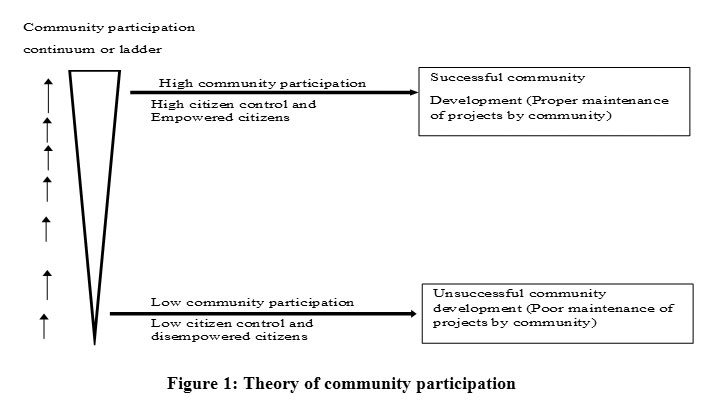 | Figure 1: Theory of community participation |
Methods and Materials
The study was conducted in Ashaiman, a municipality in the Greater Accra region of Ghana with population of about 190,972 (Ghana Statistical Service, 2012). Ashaiman is located about five kilometres north of Tema and thirty kilometres away from Accra central. Although it is close to the prominent cities in Ghana, the conditions in Ashaiman are deplorable. Within Ashaiman, there are many slums such as Tulaku, Taboo line and Valco flat. Ashaiman was selected for the study because electrification efforts have been undertaken in many of its slums in recent years due to the lack of electricity in such areas. The qualitative research design was adopted as it enhanced the collection of detailed information from participants, based on their experiences and perceptions about electrification efforts in Ashaiman.
Fieldwork took place from January to June 2017. Thirty participants who had experienced community development-driven electrification efforts in the communities were purposively selected for the study. The participants consisted of nine officials from three NGOs, three officials from the Department of Community Development (DCD) in Ashaiman, nine inhabitants, three traditional leaders, three assembly members and three workers of the Electricity Company of Ghana (ECG). Assembly members are democratically elected representatives of the central government in the local communities. Traditional leaders on the other hand are leaders appointed by the members of ethnic groups and inhabitants of communities by virtue of their membership to particular ethnic groups and the influence of such ethnic groups in the communities. These leaders consist of chiefs of the communities and leaders of ethnic groups who are influential in the slums.
Primary data which were used for the study were collected through semi-structured interviews and focus group discussions (FGDs) conducted in English and Twi, depending on participants’ language proficiency. These tool data collection strategies were adopted because they afforded the researchers the ability to not only collect detailed information but also allow them to fact-check information provided by each participant, which helps to improve the credibility of data obtained. The semi-structured nature of the interviews enabled the researcher to probe into issues that came up in the interviews. An interview guide designed in English was used to aid the interviews and FGDs. Three FGDs were conducted in each of the three selected slums. The groups within which the discussions were held comprised of inhabitants and officials from the community development agencies and ECG. The import of the FGDs is that they afforded participants to address issues raised by others during such sessions and that aided thorough delving into issues related to electrification in the communities. Furthermore, they aided the researchers to triangulate information obtained from the individual interviews. The researchers’ proficiency in both languages eliminated the need for a translator during the interviews, FGDs and the organization of data. In order to facilitate detailed data collection, the interviews and FGDs were recorded with the permission of participants.
Data were analysed using Creswell’s (2013) data analysis spiral. With this framework, data obtained from the interviews were organised through transcription. After this, data were familiarized with by reading the transcripts and making meaning of them. Themes and sub-themes were then developed from the data by grouping similar or related ideas according to the research questions. The data were then interpreted by defining the developed themes. Finally, findings were presented in accordance with the research questions, with some quotes from the interviews.
Ethical issues that were considered in the study are informed consent, voluntary participation, anonymity and confidentiality and avoidance of plagiarism. While seeking the consent of participants, the purpose of the study and likely benefits and challenges they could face as a result of their participation was clearly explained to them. Consequently, some potential participants declined participation whiles others opted to participate without any form of coercion. Furthermore, in order to observe anonymity of participants and confidentiality of their exact views, their names and positions have been withheld from the quotes provided in the study to support findings.
Demographic Characteristics of Participants
The age and sex information of participants have been illustrated in Table 1. Regarding the ages of participants, 9 of them had their ages between 25 – 34 years, 15 were between 35 – 44 years whiles the remaining 6 were between 45 – 54 years. With all participants more than 18 years, they were able to speak for themselves. There was male domination in the sample with 20 males and 10 females. Out of the 10 female participants, four were community developers, four were community inhabitants, there was a female assembly member and a female official of ECG. The domination of males in the participant group is due to the limited number of female officials in the agencies engaged in the study as well as the limited number of females who participate in electrification efforts in Ashaiman.
Table 1: Demographic characteristics of participants (Age & Sex)
Age | Sex | ||
25 – 34 years | 9 | Male | 20 |
35 – 44 years | 15 | Female | 10 |
45 – 54 years | 6 |
|
|
Total | 30 | Total | 30 |
Participants’ experience in community development-driven electrification efforts was a key determinant of their views on projects. Regarding the inhabitants, six had participated in electrification projects in their community for less than four years whiles the remaining three had been part of projects for more than four years. Eight community developers had been part of electrification projects in Ashaiman for less than four years whiles the remaining 4 had been part of the projects for more than four years. All the three officials from ECG and three traditional leaders had been active in electrification efforts in Ashaiman for more than four years. Finally, one of the assembly members had participated in electrification efforts for less than four years whiles the remaining two had experienced such efforts for more than four years. This information is illustrated in
Table 2: Demographic characteristics (Experience in electrification efforts)
Inhabitants | Community developers | ECG officials | Assembly members | Traditional leaders | |
Less than 4 years | 6 | 8 | 0 | 1 | 0 |
More than 4 years | 3 | 4 | 3 | 2 | 3 |
Total | 9 | 12 | 3 | 3 | 3 |
Findings
Community development in Ashaiman entails inhabitants collaborating to achieve their common needs with or without the assistance of external agencies such as the Ashaiman Municipal Assembly (ASHMA), DCD or NGOs. Most projects are undertaken with the help of external agencies who usually spearhead the efforts. Ordinarily, the three main drivers of community development in Ashaiman are the inhabitants including the traditional leaders and assembly members, ASHMA and community development agencies. However, in electrification efforts, the ECG plays a key role, since it is the agency mandated to distribute electricity in Ghana. The decision to embark on electrification is usually made by the leadership of the slums, inhabitants and community developers. This decision is then communicated to ASHMA and ECG. Although there are some slums in Ashaiman that lack electricity, the efforts made by these entities has supplied electricity in many neighbourhoods.
Roles Played by Community Development in Electrification Efforts
The adoption of community development as a tool for electrification has been beneficial to many Ashaiman slums, as a result of the role played by the practice. The major roles found in the study are subsequently discussed.
Improving Slum Dwellers’ Sense of Project Ownership
Community development in Ashaiman slums have contributed to an improvement in the inhabitants’ sense of ownership for projects undertaken. By the nature of the slums’ heterogeneous composition coupled with the insecure land tenure system and high levels of poverty, many inhabitants were apathetic to projects in their communities. Now, due to the positive impact made by projects such as provision of portable water and housing units, inhabitants support and participate in projects. This renewed commitment has translated into their participation in electrification efforts in ways such as attending meetings to discuss pertinent issues, contributing money and assisting technical workers in ways they can in processes such as erecting electricity poles:
…The people try to help in electrification efforts through diverse ways, because they know they are the beneficiaries. They attend meetings and contribute money... Some even help in erecting poles and wiring the houses (ECG official, male).
Although traditional community development practice in Ghana did not include electrification efforts, the inhabitants’ appreciation of its contributions in their communities has encouraged many of them to not only support but also participate in electrification efforts in their communities. Furthermore, the improved ownership of projects by the inhabitants has stemmed from their realization that the provision of infrastructure in their communities leads to an improvement in their standard of living. Consequently, many slum dwellers do not only own the electricity provided but the electrification process in itself, and this is seen in their participation in activities such as wiring houses despite some challenges which are discussed later.
Promoting Dialogue and Relationship between Communities and ECG
Electrification efforts involve series of meetings among the inhabitants and other stakeholders such as ECG. Considering that community meetings and dialogue are already integral parts of community development in Ashaiman, this has catalyzed the organization of meetings for electrification efforts. These meetings have created a positive dialogue and healthy relationship between the people and officials of ECG. This improved relationship has been crucial in the processes geared towards providing services. Considering that slums have limited access to electricity and other social amenities due to their informal and illegal status, this relationship has helped slums in Ashaiman to be supplied with electricity:
Through our constant dialogue with ECG, now the officials recognize the slums…And as you have seen for yourself, electricity has been provided in some households. And we are still trying to connect more household (Assembly member, female).
As revealed in the study, the collaborative mechanism built in the slums, although not absolute, has been crucial in the organization of electrification efforts. This shows that the foundation built in Ashaiman regarding collective efforts, has catalyzed electrification efforts.
Electrification Efforts
Through the constant dialogue between the slum dwellers and ECG, some slums have been provided electricity. Although the connection of electricity is done by ECG, their communal efforts have expedited the process. A key communal effort made in Ashaiman has been the formation of small groups with the aim of making contributions in order to raise money to pay for charges related to electricity connection. Furthermore, some electricians among the inhabitants have assisted in wiring the houses, which has helped in cutting down the cost of connection. Considering the limited financial resources in the slum, contributing their skills through wiring the houses marked for electrification helps them to cut the cost of electrification. Also, their utilization of their skills in electrification efforts helps them build and strengthen their relationship with ECG who considers inhabitants in such slums as partners in electrification efforts. Inhabitants’ participation in the projects also helps them to better their skills in wiring which then improves the human capital resource in such communities. This shows that although electrification in Ghana is strictly the job of ECG, the use of local resources such as the human capital of electricians in the communities has encouraged the officials of ECG to help some slums gain access to electricity:
The inhabitants play key roles to assist us in electrification efforts… There are some few electricians among them, and they help by wiring some houses with our supervision (ECG official, male).
Although electrification is a technical process, it has been successful in some slums in Ashaiman partially due to community participation in the processes. Findings revealed that as slum dwellers assisted in electrification projects in ways such as wiring houses and helping in the erection of electricity poles, the stronger they relate with the officials of ECG who have the primary mandate of providing electricity in Ghana.
Improvement in Housing Conditions
Community development has also led to an improvement in the housing condition in the slums. Although housing projects are different from electrification, improved housing as a prerequisite for electrification has motivated households with dilapidated structures to renovate them. Also, various housing projects have been undertaken to provide new houses. It was revealed that this has usually been done by the inhabitants who own the land on which they live which has been rare, considering the high insecure land tenure in Ashaiman slums. However, the main drivers of housing projects have been the NGOs who have utilized their own resources to provide houses with the support and participation of the inhabitants. As captured in the following quote from a traditional leader in the slums, their intentions and efforts to gain electricity has led to an improvement in housing condition in some communities:
Some new houses have been built while some old ones have also been renovated so that ECG would not have a problem with providing electricity for them… So, there has been improvement in terms of housing and electricity provision over the last five years (Traditional leader, male).
Although poor housing condition continues to be a problem in various slums in Ashaiman, the situation in some neighborhoods has improved as a result of the execution of community development projects as a facilitator of electrification efforts. As portrayed above, although community development originally was not employed in electrification efforts upon its introduction into Ghana, it has made key contributions in Ashaiman upon its adoption in electrification efforts.
Challenges Encountered in Electrification Efforts in Slums
Despite the success achieved in some electrification projects in Ashaiman slums, many projects have been compromised by some factors in these communities. Such challenges have been discussed below.
Theft of Materials
Theft has impeded many electrification efforts in Ashaiman, as materials such as bags of cement and tools have been stolen. Although the stakeholders try to acquire enough resources to complete projects, such incidences delay the completion of projects. The theft of cables which have already been laid is also possible as a result of the erratic power which affords people the opportunity to do that:
People have been stealing some materials acquired for projects. It is a big challenge because it has denied some households electricity... Some thieves steal cables from already electrified areas when the light is off (Inhabitant, female).
Although theft is also experienced in other projects and in the organized parts of the city, it is rampant in the slums as a result of their informal nature coupled with the minimal presence of security agencies in such communities.
Resource Constraint
Resource constraint is a key challenge faced in electrification efforts in Ashaiman. Due to the lack or inadequacy of resources, the design of some projects has been altered whiles some planned electrification projects have been suspended. This challenge is exacerbated by the theft of resources acquired for projects. As a result of poverty among the inhabitants, some are unable to pay agreed-upon contributions towards electrification. Also, some inhabitants are unable to connect electricity to their houses even when their neighbourhoods are put on the national electricity grid, due to their lack of funds. In other instances, the electricity connection in some houses has been cut due to their inability to pay their electricity bills:
Unfortunately, many households in the area still do not have electricity because they cannot afford the connection fee… But if you cannot pay for it, then ultimately you cannot pay electricity bills if you are connected (Assembly member, male).
With the background that the slum population is offered minimal support by the state due their illegal and informal status, coupled with the limited source of income in such settlements, inhabitants’ ability to mobilize funds for electrification has been compromised in many instances.
Ethnic Differences
Ashaiman as a municipality has high ethnic diversity. Electrification efforts require series of meetings by stakeholders for deliberation on pertinent issues, making cohesion among the inhabitants a prerequisite. However, ethnic differences among the inhabitants have compromised cohesion in some instances. Such differences have sabotaged some efforts, especially when people from a particular ethnic group perceive that their leaders have been sidelined in activities. This perception which creates apathy among the aggrieved groups discourages support and participation, rendering some electrification efforts futile:
Sometimes people want to see their tribal leaders at the helm of affairs in electrification projects. If they do not see that, then some become aggrieved… In such instances, they do not participate in projects (Traditional leader, male).
With high reverence paid to tribal leaders, many inhabitants are willing to participate in projects in which their leaders are among the nucleus. Consequently, this has affected community collaboration in projects when specific leaders and their respective subjects feel sidelined from them.
Lack of Land Ownership
Some electrification efforts have been stalled by insecure land tenure by many inhabitants many of whom are informal squatters on people’s properties. This is as a result of the governments’ and tribal leaders’ failure to lease land to the people. This discourages some inhabitants from spending their scarce resources to provide electricity to such properties, knowing they could be evicted by the legal owners. Considering that many slums dwellers in Ashaiman have limited resources, their lack of land ownership reinforces their reluctance to spend their limited resources into electrifying the properties from which they could be evicted:
Lack of land ownership is a big challenge in the slums... it is understandable that some will not spend their little money to pay for electricity to be provided in properties which are not theirs... They could be evicted anytime, and this has happened before (Assembly member, male).
Some households also lack access to electricity legally because occupants are unable to provide documents which certify their ownership of properties. Without the documents to the land, they cannot claim ownership to the properties, and that disqualifies them to be considered for electricity provision.
Poor Demarcation of Settlements
The lack of land ownership is exacerbated by the poor demarcation of land and the dilapidated housing structures in some neighbourhoods. This has stifled some electrification efforts in ways such as difficulty in finding the appropriate spaces for erecting electricity poles as a result of the unplanned nature of the settlements. Furthermore, the haphazard arrangement of houses has constricted the ease with which the workers of ECG can plan the electrification of such communities. This means that although some slum dwellers establish healthy relationship with the ECG and mobilize resources needed for projects, actual electrification projects have been stalled by the difficulties faced in finding appropriate spaces:
The haphazard settlement pattern in the slums is a challenge we contend with in electrification efforts… It makes planning and execution stressful... If the communities we well demarcated, we could easily identify the portions allocated for streets and then plan the positioning of the poles along that line (Official of ECG, female).
This is a major concern, as the erection of electricity poles is a key requisite in electricity connection in Ghana. With these challenges encountered in electrification projects, the goal of electrifying most slums in Ashaiman has been defeated, despite the vital roles played by community development in the efforts.
Discussion of Findings
This study sought to examine the role played by community development in electrification projects in Ashaiman and the challenges encountered in the projects. The application of community development in Ashaiman has proved advantageous to the inhabitants as a result of its facilitation of electrification efforts. As a result of community development projects undertaken in the neighbourhoods and the improvements emanating from such projects, the sense of ownership of projects has improved. Although this acknowledgement begun with other projects, this interest has encouraged inhabitants to work with other agencies such as NGOs, ECG and ASHMA, to support and participate in electrification projects. Consequently, some inhabitants have devoted resources such as money and technical skills in the execution of projects. This finding lends credence to Kirubi, Jacobson, Kammen and Mills’ (2009) observation that communal efforts undertaken in Mpeketoni village in Kenya, in conjunction with some private organizations, contributed to the provision of electricity.
Community participation has been significant in many electrification efforts. Through this, inhabitants have improved upon their skills in wiring houses and playing other roles as part of the electrification projects, and this helps them in the maintenance of electricity in their communities. This supports Brueggemann’s (2006) argument that community participation in projects leads to success, as inhabitants acquire skills with which to sustain projects in their communities. However, the presence of other challenges such as theft of resources has compromised the successful execution of some electrification efforts. This observation shows that although community participation is crucial in community projects, the lack of other factors ruins projects regardless of the level of participation.
Another dividend paid by community development in electrification efforts is its facilitation of the relationship and dialogue between the communities and ECG. This dialogue has changed the perception of ECG about these illegal settlements who get the opportunity to exhibit their potential in the development within the city space. This has also encouraged the officials of ECG to work with the communities towards the supply of electricity. This is in consonance with Singh et al’s (2015) assertion that the relationship between some informal settlements and electricity providers has led to the provision of electricity in such communities.
Housing structures in Ashaiman slums have also improved as a result of the adoption of community development in electrification efforts. Although the improvement of housing is not a principal objective of electrification efforts, good housing structures as a condition for gaining access to electricity has encouraged the communities to renovate their houses. Consequently, the inhabitants and some NGOs have executed housing aimed to improving the housing conditions in these communities. An example of this is the Amui Dzor housing project which was undertaken by an NGO in Ashaiman. These houses have been provided electricity which is a major improvement in the living conditions in such communities. This is not an isolated observation as it corroborates Lewis and Severnini’s (2014) report that electrification efforts in rural communities in U.S. led to improvement in the quality of housing in the communities.
Even though some communities have been supplied electricity, there are still many other communities without electricity. This is as a result of challenges encountered in electrification projects. A key challenge faced is resource constraint. Inhabitants in Ashaiman are compelled to pay connection fees beside others in electrification efforts. This means that people who can pay are provided electricity. With the high level of poverty and unemployment in the slums, many inhabitants’ aspiration of having access to electricity has been ruined by their inability to pay such fees. Also, there have been instances where inhabitants’ power has been disconnected due to their failure to pay electricity bills which are generally high in Ghana. This challenge has been encountered in other communities, as it corroborates Mimmi’s (2014) and Mimmi and Ecer’s (2010) that electrification projects in India and Brazil were compromised by financial constraint.
The theft of materials such as bags of cement and tools acquired for electrification projects has inhibited the smooth execution and completion of projects. Considering the difficulties encountered in the mobilization of minimal resources for projects, the theft of even few materials and equipment compromises such projects. Furthermore, the theft of already connected electricity cables has compromised the maintenance of electricity in Ashaiman. As revealed in the study, some cables have been cut during power outage, meaning affected communities cannot have their power back on. This confirms Yakubu, Babu and Adjei’s (2018) position that the shortage of electricity in some communities has been caused by the theft of electricity and other materials.
The high ethnic diversity and the plural leadership in Ashaiman have compromised many electrification projects. With the difference in slum dwellers’ ethnicity comes their difference in interests and values regarding how electrification projects in their communities should be approached. This problem has been exacerbated by the presence of multiple leaders for the various ethnic groups, limiting communities’ ability to tow the same direction in projects. This has translated into low community participation in some electrification efforts which in turn has limited communities’ ability to sustain electricity due to the lack of expertise in its safe use. This coupled with some instances of illegal connections has caused destruction of appliances and even fire outbreaks in extreme situations. This confirms an argument of the theory of community participation that low community participation leads to unsuccessful projects.
Electrification efforts in Ashaiman have also been impeded by slum dwellers’ lack of land ownership. As explained earlier, Ashaiman slums are cohabited by immigrants from various parts of Ghana and beyond. As a result, many of these inhabitants who are not legal owners of the land on which they live, are subjected to the constant threat of eviction from the government who owns most of the land in these settlements. This problem has discouraged the inhabitants to expend their limited resources on connecting their houses to the electrical grid, a confirmation to Singh et al’s (2015) report that slum dwellers’ lack of land ownership has compromised their efforts to access electricity. Also, in extreme situations, electrification projects have been compromised by slum dwellers who see these projects as ploys to evict them from the land. Such sabotage in ways such as not attending meetings and opposing the erection of poles on specific plots has also been reported by Hamann (2003) in electrification projects in South Africa.
Although some inhabitants have not been discouraged by their illegal status, their inability to provide documents to the land on which they live has obstructed efforts to connect electricity to their houses. Considering that insecure land tenure is a key characteristic in slums, this observation is not peculiar to only Ashaiman. It confirms a situation in Mumbai slums where legal access to electricity has been compromised by slum dwellers’ inability to provide paperwork to their houses as a result of their illegal and informal status settlements, as reported by Karim, Lipu and Mahmud (2017) and Mimmi (2014). The poor demarcation of land in Ashaiman slums has also aggravated the problem posed by insecure land tenure. This proves that land demarcation is a crucial determinant in the identification of suitable spaces of land for erecting poles, transformers and other requisite structures in such projects. This also lends credence to USAID’s (2004) report that physical arrangements in slums influence success in electrification projects.
Conclusion
The lack of electricity is a key problem that has stifled the development of slums around the globe. Besides being an infringement upon slum dwellers’ right to enjoy a minimal standard of life that includes access to electricity, it profoundly retards development in the slums. By the instinct inherent in them, some inhabitants have improvised means to access electricity. However, these means which are mostly illegal robs the electricity operators and governments of revenue. This makes it imperative for some efforts to be made to legally provide electricity in the slums.
Considering that slum electrification efforts have led to the provision of electricity and improved the sense of ownership among the inhabitants of such communities, it is important that more of such efforts are championed. As portrayed in this study and others, community participation is key to the execution of community-based projects. It is therefore incumbent for the stakeholders of slum electrification to work with the slum dwellers to understand their views and available resources as a means of partnering them in the projects.
Emerging literature on slum electrification also points to the exploration of alternative sources of electricity that can be provided in the slums. Like Ghana, many developing countries battle with the shortage of hydropower which is the main source of electricity in such countries. This has consequently discouraged the extension of electricity to the slums which are already unrecognized within the city space. If other sources of electricity such as solar are explored like in the case of the Dhaka megacity in Bangladesh, such sources can supplement the hydropower. With such augmented generation of electricity, the slums can be considered in its distribution. More research should therefore be conducted by both governments and NGOs that have a stake in electrification efforts, to explore how feasible it is to generate electricity through other means beside hydropower.
Recommendation
Considering the high appreciation of electricity as a major need, it is important that the challenges encountered in electrification efforts are overcome. Electrification efforts should be supervised so that the theft of resources can be prevented. Additionally, the traditional leaders, ASHMA and the police should institute community patrol programmes so that theft and other crimes that have impeded electrification efforts in Ashaiman can be resolved. Transparency should also be ensured by the front runners of the electrification efforts such as ECG officials and community developers. This would prevent sabotage by some inhabitants who may misconstrue such projects as ploys to evacuate them from the land they are occupying.
Resource acquisition should also be promoted so that more resources can be obtained for electrification efforts. Lack of resources has been a huge challenge in many electrification efforts, and hence must be dealt with in order to expand electrification. Mechanisms such as appealing for funds and grant writing can be adopted by the community development agencies and the municipal assembly. Employment and other means of economic growth should also be promoted in the slums so that the inhabitants can pay their bills and other electrification-related charges. Regarding the challenge of ethnic differences, community developers and ECG officials should work with the various ethnic groups so that they will put aside their differences and be enthused to participate in projects.
The government and traditional leaders of the tribes in Ashaiman also have a key role to play in overcoming the lack of land ownership by the inhabitants. Considering that the lack of land ownership has served as a disincentive to some inhabitants to engage in projects, the government through ASHMA should work with the traditional leaders to lease land to the inhabitants so that they will be motivated to spend their resources to develop them. ASHMA and the traditional leaders must also expedite the demarcation of the land in the slums so that electrification and other development efforts can be well planned and executed.
Acknowledgment
We thank God for our lives and the strength He has given us to undertake research and also to come up with this manuscript. We also thank our families and friends for the words of encouragement in our educational endeavours. Finally, we thank Ankara Yildirim Beyazit University, Washington University in St. Louis and University of Ghana, for the training given us in our educational endeavours.
Funding Source
The author(s) received no financial support for the research, authorship, and/or publication of this article.
Conflict of Interest
The author's declare no conflict of interest.
References
- Adusei, P. K., Oduro-Ofori, E., Amponsah, O., & Agyeman, K. O. (2018). Participatory incremental slum upgrading towards sustainability: An assessment of slum dwellers’ willingness and ability to pay for utility services. Environment, Development and Sustainability, 20(6), 2501-2520.
- Arnstein, S. R. (1969). A ladder of citizen participation. Journal of American Institute of Planners, 35 (4), 216-224.
- Banks, N. (2008). A tale of two wards: Political participation and the urban poor in Dhaka city. Environment and Urbanization, 20(2), 361-376.
- Baruah, B. (2010). Energy services for the urban poor: NGO participation in slum electrification in India. Environment and Planning C: Government and Policy, 28, 1011 -1027.
- Bhattacharyya, S. C., & Palit, D. (2016). Mini-grid based off-grid electrification to enhance electricity access in developing countries: What policies may be required? Energy Policy, 94, 166-178.
- Bonye, S. Z., Thaddeus, A. A., & Owusu-Sekyere, E. (2013). Community development in Ghana: Theory and practice. European Scientific Journal, 9(17), 79-101.
- Brueggemann, W., G. (2006). The practice of macro social work. (3rd Ed.). Australia: Thomson Brooks/ Cole.
- Creswell, J.W. (2013). Qualitative inquiry and research design: Choosing among five approaches, 3rd edn. Los Angeles: Sage Publication.
- Datta, A. (2016). The intimate city: Violence, gender and ordinary life in Delhi slums. Urban Geography, 37(3), 323-342.
- Elrayies, G. M. (2016). Rethinking Slums: An Approach for Slums Development towards Sustainability. Journal of Sustainable Development, 9(6), 225-244.
- Field, E. (2005). Property rights and investment in urban slums. Journal of the European Economic Association, 3(2â€3), 279-290.
- Fox, S. (2014). The political economy of slums: Theory and evidence from Sub-Saharan Africa. World Development, 54, 191-203.
- Ghana Statistical Service (2012). 2010 population and housing census (PHC). Accra: Ghana Statistical Service.
- Hamann, R. (2003). Mining companies' role in sustainable development: The 'why' and 'how' of corporate social responsibility from a business perspective. Development Southern Africa, 20(2), 237-254.
- Karim, T. F., Lipu, M. H., & Mahmud, M. S. (2017). Electricity access improvement using renewable energy and energy efficiency: A case of urban poor area of Dhaka, Bangladesh. International Journal of Renewable Energy Research (IJRER), 7(3), 1296-1306.
- Kirubi, C., Jacobson, A., Kammen, D. M. & Mills, A. (2009). Community-based electric micro-grids can contribute to rural development: Evidence from Kenya. World development, 37(7), 1208-1221.
- Lewis, J., & Severnini, E. (2014). The value of rural electricity: Evidence from the rollout of the us power grid. Technical report, Technical report.
- Mimmi, L. M. (2014). From informal to authorized electricity service in urban slums: Findings from a household level survey in Mumbai. Energy for Sustainable Development, 21, 66-80.
- Mimmi, L. M., & Ecer, S. (2010). An econometric study of illegal electricity connections in the urban favelas of Belo Horizonte, Brazil. Energy Policy, 38(9), 5081-5097.
- Okech, T. C., & Lelegwe, L. S. (2016). Community participation in donor funded projects among pastoral community of Northern Kenya. International Journal of Economics, Commerce and Management 4(9), 588-599.
- Owusu, G. & Afutu-Kotey, R., L. (2010). Poor urban communities and municipal interface in Ghana: A case study of Accra and Sekondi-Takoradi Metropolis. African Studies Quarterly, 12(1), 1-16.
- Palit, D., & Chaurey, A. (2011). Off-grid rural electrification experiences from South Asia: Status and best practices. Energy for Sustainable Development, 15(3), 266-276.
- Parikh, P., Chaturvedi, S., & George, G. (2012). Empowering change: The effects of energy provision on individual aspirations in slum communities. Energy Policy, 50, 477-485.
- Samah, A. A. & Aref, F. (2011). The theoretical and conceptual framework and application of community empowerment and participation in processes of community development in Malaysia. Journal of American Science, 7(2), 186-195.
- Singh, R., Wang, X., Mendoza, J. C. & Ackom, E. K. (2015). Electricity (in)accessibility to the urban poor in developing countries. WIREs Energy Environ, 4, 339–353.
- SPIRI. (2012). Productive uses of energy in enterprises in slums in Ghana. International Journal of Social Science Tomorrow, 1(5), 1-10.
- Thieme, T. & Kovacs, E. (2015). Services and slums: Rethinking infrastructures and provisioning across the nexus. The Nexus Network Think Piece Series, Paper, 4.
- USAID. (2004). Innovative approaches to slum electrification. Washington, D.C: United States Agency for International Development.
- Yakubu, O., Babu, N., & Adjei, O. (2018). Electricity theft: Analysis of the underlying contributory factors in Ghana. Energy policy, 123, 611-618.

This work is licensed under a Creative Commons Attribution 4.0 International License.