
Socio-Economic Structure of Widowhood in India: Past and Present
Jyoti Atwal 
1Centre for Historical Studies, School of Social Sciences, Jawaharlal Nehru University, New Delhi, India .
http://dx.doi.org/10.12944/CRJSSH.6.1.05
Copy the following to cite this article:
Atwal J. Socio-Economic Structure of Widowhood in India: Past and Present. Current Research Journal of Social Sciences and Humanities. 2023 6(1). DOI:http://dx.doi.org/10.12944/CRJSSH.6.1.05
Copy the following to cite this URL:
Atwal J. Socio-Economic Structure of Widowhood in India: Past and Present. Current Research Journal of Social Sciences and Humanities. 2023 6(1). Available here: https://bit.ly/3CERKy5
Download article (pdf) Citation Manager Review / Publish History

Introduction
From the Mauryan period itself there comes evidence of the difference in experience of widowhood for high and low caste/ class woman. The Arthashastra informs us that the staff of the royal weaving and spinning establishment was made up of indigent women a motley collection, including widows, cripples, orphans, beggar-woman, women who had failed to pay fines and were compelled to work them off, and broken- down prostitutes. (Basham, 1967, p. 181) These were all of low class, and worked under male overseers. It might happen that sometimes a better– class woman fell on bad days, and was compelled to earn a living in this way. She was catered for, however, in a different manner. If she could still afford to employ a maid, the maid might fetch the yarn from the weaving shop, and bring it back in the form of cloth; but if the lady was compelled to fetch and deliver her own material, stringent precautions were laid down so they eat her modesty should in no way be offended. She was to go to the weaving shop in the dim light of dawn, when she would not be easily seen. The official who received her work used only a lamp to examine its workmanship; if he looked her in the face or spoke to her about anything other than her work, she incurred the fine known as “the first amercement”, from forty-eight to ninety panas. (Pana was a silver currency of the Mauryan period in ancient India). It is evident from this account that “upper -class” women, through their faces were unveiled, were not normally seen in public without their menfolk.
The difference in the widowhood experience is also premised upon the fact that the high-caste customs and cultural codes has created a disadvantageous gender equation for women. According to the Census of 1881 it was found that the custom of early marriage was prevalent extensively, more so among the brahman caste. To quote from the report (Aiyar, 1885, p. 22) ‘some are married before seven, and nearly all are married before ten.’ This naturally resulted in high percentage of widows. Nearly one-third of the Brahman women were widows. Out of every fifteen Brahman women of all ages, seven were married, and five were widows. There were nearly 50% more widows among Brahmans than amongst to their castes. Out of 80,000 widows less than 20 years 60,000 belonged to Brahman caste and 20,000 to other (Aiyar, 1885, p. 22).
William Crooke, as the British administrator in Bengal, had written in 1906, the “lower we go in the social scale, the more freedom the woman claims. The wife of the Banjara carrier stalks with a fine dignity ahead of the caravan, and among the jungle tribe, particularly, when as is not uncommon, the wife is older than the mate, she regards him no whit superior to herself, and no business is done without her sanction.” (Crooke, p. 525)
The situation remains strikingly similar today. In 1991, Martha Alter Chen and Jean Dreze (Chen et al., p. 325-346) made a study of a total of 275 Hindu widows in 8 villages of North India- two each in the states of Bihar (Muzzafarpur district), West Bengal (Birbhum district), Rajasthan (Udaipur district), and Uttar Pradesh (Tehri Garhwal and Dehra dun Districts). The study of Hindu widows in these eight villages, concluded that lower caste women have greater freedom to take up gainful employment. The modern day rigidity of high - caste codes manifests itself in two ways - a) the prohibition of widow remarriage, b) the withdrawal of women from the labor market. Chen points out that when the middle case groups, acquire wealth, or aspire to higher status, they often try to distance themselves from households perceived to be lower in social status emulating the practices of higher status households. Various terms have been used to describe this imitation of upper castes by lower castes. The most common term is sanskritisation (M.N Srinivas argues that as a caste rises in the hierarchy and its ways become more Sanskritised, it adopts the sex and marriage code of the Brahmins. Sanskritization results in harshness towards women), (Srinivas, 1962, p. 64) arising from the fact that certain Vedic or Sanskritic rites are confined to the upper castes. A large number of widows are caught between the contradictory demands of the Sanskritization of their community and their own survival. It is immensely difficult for widows with insufficient male support to meet subsistence needs on their own during the period of hardship following the husband’s demise. Table 1 shows that out of a total of 275 widowed women in eight study villages, only 36 had remarried, of which 29 were from scheduled or lower- middle castes. Table 2 shows that only six out of 95 upper caste widows were reported as being engaged in cultivation/farms, whereas a large percentage of scheduled case widows were reported to engage in wage labour as an economic activity, whereas five scheduled caste widows were reported as being self-employed or in trades outside their village of residence, only one other widow (from a higher- middle caste ) was reported to be doing so (Chen et al., p. 281).
Table 1:Distribution of the Widowed women by Current Marital Status and Caste Group
|
Caste Group |
Not Remarried |
Remarried |
|
|
|
|
Currently Widowed |
Currently Married |
|
Upper Castes |
91 |
4 |
2 |
|
Middle Castes |
|
|
|
|
Higher |
31 |
0 |
1 |
|
Lower |
57 |
9 |
6 |
|
Scheduled Castes |
58 |
10 |
4 |
|
Others |
2 |
0 |
0 |
|
Total |
239 |
23 |
13 |
Source : Widowhood and poverty in rural India: some inferences from household survey data /by Jean Dreze and P.V. Srinivasan p.325-346 IN Widows in India: social neglect and public action/ed. by Martha Alter Chen. - New Delhi: Sage,1998. 455p
Table 2: Percentage of Widows Engaged in Different Activities by Castes Group
|
Percentage of Widows Engaged in Different Activities by Castes GroupEconomic Activity |
Upper Castes |
Middle Castes |
Scheduled Castes |
|
|
|
|
Higher |
Lower |
|
|
Cultivation |
52 |
13 |
53 |
31 |
|
Wage Labour |
|
|
|
|
|
Farm |
2 |
0 |
20 |
50 |
|
Non- farm |
3 |
0 |
5 |
24 |
|
Migrant |
1 |
0 |
2 |
0 |
|
Animal husbandry |
23 |
0 |
2 |
0 |
|
Self employment: |
|
|
|
|
|
In Village |
4 |
3 |
8 |
9 |
|
Outside village |
0 |
3 |
0 |
6 |
|
Caste Services |
0 |
0 |
6 |
9 |
|
Trade: |
|
|
|
|
|
In Village |
0 |
0 |
5 |
1 |
|
Outside Village |
0 |
0 |
0 |
1 |
Source : Widowhood and poverty in rural India: some inferences from household survey data /by Jean Dreze and P.V. Srinivasan p.325-346 IN Widows in India: social neglect and public action/ed. by Martha Alter Chen. - New Delhi: Sage,1998. 455p
Uma Chakravarti has pointed out that an important factor responsible for the differences between high castes and low castes is the contrast between high castes as land owners and the low castes as wage earners. The lower caste woman’s economic role accounts for her more equal rights, both in her marital and natal homes. The difference between high caste woman and low caste women is caused by differences in relation to production. (Chakravarti, 1998) Pauline Kolenda (Kolenda, 1982) studies the widowhood condition among high caste Rajputs and low caste Chuhras in a north India village of Khalapur. Lack of land had made the Chuhra more mobile as compared to the high caste Rajputs. Chuhra women work outside the home, and do the jajmani work, a service based on a religious cum economic division of labour. A Chuhra widow could support herself and her children as long as she could continue the jajmani work. There was no dramatic change in the Chuhra widow’s life style or standard of living. The Rajput widow, on the other hand, was stripped of jewels and remained in her dead husband’s family contingent only upon her good behavior. Kolenda identifies a sanskritic shudra model – ‘if Chuhras are emulating Rajput patrilineality, we might label this impoverished emulation.’ (Kolenda, 1982)
Chuhra widows of child bearing age were expected to remate, land once the patrilateral parallel cousin and matrilateral cross cousin have mated with her, they had the right to sell her off. Therefore, despite the relative economic independence and security of Chuhra women, it did not make them ‘close to equal to men.’
Similarly, Prem Chowdhry (Chowdhry, 1989, p. 302) has pointed out that in the colonial Haryana region the British, while granting certain rights to widows in the interests of revenue extraction, were anxious to discourage them from availing of those very rights. Out of political and financial interests, the colonial administration sought to reinforce the local customary form of widow remarriage (karewa) in order to ensure male control over inheritance and property.
In the context of contemporary India, most research on widowhood tends to represent it as belonging to an excluded social category. This has resulted from the persistent academic/activist focus on widows (mostly Hindu) at the pilgrim sites—Vrindavan, Mathura or Benaras. These widows located outside the family are indeed important markers of gender inequity and the denial of a life of dignity to women in India. However, over engagement with one variety of widows has served to standardize and universalize the widowhood experience. Feminist scholarship is faced with the challenge of explaining the causes of modern day crime against women in India—mostly in the form of rape and honour killing. There is a tendency to string together historically oppressive widowhood with other crimes against women. I have argued in my book that the study of widowhood belongs to the broader realm of gender relations. (Atwal , 2016) Nineteenth century legal-reformist debates around sati, widow remarriage and the age of consent were templates on which deep anxieties over the Hindu female body were expressed. Widow remarriage was a way of bringing this body back into the arena of reproduction and motherhood. While the actual practice of sati was declared unlawful, the cultural codes upholding a widow’s imagined renunciatory powers were also being rewritten throughout the anti-colonial movement. A strong notion of a possible ‘living’ sati was created. The attributes of self-discipline and perfect control over one’s sexual desires and impulses became the highest preferable form of Hindu womanhood (irrespective of the caste and class of women). These imagined ‘powers’ of widowhood were projected on the unmarried/ married women as well. Besides nation building, the patriarchal perceptions of the ‘self-controlled’ body of a Hindu widow also facilitated the ease with which modernity could be fused with ideas of honour and self-abnegation amongst Hindu women. These ideas coexisted with the reformist demand for enhanced property rights for women (widows in particular) and women’s growing role in the anti-colonial movement as well as in the post-1947 Indian society and economy.
From such research, it becomes necessary to examine the ‘structure’ of widowhood more in terms of widow’s own response and adjustment towards a given set of circumstances, because the caste of a woman does not always help in explaining her status. Her own ‘response’, determined by her immediate living conditions has acquired centrality in modern day perception of the widow’s problem. As has already been observed, the Malabari Notes essentially linked up the issue of enforced widowhood with the custom of marrying infants prevalent mostly amongst higher castes. Remarriage was seen as the only remedy by Hindu reformers as well as the colonial government (1856 Act). The modern day perception of ‘reform’ marks a break from ‘remarriage’ as the only idea of freeform- because the widow’s well being has now become the central issue of concern with the State and with activist groups. The present idea of well- being looks at networks of patriarchy beyond the caste and class paradigm. The focus now is not exclusively on the structures to which widow is subjected but her own negotiation with this structure.
An interesting model has been used by Mukesh Ahuja, in a study of Jaipur city in Rajasthan, and included 190 widows as sample. The study is focused on the Hindu (including Jain, Sikhs and Scheduled castes) widows. It does not include those widows who had remarried.
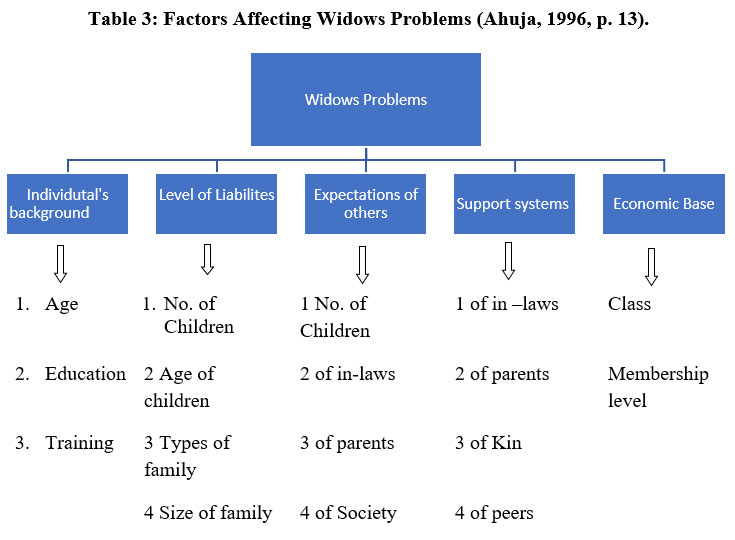 |
Table 3: Factors Affecting Widows Problems Click here to view Table |
This model has been applied in this article to draw implications from other studies on widows with which the widowhood question operates at present.
The time of the onset of widowhood is extremely important because of the psycho-sexual needs of the widow. This position differs when she is in the non- productive stages of life and when she is least likely to have a strong sexual urge. At the time of 1991 Census, the total number of widows in India was extremely large 33 million which was 8% of all females in India. The corresponding figure for males was 2.4% of total male population. 50% of all widows were less than 50 years of age. In rural India, widows represent about 3% of all younger women (15-34), 30% of all middle aged women (35-39) and 60% of women above 60 years of age.
The following table shows the mean age at widowhood in the major states in India in the last eight decades.
Table 4: Mean Age at Widowhood in Major States in India in Eight Decades
|
State |
Years |
|||||||
|
|
1900-11 |
1911-21 |
1921-31 |
1931-41 |
1941-51 |
1951-61 |
1961-71 |
1971-81 |
|
India |
31.2 |
29.8 |
34.1 |
28.8 |
33.2 |
34.0 |
35.1 |
36.2 |
|
State |
|
|
|
|
|
|
|
|
|
Andhra Pradesh |
33.6 |
28.5 |
33.7 |
27.7 |
35.2 |
34.0 |
33.7 |
35.0 |
|
Jammu & Kashmir |
32.6 |
29.1 |
32.6 |
31.7 |
38.1 |
38.4 |
36.3 |
36.2 |
|
Karnataka |
29.5 |
25.1 |
33.0 |
33.2 |
33.7 |
36.5 |
34.7 |
35.9 |
|
Kerala |
27.3 |
29.8 |
33.6 |
29.8 |
31.1 |
36.0 |
30.5 |
34.2 |
|
Madhya Pradesh |
34.2 |
30.9 |
36.4 |
32.5 |
31.5 |
36.7 |
36.1 |
36.2 |
|
Rajasthan |
35.4 |
29.2 |
34.0 |
33.4 |
32.3 |
34.5 |
35.9 |
35.7 |
|
Tamil Nadu |
31.6 |
28.0 |
32.4 |
29.1 |
31.7 |
35.2 |
35.5 |
35.0 |
|
Uttar Pradesh |
30.8 |
32.3 |
35.8 |
32.9 |
34.8 |
34.8 |
35.6 |
36.3 |
|
West Bengal |
30.5 |
29.8 |
30.5 |
29.0 |
33.2 |
32.0 |
33.5 |
36.2 |
If not very significantly, the mean age did go up. This could have been due to the decrease in the incidence of child – marriages or/ and better medical facilities. Age alone stands as one of the most important factors which decides the role of a women in her widowhood. It determines whether the widow would be willing to remarry or not.
The level of education or professional training acquired by the widow determines her ability to support herself financially after the husband’s death. A ‘support’ is defined as ‘any object or action’ that the receiver and/ or the given defines as necessary or helpful in maintaining a lifestyle. (Lopata, 1998, p. 114)
If the widow is employed and shows a regular source of income then her dependency level on traditional support system, viz. maintenance from in- laws decreases. In patriarchal and the patrilocal societies, a woman who becomes a widow, generally would continue living with her late husband’s family. However, Martha Alter Chen’s study of the 572 rural widows of West Bengal, Bihar, Uttar Pradesh, Rajasthan, Andhra Pradesh, Tamil Nadu and Kerala, in 1994 (Shrivastava, 1998, p. 2) showed that 62% of the widows lived in households headed by themselves. Less than 3% were living with their in–laws and less than 3% were living with parents or brothers. About 26% were living with their sons. The ‘regular support’ from the family members did not mean “full support”.
Table 5: Maintenance and Support: Rural Widows who Report Regular support or Periodic gifts from Family Members
|
|
Regular Support |
Periodic Support |
|
In laws |
3% |
3% |
|
Parents |
5% |
5% |
|
Brothers |
9% |
19% |
|
Daughters |
16% |
28% |
|
Sons |
60% |
37% |
Source: Ginny Shrivastava ‘The unwanted insider - the widow’ Paper 2 IN National Conference on Women's Studies: Survival and Sovereignty Challenges to Women's Studies (8th: 1998: Pune). Organised by Indian Association of Women's Studies in collaboration with Maharashtra Stree Abhyas Vyaspeeth, May 30-June.2, 1998
Widows in Chen’s study earned their living by a variety of activities as has been shown in table 2. There was, however, a trend to do less self- employed work after widowhood and more domestic services and wage labour work.
From Maharashtra there is evidence of the fact that the widows dependence on others for her physical survival put her in the power and control of others which was reflected in her lack of alternative. Uma Chakravarti has pointed out that along with the insults and humiliation she must bear, she had to accept a life of ceaseless labour in return for the maintenance provided to her. ‘Drudge labour extracted from the widow is a leit-motif in the writing of the widows is likened to that of a slave from Africa.” (Chakravarti, 1993, p. 1345) She used a set of essays written by young widows studying in the fifth and sixth form in the Widow’s Home in Poona around 1910.
“A widow is worked like a menial… if she but stops for a few minutes, just to take a breath, her mother–in- low throws a volley of abuse, intermixed with filthy accusation.” (Inamdar, 1911, p. 134)
“She does not get her to meal a day…. She is made to work like a coolie.” (Inamdar, 1911, p. 134)
These widows were often sent from one household to another to serve as ‘mobile‘ labour. As more men went to the cities to study and pursued profession there was a demand for women’s labour…. Widows in the family were the most expendable labour available. (Inamdar, 1911, p. 135)
As regards the inheritance structure of property, Chen’s study revealed that while widows may have “use rights” over a share of the husband’s land, or even the father’s land, in fact those rights are often violated in practice. Varsha Bhagat Ganguly’s study of Gujarati widows (Ganguly, 1994) in 1994 shows that the widow is not usually able to plough the land, which she has been given to use for her maintenance and has to take the help of a male members of her in laws family. This often result in the demand for a share of the crop, as they had helped her in cultivation.
Moreover, the items like a pair of bullocks or a plough are collectively owned by the in-law’s family and the brothers–in–law create a situation where she herself is forced to leave and the property becomes theirs.
In tribal households, (Ganguly, 1994, p. 7) where the pattern of living is as a nuclear family, with a separate house, the widow has the property right to the house in which she, her husband and children had been living. Then, even without land rights or use rights, if she can get work as a laborer, she may stay on in her in- laws’ village.; if she lives in a ‘longhouse’, where each brother and his family have one big room, opening into a ling common verandah, she does not have ownership rights over the portion of the house where she and her husband and children had been living.
The upper caste widows, rightfully, ‘own’ the jewelry that was given to them by their parents at the time of marriage, but jewelry, including other items given by the relatives and parents of the bridegroom, are usually absorbed into the property of the husband’s family, and are never give back when she is widowed.
Finally, the importance of children, mostly sons, but also daughters, to the well- being and security of the widow can be seen from the data of the Martha Alter Chen’s Study of rural widows in India, about 26% of the total widows surveyed were living in households headed by sons. (Shrivastava, 1998, p. 8)
The sons were looked at as the single most important source of a widow’s economic and emotional support. Testimony comes from the 1934 Panchgani Proceedings of the All-India Women’s Conference, (Ali, 1934, p. 2) which discussed the Bill moved by one Mr. Desai, for taking away the advantage given to Hindu widows to adopt a child after the death of her husband. Mrs. Shareefah Hamid Ali, the chairperson of the Committee, quoted the shastras “…. nor let a women give or take without the consent of her lord” …and said that this cannot in any way be interpreted that the widow should take the consent of her ‘sapindas’. If it was not necessary for her to take the consent of the sapindas during her husband’s lifetime then how can it be made compulsory by law that she should take the consent of sapindas after her husband’s death? The Hindu widow’s position is strengthened by her right to adoption, as she can when not treated well, make for herself a good economic, position by exercising this right…. the widow can make herself an economic unit by adoption.” (Ali, 1934, p. 2)This adoption referred essentially to a male child- “she can wake an absolutely valid contract with the adopter, if he is a major and be independent economically.” (Ali, 1934, p. 2)
In large parts of India, particularly North India, women by and large do not have property rights. Women do not own any means of production. Any property or other means of generating income are owned by the men in the family. Even where they do have property rights, the women do not possess a self – assertive consciousness and are unable to exercise that right. This makes it essential for her in the absence of a male child to adopt one. Moreover, the women in general do not claim their share to the parents’ property for the fear of alienating their brothers. There are many cases in our courts regarding property disputes amongst male members of the family, yet as soon as a woman asks for her rights to property, she is told she is breaking up the family. (Radhakrishnan, 1995, p. 182) The modern-day perception of the widowhood issue has laid bare the entire structure of widowhood, which belongs to a larger patriarchal structure. It has much to do with how the woman travels from being a girl-child towards her journey into wifehood and finally into widowhood.
A different world-view and the world are socially and culturally created for the widows. The passage of a woman from the position of a wife to that of a widow is marked by various rites. Uma Chakravarti emphasizes the symbolism in the red/ white and wife /widow equations.
Tonsure explains how the notion of sin and pollution are woven together in the discourse on her hair. Chakravarti points out that hair has the most mystical association; for men generally, hair is a symbol of power, manliness and freedom. A shorn head is conversely symbolic of the loss of power. (Chakravarti, 1995, p. 77) I cannot be assertively said that this ideological –cultural structure of widowhood is always in the material conditions, governing the widow’s livelihood. (Michele Barrett has pointed out that it is impossible to understand the division of labour, for instance with its differential of ‘skill’, without taking into account the material effects of gender ideology.) (Barrett, 1985, p. 68) A widow might not be dependent economically or her survival on her in-laws on her parents, but she might live in a widow’s dress code; might not even think of remarrying even though she might not have passed the reproductive age (It is important to recognize the fact that the sexual urge might have little to do with reproductive age, but ‘remarrying’ perhaps involves both factors); or might make pilgrimages and give alms for the departed soul of her husband.
The seeds of this emotions are however, sown very early in a women’s mind –it begins from childhood and continues till wifehood. She is looked upon as ‘parayadhan’ or property belonging to someone else. Even in cases where the women are literate, educated or even economically independent (whether rural or urban), the ideology and practice of patrilocality marks a big change, for (whether rural or urban), the ideology and practice of patrilocality marks a big change for which she had already been prepared. A woman’s married status forms her prime identity. The two fallouts of this practice of patrilocality are (a) the parents cannot look upon daughter as a source of their own support in old age, thereby gig in sons a primacy and preference. (Psychologically adults react to a new born’s sex as an all-important defining characteristic. They want to know and to inform other of the bay’s sex, they quickly provide a boy name or a girl name, select pink versus blue clothing, decorate the infants’ room in a suitably masculine or feminize style, and begin the process of selecting ‘sex –appropriate’ toys and wearing apparel. It is from this stage that he gender difference is give weaving socially.) (Baron et al., 1995, p. 197-198) (b) the woman herself feels detached from her patens’ house, and because ideologically she had already been given away, the woman does not feel it right to ask for parents’ support even after she is widowed and is not supported by her in laws.
As regards the firs fallout, the sex ratio over past eight decades shows the strong preference for males over females.
Table 6: Sex ratios of the States, Population, 1901-1961
|
States |
1901 |
1911 |
1921 |
1931 |
1941 |
1951 |
1961 |
|
A.P |
985 |
992 |
993 |
987 |
980 |
986 |
981 |
|
Assam |
933 |
927 |
908 |
886 |
886 |
877 |
876 |
|
Bihar |
1054 |
1044 |
1016 |
994 |
996 |
990 |
994 |
|
Gujarat |
954 |
946 |
944 |
945 |
941 |
952 |
940 |
|
J.K. |
882 |
876 |
870 |
865 |
969 |
873 |
878 |
|
Kerala |
1004 |
1008 |
1011 |
1022 |
1027 |
1028 |
1022 |
|
M.P |
990 |
986 |
974 |
973 |
970 |
967 |
953 |
|
Madras |
1044 |
1042 |
1029 |
1027 |
1012 |
1007 |
992 |
|
Maharashtra |
978 |
966 |
950 |
947 |
959 |
941 |
936 |
|
Mysore |
983 |
981 |
969 |
965 |
960 |
966 |
959 |
|
Orissa |
1037 |
1056 |
1086 |
1067 |
1053 |
1022 |
1001 |
|
Punjab |
848 |
807 |
821 |
830 |
850 |
858 |
864 |
|
Rajasthan |
905 |
908 |
896 |
907 |
906 |
921 |
908 |
|
U.P. |
937 |
915 |
909 |
904 |
907 |
910 |
909 |
|
W. Bengal |
945 |
925 |
905 |
890 |
852 |
865 |
878 |
The predominance of female deficiency has been present all through and it has tended to be even more widespread over the period considered as a whole. At each census a majority of the states revealed female deficiency. Deficiency of males indicated by the sex ratio being higher then 1000, was exhibited by the four states of Bihar, Orissa, Madras and Kerala in the first three censuses of 1901, 1911, and 1921. Bihar among these four states, reported female deficiency in 1931 for the first time and repeated it in all the subsequent censuses. Then Madras joined the majority of state reporting female deficiency in the final census of 1961. In Orissa the females excess t ended to increase between 1901 and 1921 and to decrease thereafter with result that is came to be very nominal in 1961. In Kerala, the excess of females tendered steadily to rise, the ratio moving up from only 1004 in 1901 to 1028 in 1951. Excess of females was replaced by a small excess of males in Madras and Bihar, while the female deficiency was reduced in the case of Punjab and Rajasthan.
So deep rooted is the preference for the male child in India today, that section 3(2) the Medical Termination of Pregnancy Act, (Need to prevent abuse of Provisions of the Medical Termination of Pregnancy Act. ) (Lok Sabha Debate, 1989, p. 372-373) as it stands today, permits termination of pregnancy on the ground that (a) that there is a grave injury to the pregnant woman and (b) if the child is born, it would suffer from such physical and mental abnormalities as to be seriously handicapped.
It is provided that there where pregnancy occurs as a result of failure of the contraceptive, the anguish caused by such unwanted pregnancy may be presumed to constitute a grave injury to the mental health of the pregnant woman. No action could therefore be taken legally against the abortion of female fetus, as it could be argued that birth of a third daughter to a woman already having two daughters can cause mental injury to the woman. The Pre Natal-Diagnostic Techniques (Regulation and Prevention of Misuse) Act 1994 was passed in response to this misuse. It declared that ‘the determination of sex of the fetus with the sole purpose of female feticide and offence under the above mentioned act”. (Doctors/ Agencies performing sex determination tests, couples seeking such facilities and relatives/ any person who compel the pregnant woman to undergo such tests exclusively for the purpose of female foeticide are all punishable under the Act the Punishment may extend upto 3 years imprisonment and five upto Rs. 10,000/- for the first offence and imprison men upto five years and fine upto Rs. 50,000/- for subsequent offences. Pre- Natal Diagnostic Techniques Act 1994. Govt. of NCT of Delhi, Directorate of Family Welfare.)
The very prevalence of these Acts explains the gravity of the problem of female non- preference.
As regards the second fallout of patrilocality, because of her detachment from the parents’ house, the widow is forced to look for employment or support from an outside agency-viz. towards state pensions or ashrams or the widow homes. It has been recently enacted that a destitute widowed daughter can claim maintenance either from her father or mother if she has nothing to fall back upon to maintain herself. (Destitute widow has right to parents property) (Rules of Supreme Court, India) The Apex court said that section 19 of the Hindu Adoption and Maintenance Act creates an independent and personal right for the daughter on her parent’s property during their lifetime if she is unable to maintain herself out of her earnings or other property. A Division Bench Comprising justice S.B. Majumdar and M. Jagannadha Rao, said “this provisions also indicates that in case of widowed daughter–in–law of the family, if she has no income of her or no estate of her husband to fall back upon for maintenance, then she can legitimately claim maintenance from her father or mother.” (Rules of Supreme Court, India). It was added that once she was found to be dependent, she had a pre existing right in her father’s property after his death. (Rules of Supreme Court, India). Uncertainty remains as to how this dependency level could be determined or how much of a destitute she should be to qualify for the above mentioned claim.
To sum up this section, the widow’s intra household support system put together with the widow’s own willingness to adjust to the role of a widow explain how she has imbibed the pativrata concept; the honor of the family concept; and how conscious she is of her rights to maintenance and property determines her actual status. Recent studies on widows such as that by Martha Alter Chen, Mukesh Ahuja and T. N. Kitchlu use a mixed pattern of widows – viz. low, middle, high caste. The findings reveal that widowhood is more gender based than caste based. Widowhood has certain socio-psychological connotations which run through all castes. It is understood in diverse ways by women of various castes, but what is common to them is the feeling of having lost their marital status which means social and sexual death. For instance, a widow who is a slum dweller or wage laborer and a middle-class unemployed housewife- would share a common experience of loss and helplessness even though the former is capable of supporting herself and the latter may depend on a good amount of inheritance to live off and raise children, the social security of both females is at stake. It is this lived experience of widowhood which differs in form, but the content is the same and derives its meaning from the social acquired meaning of singlehood.
The next sub section looks at the outside support to widow the State support.
Support from the State
There is at present no separate plan or programs exclusively for the maintenance of the widows by the State, but like other women they are also beneficiaries of different welfare programmes of government. She gets preference in employment in some places. The state helps them to be independent through various socio- economic uplift programmes. Scheduled caste widows are helped during the marriage of their daughters for which they get Rs. 5000/- form the state government. (Sandhya, 1994, p. 53) The Central Social Welfare Board assists various voluntary agencies who are involved in the development or welfare of widows. (Sandhya, 1994, p. 53) Some states have a fixed quota of widows’ pensions for each year; the state gives Rs. 5000 per months for 3 years and then it stops it because in those three years the widow is supposed to have taken income generation training and become economically self- sufficient. However, the conditions that qualify widows for pensions are absurd. If a widow has a son aged 18 or above (irrespective of whether he supports), if she owns any land (1 bigha or so) or if she has a monthly income of over Rs. 1000, then she will not be eligible for the government pension Rs. 100/- or so. (Sandhya, 1994, p. 53) The Chen study reports on rural widows from seven states reveals that there is more than a total of 28% widows eligible and yet the pension receiving widows were only 11%. (Shrivastava, 1998, p. 12)
A discussion of the widows’ pension came up in 1986 when a Bill was moved by Shri Virdhi Chander Jain in Lok Sabha on 1 August. (Lok Sabha Debates, 1986, p. 358) An analysis of this debate shows how the widowhood question is now understood within larger structural contexts. It was proposed than y widow who has become destitute and has no son above the age of 20 years or has a son of such age but is incapable of earning his livelihood due to physical or mental disability and infirmity, shall be eligible for a pension between Rs. 75 and Ra. 125 a month. Another male member raised the question that “if a woman becomes widow at the age of 20 should she be given pension…if the widow does not earn anything up to the age of 20 year, she should be sent to the Vidhwa Ashram. If a widow cannot earn, will it be proper for the country to sustain her on pension?” (Daga, p. 361) it was further added that “you should provide job to a widow in indigent condition and without any mean so livelihood. If you start paying her a pension, when would become indolent.” He added that all men and women are equal. Our constitution doesn’t discriminate between sexes… “But we have raised a wall between men and women. Tomorrow a man may also make a demand that he is a widower or is not married or his wife has left him or he is not keeping good health, so pension should be paid to him.” (Daga, p. 363)
The basis on which Mr. Daga rejected the pension proposal was the ‘equality of sexes’ which he thought was void if the women are given special privileges as this. It is interesting to note the differences in the bases of Mr. Daga’s and Mrs. Margaret Alva’s rejection to the pension Bill. Mrs. Alva pointed out that there would not be sufficient funds to give a pension to all widows as proposed. Secondly, she added that the new thrusts as far as women-oriented programmes are concerned, are now shifting from welfare measures to developmental activities. “I am certainly one who realizes her conditions in which Indian women as a whole, not only widows are placed… there is a big gap that exist between educated and the uneducated, and the general lack of awareness among women even about the basic rights which they are entitled to, and therefore while one is telling about helping women, I think one has got to take a long-range view of women’s development itself. Unless we educate our women, give those equal opportunities and opportunities for employment that we have to create, there is no point in believing that just giving a pension of Rs. 125/- to live or to carry on with her family in the sense of looking after children, herself and everything, to accept this is, I think the impossible.” (Daga, p. 399)
Regarding the second proposal to give pensions to the widows of age 20 onwards, Mrs. Alva, argues that “to say that even women, girls of 18, 20 and 25, should be told that because they have lost their husbands, they are now useless, they cannot do anything, they must be given welfare, they must be given pension and that sort of thing is, I think completely negates the very concept of treating woman as human resource.” (Daga, p. 400)
Conclusion
Feminist scholarship is faced with the challenge of explaining the causes of modern-day crime against women in India—mostly in the form of rape and honor killing. However, widowhood presents challenge of a different kind where socio-economic standing of the woman makes her more vulnerable after her husband’s death. This paper has shown through historiography that has emerged in the last 30 years or so, that sociological – economic surveys (although limited) are crucial in mapping widowhood. The status of the widow largely depends on the household she belongs to. There was a tendency towards deterioration of socio-economic status of then widows. The state as a welfare instrument has been only marginally successful in bringing any security and welfare to widows.
Acknowledgment
The author is immensely grateful to Prof Bhagwan Josh (formerly at Jawaharlal Nehru University) for his comments and observations on this paper.
Conflict of Interest
There is no conflict of interest.
Funding Sources
There is no funding sources.
References
- Basham A.L. (1967) The Wonder that was India, Rupa & Co. Delhi, 1967 (I Edition 1954), p. 181
- Aiyar Subraya C. (1885) A Memorandum by C. Subraya Aiyar, Papers Relating to Infant marriage and Enforced widowhood, p. 22
- Crooke W. (1906) Things Indian: Being Discursive Notes on Various Subjects Connected With India, John Murray, London, p. 525.
CrossRef - Chen Alter M. & Dreze J. (1998) ‘Widowhood and Well –Being in North India’ Widowhood and poverty in rural India: some inferences from household survey data /by Jean Dreze and P.V. Srinivasan, p. 325-346 IN Widows in India: social neglect and public action/ed. by Martha Alter Chen. - New Delhi: Sage, p. 455
- Srinivas M.N (1962) Caste in Modern India and other Essays, Media Promoters, Bombay, p. 64
- Chen & Dreze in Gupta, Chen and Dreze (ed.) op.cit. p, 281.
- Chakravarti U. (1998) Gender, Caste and Labour: The Ideological and Material structure of widowhood. Martha Alter Chen (ed): Widows in India, Sage
- Kolenda P. (1982) Widowhood among ‘untouchable ’Chuhras. In Akos Ostor, Lina Furzetti, Steve Barnett (eds.) Concepts of Person: Kinship, Caste and Marriage
- Chowdhry P. (1989) Customs in a Peasant Economy: Women in Colonial Haryana. In KumKum Sangari & Sudesh Vaid (Eds.), Recasting women: Essays in Colonial History. Kali for Women (p. 302), Delhi
- Atwal J. (2016) Real and Imagined Widows: Gender Relations in Colonial North India. Delhi: Primus Books
- Ahuja M. (1996) Widows: Role Adjustment and Violence, Delhi : Wishwa, p.13
- Shrivastava G. (1998) The Unwanted Insider: The widow, A Paper prepared of the IAWS conference, Survival and Sovereignty Challenge 27.3s to women’s Studies for sub Theme 1 “Intra Household Access to Resources,” Pune
- Kitchlu T.N (1993) Widows in India, Delhi: Ashish, p.303
- Lopata H.Z (1988) “Support systems of American Urban Widowhood’ Journal of Social Issues, 44 (3), 114.
CrosssRef - Chakravarti U. (1993) “Social Pariahs and Domestic Drudges: Widowhood among Nineteenth Century Poona Brahmins”. Social Scientist, 44(3), 1345
CrossRef - Inamdar R. (1911) ‘Position of widows’, cited in Uma Chakravarti op. cit. p. 134
- Ganguly Bhagat V. (1994) Social Security for Widow in rural Gujarat, [Conference Presentation] Widows in India, Bangalore, India
- Ali Hamid H. (1934) to the Secretary to the Legislative council to the Government of Bombay. All India Women’s Conference Papers., p. 2.
- Radhakrishnan M. (1995) Feminism, Family and Social change: Myths and Models. In Roudolf C. Herredia & Edward Mathaisa (Eds.) The Family in a changing World women, Children and Strategies of Intervention (p. 182). New Delhi: Indian Social Institute
- Chakravarti U. (1995) Gender, Caste and Labour - Ideological and Material Structure of Widowhood. In Martha Altar Chen (Eds.). Op. cit. p. 77.
- Barrett M. (1985). Ideology and the Cultural production of gender. In Newton J. & Rosenfelt D. (Eds.), Feminist Criticism and Social change: Sex, Class and Race in Literature and Culture (p.68). New York : Mehtheun
- Baron A. R. & Byre D. (1995) Social Psychology understanding Human Interaction (p. 197-198). New Delhi : Prentice Hall of India
- Desai P.B (1964) Size and Sex composition of Population in India (1901-1961) (p.16). Bombay
- Lok Sabha Debate Vol II, No. 6.14 Session 8th Lok Sabha. July 25, 1989, p.372-373
- Rules of Supreme Court, India
- Sandhya (1994) Widhowhood: A Socio Psychiatric Study (p. 53), New Delhi : Mohit Publications
- The Widow’ s Pension Bill (1985). Lok Sabha Debates, Vol. XX No. 21, 8th Series, August 14, 1986. P. 358.
- The Widow’ s Pension Bill (1985). Lok Sabha Debates, p. 361.

This work is licensed under a Creative Commons Attribution 4.0 International License.