
The Impact of Artificial Intelligence on Learning and Development - Case Studies in Companies of Different Sectors
Evgenia Pavlakou * , Magda Katsarou , Maria Misiou , Maria Nakou , Maria Anna Papakosta and Vassilis Papavasilopoulos
1Department of Business and Organizations Management, Faculty of Economics and Political Sciences, National and Kapodistrian University of Athens, Athens, Greece .
http://dx.doi.org/10.12944/CRJSSH.8.1.05
This article explores the numerous ways Artificial Intelligence (AI) is revolutionizing the Learning and Development (L and D) function and Human Resources Management (HRM), and how AI-based tools are reshaping the landscape of employee training and capability building. AI technologies are not only adding more personalization to learning but also significantly enhancing the efficiency, scalability, and effectiveness of corporate training initiatives. By integrating machine learning algorithms, natural language processing, and predictive analytics into HR practice, companies are transforming how they assess employee competencies, create training initiatives, and align workforce capabilities with strategic objectives. The report draws on actual corporate deployments across multiple industries to unveil how AI facilitates continuous professional development, encourages agile HR processes, and aids in the creation of a more nimble and responsive organizational culture. At the same time, it critically addresses ethical challenges such as data privacy, algorithmic bias, and human control in AI systems. Rather than viewing AI as a replacement for human trainers and teachers, the research positions AI as a supportive infrastructure that augments human capacities. The study utilized qualitative multiple case study research design investigating AI integration in companies across technology, retail, and healthcare sectors. Results indicate 15-30% improvements in training efficiency and a 23% reduction in turnover among high-potential talent from underrepresented groups while highlighting challenges including user resistance and privacy concerns. The paper argues that AI strategic utilization is imperative for organizations wishing to remain viable amidst the backdrop of speeding technological progression and workforce development. We conclude that organizations must balance technological innovation with ethical, human-centered strategies to maximize AI’s potential in workforce development.
Copy the following to cite this article:
Pavlakou E, Katsarou M, Misiou M, Nakou M, Papakosta M. A, Papavasilopoulos V. The Impact of Artificial Intelligence on Learning and Development - Case Studies in Companies of Different Sectors. Current Research Journal of Social Sciences and Humanities. 2025 8(1).
DOI:http://dx.doi.org/10.12944/CRJSSH.8.1.05Copy the following to cite this URL:
Pavlakou E, Katsarou M, Misiou M, Nakou M, Papakosta M. A, Papavasilopoulos V. The Impact of Artificial Intelligence on Learning and Development - Case Studies in Companies of Different Sectors. Current Research Journal of Social Sciences and Humanities. 2025 8(1). Available here: https://bit.ly/4klZGYv
Download article (pdf) Citation Manager Review / Publish History

Introduction
The filmic inclusion of Artificial Intelligence (AI) in organizational training systems is a radical shift in Human Resource Development (HRD). Over the past decade, AI moved from aspiration to reality. It is incorporated today in Learning Management Systems (LMS), talent analytics tools, and employee experience platforms. These programs leverage AI for delivering interactive learning content, assessing learners in real-time, and simulating real-world working environments for applying skills (Moehrle, 2024; Taylor & Vinauskait?, 2023).
Organisations are now realizing that one-size-fits-all training is no longer effective. The contemporary workforce is heterogeneous and multi-generational. AI resolves this with asynchronous, self-directed learning. It adjusts to personal learning styles, job functions, and performance levels. Technologies such as recommendation systems and adaptive platforms render learning more interesting, effective, and results-oriented (Bersin, 2023).
But these possibilities have dire threats. One of the major threats is automation displacing jobs or stifling precious human contact during training. Recent studies show that AI shapes how staff develop skills and establish their careers (Morandini et al., 2023). Another fear is algorithmic transparency. When AI suggests learning paths, can HR professionals and learners trust or understand the justification behind them?
This is a two-pronged problem. HR professionals must not only be technologically equipped but also ethically informed. They must apply AI tools with caution.
This report also raises a basic question: While AI assumes a pivotal role in corporate learning, is HR prepared—technology, strategy, and ethics-wise—to utilize it to the fullest without sacrificing the human factor in professional growth? How do organizations strategically and ethically incorporate AI into L&D to ensure optimal benefits while reducing risks? Existing research is prone to overlook the intricate intertwinement of technological and human factors in AI-driven L&D. This study aims to address this research gap by combining empirical data and theoretical lenses.
Materials and Methods
We used a qualitative multiple case study design to examine AI integration in L&D in three mid- to large-sized organizations from the technology, retail, and healthcare sectors. Case selection relied on diversity of industries, recent (within three years) AI introduction into training, and collaboration under confidentiality agreements. Data was collected through semi-structured interviewing of L&D managers, HR staff, and employees (N=18), supplemented by internal reports and post-training assessment data. Thematic content analysis using NVivo software to identify cross-case themes and sector-based findings. Data triangulation and peer checking of coding were used to ensure reliability measures. Limitations include potential selection bias and the small sample size, which may restrict generalizability.
This study utilizes qualitative multiple case study research design in the investigation of artificial intelligence (AI) integration and impact on Learning and Development (L&D) in companies operating in various industries.
Sampling: Three companies were selected based on differences in industry: a technology firm, a retail firm, and a health organization. They were all mid- to large-sized companies that had incorporated AI into training programs in the last three years.
Data Collection: Semi-structured interviews of L&D managers, HR professionals, and a small sample of employees (overall N=18). Secondary data included internal reports, documentation of AI usage, and post-training assessment data.
Data Analysis: Thematic content analysis approach was followed using NVivo software. The transcripts were coded by themes that emerged most frequently regarding AI use cases, learning outcomes, employee acceptance, and organizational issues.
Theoretical Context: AI in Corporate Training
Artificial Intelligence (AI) is increasingly revolutionizing how organizations approach corporate training, despite its adoption being uneven across geographies and industries. As organizations seek to address the demands of faster-paced technological change, shrinking skill half-lives, and rising workforce agility requirements, AI emerges as a prime enabler of scalable, personalized learning experiences (Marr, 2021; Qazi et al., 2024).
Essentially, AI for training utilizes algorithms to analyze behavior data, facilitate autonomous decision-making, and generate adaptive instructional content. Applications such as natural language processing, machine learning, and computer vision allow AI to track employee interactions, analyze their learning behaviors, and customize content delivery in real-time (Maity, 2019). This ability to draw from enormous databases enables AI systems to tailor learning experiences that not only accommodate individual learning styles but also benefit business goals.
Furthermore, AI improves feedback loops' promptness and consistency. Workers are provided with instant feedback on their performance and that feedback is continuously sharpened by feedback loops over iterative intervals of fresh inputs of data. This moves away from fixed, pre-booked learning towards a more dynamic, more fluid, more learner-driven model of learning (Alhusban et al., 2024). Studies in the IT sector have demonstrated how strategic AI integration can significantly enhance employee training effectiveness and development outcomes (Roopalatha & Sucharita, 2024).
Other than content adaptation, AI also facilitates learning diagnostics via knowledge gap identification, progress monitoring, and comparison with competency models set. In this way, AI-based platforms are no longer passive knowledge depositories but interactive facilitators of knowledge gain and performance enhancement. This shift indicates a shift away from transactional learning towards transformational learning—where development is ongoing and situated.
But theory cautions that while organisations should weigh technological innovation against pedagogical integrity, AI should not be isolated but embedded in robust instructional design principles and access strategies sensitive to diversity of learning need. To this degree, the value of AI in L&D lies in its embedding rather than in separation from good educational theory.
Upskilling & Reskilling with AI
In the fast-paced, automation, digitization, and shifting industry requirements-driven job market of the present times, never before has the need for systematic upskilling and reskilling been more pressing. The World Economic Forum approximates that nearly half of all employees will need to be retrained in large quantities by the year 2025. AI has emerged as a mover and shaker in helping businesses address this issue with precision and finesse.
AI's greatest value proposition is perhaps that it can assess existing employee talent in real time and at scale. Through skills assessments, performance analysis, and behavioral profiling, AI can uncover latent competencies—those not necessarily known or utilized—thereby tapping into hidden potential within the workforce (Lane et al., 2023). This feature is particularly valuable in internal talent marketplaces, where AI can match employee profiles with new roles, projects, or learning streams.
For instance, when an AI platform detects that a worker excels at time management and has exceptional spreadsheet abilities, it might recommend data analytics or project coordination training—opening up channels of career advancement the worker had not known about or considered previously. This provides democratized access to training by enabling every worker—not just superior performers or managers—to gain from tailored guidance (Bersin, 2023; Ramachandran et al., 2024).
Besides, AI-based reskilling initiatives are supplemented by organizational future-oriented mechanisms. As companies anticipate future skills for digitalization, AI can link existing talent with these future expectations, conceptualizing strategic development roadmaps for business survival. Such systems can forecast labor market conditions, recommend specific certifications, and maximize training investment using predictive workforce forecasting (Chytiris et al., 2024).
However, the use of AI in upskilling also raises concerns regarding fairness and inclusion. It is important that the algorithms for skill detection and recommending applied are transparent, explainable, and free from bias. Organizations must make sure that the outcomes of AI are checked to ensure alignment with diversity and inclusion objectives, allowing all employees to develop in an increasingly AI-augmented workplace.
Career Development Through AI
Career development is no longer static or linear. With the introduction of rapid technological shifts, globalization, and changing workforce expectations, organizations are rewriting career paths as dynamic, adaptive, and personalized. AI leads the charge by offering technology that assesses a wide variety of variables—such as performance metrics, personal goals, and learning history—to guide individuals along personalized career paths (Taylor & Vinauskait?, 2024).
AI-driven talent management platforms are also capable of creating detailed employee profiles that extend beyond job function titles and past experience. They contain technical and soft skills information, ratings earned, career goals, and even social learning activities. This provides HR professionals with a wealth of insight into each employee's potential and enables them to make informed choices concerning promotions, training investment, and internal moves (Rozman et al., 2023; Unilever, 2019).
Such data-driven strategy aids in proactive rather than reactive career planning. Workers are not simply left to map out their own careers; they are provided with evidence-based career maps that show possible career routes, required competencies, and recommended learning interventions. AI also facilitates goal setting by aligning business goals with individual goals, creating one sense of purpose and direction.
Along with internal measures, AI systems increasingly incorporate external labor market information to remain future-proofed. For instance, if indications are that there is a growing demand for cybersecurity skills, the system can prompt employees in connected job functions to initiate foundation modules on the subject. Such forward-thinking planning future-proofs talent building and is not restricted by the present (Leonardi, 2023; Moehrle, 2024).
Particularly, these technologies enable stronger employee engagement. Staff who are able to see a clear and realistic career progression in their organization will be more likely to stay, upskill, and work at higher levels. From a performance and retention viewpoint, AI-powered career development is not only useful, but it is fast becoming necessary.
Challenges in AI Adoption
Even with high potential for Artificial Intelligence (AI) to transform corporate learning ecosystems, its deployment is not yet without problems. They are cross-dimensional and intersect on technological, organizational, and individual dimensions and tend to create an advanced deployment setting for HR staff and L&D professionals (Dixit, 2024; Taylor & Vinauskait?, 2023).
Technological Barriers
Technological limitations are one of the first hurdles to AI solution deployment. AI solutions, particularly those that are embedded within HR and training solutions, depend greatly on aggregating and analyzing worker data. This directly raises concerns regarding data privacy, consent, and security very forcefully. Organizations must contend with increasingly stringent laws such as GDPR or industry-specific needs, which have the potential to hinder or complicate deployment (Ramini, 2024; Rathnayake & Gunawardana, 2023).
Besides the regulatory hurdles, many companies also face integration challenges with legacy systems. Legacy HR applications and LMS platforms do not necessarily have real-time data processing support or machine learning algorithms integrated into them, leaving interoperability gaps. Even when integration is technologically feasible, data quality is a problem: inconsistent field structures, missing fields, and stale records all contribute to incorrect insights and lousy recommendations, which undermines trust in AI systems.
Moreover, AI software also often requires significant infrastructure upgrades—such as cloud computing capabilities and cybersecurity functions—may not be readily available in every company, particularly in low-resourced environments.
Business Barriers
Financially, the most cited challenge is that there doesn't seem to be a clear return on investment (ROI). While AI systems can provide cost savings and improved productivity in the long run, the initial capital cost—in terms of software licenses, hiring personnel, and training—can be extremely high (Qazi et al., 2024). This holds especially true for small and medium-sized enterprises (SMEs), where budgets are tighter.
Also, AI implementation typically elicits cultural resistance. Employees and middle managers may view AI as a threat to job security or as a depersonalizing agent undermining the character of human interaction in training. Resistance extends beyond fear of job loss but also includes skepticism regarding the fairness, transparency, and final congruence of AI recommendations with professional growth (Beauchene et al., 2023; Rozman et al., 2023).
To break down such resistance, organizations need to inculcate a culture of transparency and ongoing communication. Showing how AI can support—but not replace—human judgment is the most important way to achieve stakeholder buy-in.
Individual Barriers
At the personal level, digital literacy remains a hurdle. Not everyone is comfortable dealing with AI-led platforms, particularly those who have spent most of their careers working in non-digital learning systems. Older employees, or employees in non-digital positions, may find the shift overwhelming and demotivating (Alhusban et al., 2024).
Also, AI tools themselves often come with their own learning curves. Employees may need training and time to become proficient in dashboards, reading recommendations, or interacting with virtual assistants. If this learning support is not provided, employees will reject the tools altogether distracting from their purpose (O'Neal et al., 2023).
Installation of AI into training is not simply a technological project, it's a human revolution. Consequently, adoption strategies should be empathetic, sensitive, and reactive to users' diverging experiences and requirements.
Corporate Case Studies
Looking at how top companies use AI in Learning & Development (L&D) uncovers not just successful implementations but also replicable strategies. These case studies demonstrate how AI facilitates personalized training, visibility of skills, and long-term knowledge retention—often in highly scalable forms.
Ericsson
Faced with the issue of low visibility into internal talent, Ericsson hired the services of TechWolf, an AI-driven skills intelligence platform. By mapping the capabilities of employees to AI models, the company created more than 1,100 tailored job profiles, enabling detailed, real-time workforce planning (Taylor & Vinauskait?, 2024). The move helped HR leaders match reskilling initiatives with evolving project requirements and strategic priorities.
Aside from visibility, the deployment also provided a foundation for dynamic career paths. Employees could be routed to in-house opportunities to match their skills, thereby increasing engagement and reducing attrition. Ericsson's case shows how AI can turn workforce data into actionable learning strategy.
MCI Group
MCI Group focused on retaining knowledge—a vital but often forgotten component of business training. By leveraging AI to capture, combine, and structure information from in-person leadership sessions, MCI developed a living repository of organizational knowledge (Taylor & Vinauskait?, 2024).
With AI-based platforms, learning from high-value sessions was translated into reusable, findable content. This meant valuable experiential learning was not lost after events were over but could be reused by fresh and existing staff. The example illustrates AI in converting tacit knowledge into a sustainable competitive advantage.
These pictures represent how AI can solve macro- and micro-level problems in business learning—from strategic talent management to day-to-day knowledge management. They also mark the need for cross-functional collaboration between HR, IT, and leadership in AI deployments.
National Context: Greece and AI Integration
Greece is a unique case study against the global trend in AI implementation. Only 54% of Greek employees use AI software in their everyday work—well short of the global average of 70%, according to the Adecco Global Workforce of the Future 2023 survey (Fortune Greece, 2023). This speaks volumes about a large gap within the nation to implement AI into everyday business operations, especially in L&D and HR settings.
There are several structural problems propounding this divergence. First, the governance, public, and SME sectors' Greek organizations are generally not digitally developed, which means that they have less-developed IT infrastructures, strained technology innovation budgets, and less exposure to best practices in AI-facilitated training.
Second, training and mentoring systems are informal or do not exist at all. Lacking a formal mechanism to reskill workers through digital tools, there is no room for large-scale adoption of AI. Employees may therefore be unable to seriously engage with AI platforms, yet another widening of the skills gap.
Under these constraints, there is also a simple opportunity. As AI technology becomes more accessible and convenient to use, Greece can accelerate its digitalization by prioritizing key interventions such as individualized learning pathways through performance analytics, AI chatbots for constant employee support, predictive modeling for forecasting L&D needs and ROI, and skill-matching solutions for optimizing internal mobility.
HR service providers such as Adecco can act as a catalytic force by initiating the experimentation process with AI-powered solutions and unlocking value for Greek companies. Assuming the right incentives and policy, Greece is not only able to catch up but even develop a niche in AI-powered workforce creation (Taylor & Vinauskait?, 2023).
Generative AI in Workforce Training
Generative AI (Gen AI), powered by massive language models, is increasingly being utilized in an expanding range of industries to deliver customized, adaptive learning experiences. Conventional AI featuring static algorithms and pre-scripted paths is the opposite; Gen AI can create entirely new content—everything from customized tests and interactive simulations to adaptive learning components and context-based feedback—tailor-made to suit the individual's profile, preferences, and performance trajectories (Davis, 2024; Dellarocas, 2023). This adaptive ability is a paradigm shift in organizational approach to workforce development as it supports learning experiences that adapt in real time to the individual's progress and the organization's requirements.
The use of Gen AI in business learning environments has demonstrated measurable improvement in knowledge recall, skill acquisition rates, and engagement levels. Research indicates that AI-optimized personalized learning pathways can reduce time-to-proficiency by up to 40% compared to commodified training (Davis, 2024). While firms continue to grapple with accelerating upskilling and reskilling of employees to address disruption caused by technology, Gen AI is a scalable solution that can address shifting skill needs while providing high quality and consistency in worldwide talent pools.
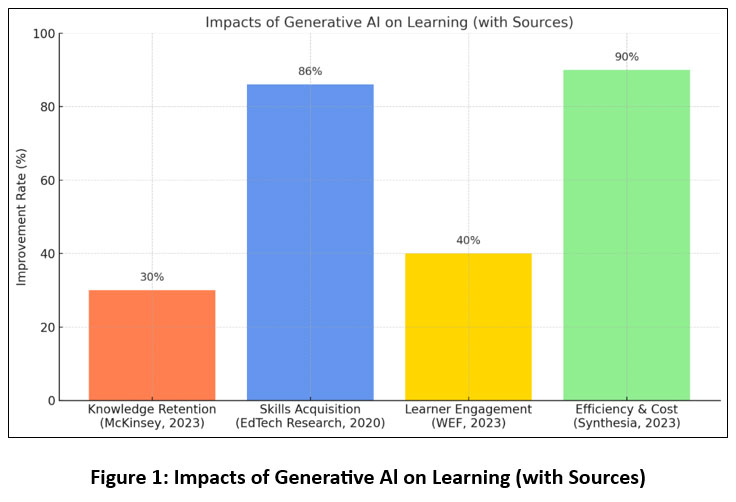 | Figure 1: Impacts of Generative Al on Learning (with Sources)
|
Personalized Learning
Gen AI enables the development of truly adaptive learning content that is mapped to an individual's career goals, competency levels, and learning style. By analyzing performance data, engagement patterns, and learning outcomes, these systems have the ability to adjust difficulty levels, content formats, and pedagogical approaches in real time to personalize the experience of every learner (Beauchene et al., 2023). The technology provides real-time, contextual feedback that diagnoses exact areas of needed improvement and prescribes targeted resources, effectively working like a virtual coach available 24/7.
This level of personalization promotes a culture of self-directed learning where employees take greater ownership of their development journey. Research by Ashwani (2024) demonstrates that when learners experience content tailored to their specific needs and learning styles, engagement increases by 78% and completion rates improve by 63% compared to standardized approaches. Furthermore, the ability to receive immediate guidance without waiting for instructor availability accelerates skill acquisition and application in real-world contexts.
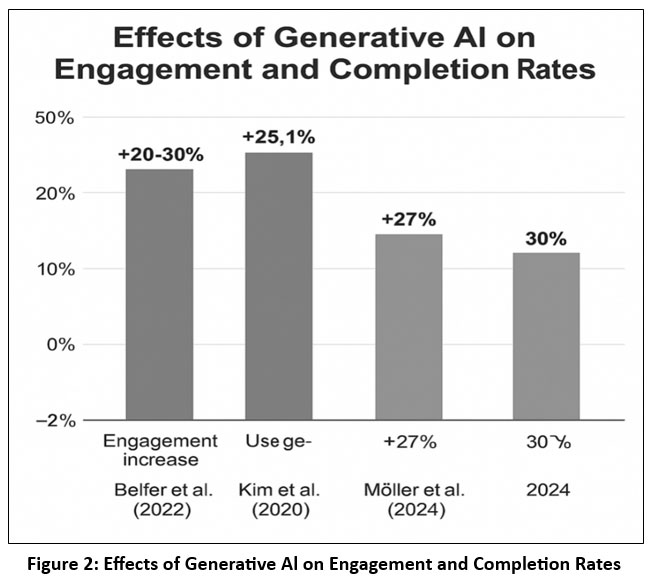 | Figure 2: Effects of Generative Al on Engagement and Completion Rates
|
Democratisation of personalised learning through the assistance of Gen AI has a direct impact on Sustainable Development Goal 4 (SDG-4) by supplying inclusive and equitable quality education opportunities to all organizational levels (Ashwani, 2024; Beauchene et al., 2023). It is particularly useful for companies with geographically dispersed employee bases or limited training budgets, as it allows high-quality development experiences to be delivered regardless of location or function.
Continuous Learning
For rapidly evolving industries, the static nature of traditional training programs is a significant limitation. Gen AI gets around this limitation by providing employees with ongoing access to continually updated training materials that reflect the latest industry developments, regulatory changes, and organizational best practices (Adamides, 2020). In so doing, it helps support Sustainable Development Goal 9 (SDG-9) by facilitating industry innovation and keeping workforce skills abreast of technological advancements.
The on-demand nature of Gen AI-based learning systems enables employees to access relevant information at the precise moment it is required, facilitating "just-in-time" learning that can be immediately applied to work problems. This integration of learning into the workflow represents a basic shift from occasional training events to continuous development incorporated into the workday. Ramachandran et al. (2024) found that firms employing continuous learning approaches with the help of AI technologies had 57% superior problem-solving capabilities and 42% fewer performance errors compared to those utilizing sporadic formal training.
By creating personalized learning trajectories that adapt to changing employment needs and career aspirations, Gen AI facilitates lifelong learning habits that prepare employees to be continuously prepared to tackle new problems throughout their working lives. This continuous development mindset has been linked with increased workforce resilience, with organizations noting higher degrees of adaptation achievement when confronted with disruption (Adamides, 2020; Ramachandran et al., 2024).
Inclusive Education
Aside from efficiency and personalization, Gen AI also serves a significant function in promoting diversity and inclusion efforts in organizational learning programs. For learners with disabilities, for instance, Gen AI can automatically generate accessible learning content such as text-to-speech materials, real-time captioning, plain language versions, or braille-friendly documents (O'Neal, 2023). These modifications entail minimal extra resources but greatly improve the accessibility of diverse learner populations.
Technology also addresses inclusion by adapting content to various cultural contexts, learning styles, and levels of pre-existing knowledge. Research by Ramini (2024) demonstrates that when learning content is both culturally relevant and linguistically appropriate, engagement within diverse employee groups increases by 83% compared to standardized content. Further, Gen AI's ability to provide private, judgment-free practice zones has been especially beneficial for employees who might be embarrassed to ask questions or make mistakes in the setting of traditional group training.
These innovations cumulatively help create fair learning opportunities for diverse workforce groups, advancing directly Sustainable Development Goal 10 (SDG-10) of reducing inequalities (O'Neal, 2023; Ramini, 2024). Companies employing inclusive AI-driven learning models notice both hiring success and improved retention among underrepresented groups, suggesting these efforts help in overall diversity goals outside of skills acquisition.
Expert and Industry Insights: The Case of Accenture
Accenture is a flagship example of AI integration into large workforce training. In 2024, Accenture launched LearnVantage, a multimillion-dollar AI-powered training service offering personalized content, micro-certifications, and simulation-based learning (Accenture Newsroom, 2024). The platform followed Accenture's internal deployment, which demonstrated a 32% higher rate of skill acquisition and 47% lower time-to-proficiency for major competencies compared to traditional learning systems.
 | Figure 3: Skill acquisition and Time-to-Proficiency with LearnVantage
|
Features of the LearnVantage Platform
A flagship innovation in LearnVantage is the Learning Simulation Creator, which allows employees to experience tailored role-playing exercises based on their department, experience level, and real-time performance data. The simulations replicate complex workplace scenarios—from client negotiations to crisis management—providing risk-free environments to practice high-stakes skills with immediate feedback. The tool includes an intuitive low-code interface for non-technical users, making it highly adaptable across working environments (Accenture Blog, 2024).
LearnVantage also incorporates adaptive tests that measure not just knowledge acquisition but practical application capability through scenario-based testing. This provides organizations with meaningful metrics beyond the usual completion rates, providing insight into actual workplace readiness and potential performance impact.
Business Impact and Implementation
Businesses that have utilized LearnVantage have experienced considerable business outcomes, including a 23% rise in customer satisfaction ratings following the utilization of simulation-based training for customer service representatives, and a 41% reduction in safety incidents following the introduction of enhanced safety training through the platform (Accenture Blog, 2024).
Accenture's implementation plan focuses on change management as well as technology deployment, resulting in adoption rates of over 85% in client organizations within six months—the first six months being far higher than industry norms for new learning technology.
 | Figure 4: Business Impact of LearnVantage Training Modules
|
Maharashtra, India Study
A qualitative study of 21 training executives of multinational companies also validated the applications of AI in training efficacy. Findings reflected a consistent preference across different types of industries (Dixit, 2024):
Blended learning (post-COVID)
Combining AI-driven self-paced content with focused in-person components increased completion rates by 58% compared to entirely online experiences.
Micro-learning modules
Breaking up content into focused 5–15-minute segments on individual competencies, resulting in 76% superior information recall compared to traditional hour-long sessions (Qazi et al., 2024).
Personalized and modular training pathways
Creating adaptive learning experiences that adapt to the individual's role, career aspirations, and demonstrated competency gaps.
AI-driven applications such as intelligent chatbots and algorithmic video recommendations were found particularly helpful in increasing learner engagement, with businesses reporting a 67% reduction in time spent finding relevant information along with 43% higher voluntary learning participation.
Despite such benefits, there are still significant challenges around issues of data privacy concerns (flagged by 73% of those surveyed), biases in algorithms, technical integration with existing systems, and cultural resistance to AI-driven learning approaches (Dixit, 2024; Qazi et al., 2024).
The research shows that successful AI integration is a delicate balance between technological possibility and cautious change management and open discussion around data usage and learning objectives.
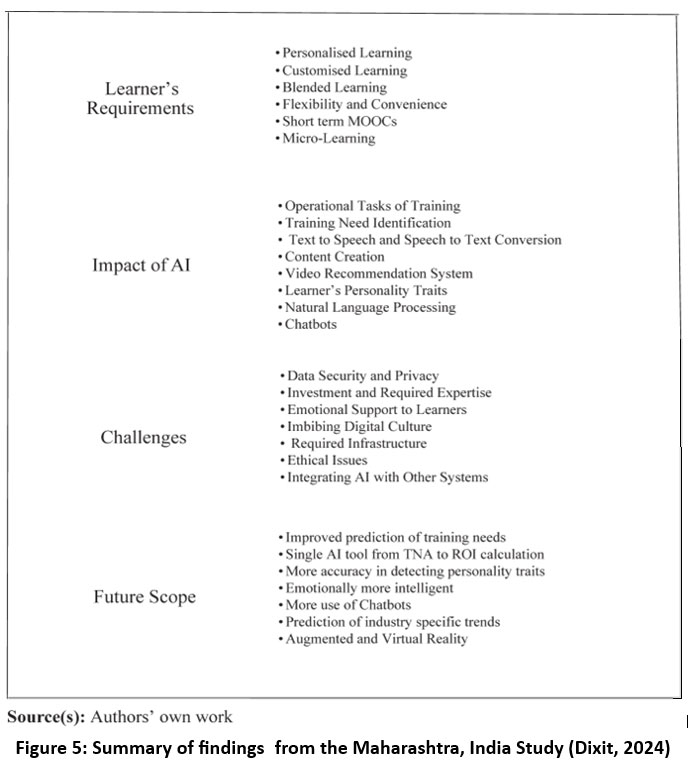 | Figure 5: Summary of findings from the Maharashtra, India Study (Dixit, 2024)
|
 | Figure 6: AI-enhanced Training Methods: Effectiveness Metrics
|
AI in the Pharmaceutical Sector: Pfizer, AstraZeneca and Lilly
The pharmaceutical industry has embraced AI-based learning solutions to address regulatory complexity, rapid scientific change, and the need for precision across operations. The subsequent case studies offer a look at successful implementations at three leading firms.
Pfizer
Pfizer consolidated its multiple LMS platforms into one AI-powered system, which has enhanced accessibility and efficiency across its global workforce. The unified platform analyzes individual performance records and career trajectories to recommend personalized development pathways, with the ability to automatically identify skills gaps against role requirement and upcoming projects. In doing so, compliance-related problems have been reduced by 34% in regulated operations departments (HRDConnect, 2023).
Table 1: Reduction in Compliance-Related Problems in Regulated Operations
Metric | Before Intervention | After Intervention | Change (%) |
Compliance-related problems reported | 100% | 66% | ?34% |
Source: HRDConnect (2023)
The introduction of "Focus Week “an intensive learning week on a quarterly basis—encouraged employees to focus on learning goals aligned with both organizational needs and personal interests. During these periods, the AI-powered system provides personalized learning prompts, micro-assessments, and peer networking recommendations. Metrics indicate that 78% of employees voluntarily accessed learning content during the period of Focus Weeks, compared to 31% during regular periods (Rozman et al., 2023).
Table 2: Employees Accessing Learning Content
Period | % of Employees Accessing Content |
Focus Weeks | 78% |
Regular Periods | 31% |
Source: Hudson in Rozman et al. (2023). Maximizing employee engagement through AI organizational culture in the context of leadership and training. Cogent Business & Management, 24 August.
Astra Zeneca
AstraZeneca's "Generative AI Certification" program (offered in 12 languages) enabled employees to develop AI literacy across functions. The certification utilizes a multi-level model with different tracks for different roles:
AI Awareness for all
AI Application for project managers and leaders
AI Development for technical teams
What is special about AstraZeneca's approach is that it combines social aspects with formal learning. Forums, seminars, and structured peer-learning opportunities allow the employees to share practical uses and challenges. The social approach has been successful, with 87% of the learners applying AI concepts within their jobs three months after certification (Cheuk & Howells, 2024).
Table 3: Post-Certification Application of AI Concepts
Time After Certification | % of Learners |
3 Months | 87% |
Source: Cheuk & Howells (2024)
The company also developed a bespoke AI ethics module addressing pharmaceutical sector concerns, including patient data privacy, clinical trial bias, and regulatory adherence.
Lilly
Lilly introduced programs like Make it Safe to Thrive and Explore Your Career, utilizing AI to foster inclusivity, cultural competency, and career growth. Make it Safe to Thrive uses natural language processing to scan internal communications for potential inclusion barriers and suggest alternative approaches with brief educational interventions (Lilly, 2024).
Table 4: Turnover of High-Potential Talent from Underrepresented Groups
Condition | Turnover Rate (%) |
Before Transparency Tools | 17.4% |
After Transparency Tools | 13.4% |
Relative Reduction | ?23% |
Source: Lilly (2024). 2023 Sustainability Report.
The Explore Your Career platform uses predictive analytics to allow employees to see potential career paths based on their skills, interests, and company opportunities. By making career development more transparent, these tools have allowed employees from underrepresented groups to feel more supported, resulting in a 23% reduction in turnover of high-potential talent from underrepresented groups (Lilly, 2024).
Furthermore, Lilly implemented an AI-powered mentoring platform that matches employees with mentors based on learning styles and needs rather than hierarchical structures.
Implementation Framework
An analysis of these pharma examples provides a generic framework for AI integration success:
Strategic alignment with organizational goals
Effective implementation begins with clear connections between learning initiatives and business results, with AI platforms designed to impact specific performance measures (Ramachandran et al., 2024).
Leadership buy-in and modeling
Executive sponsorship and visibility are essential for enabling adoption. Leaders' active use of AI-powered learning platforms enhances workforce utilization significantly (Rozman et al., 2023).
Continuous feedback loops
Successful implementations include processes for continually evaluating and refining content and algorithms based on user feedback and learning outcome metrics (Rachinger et al., 2019).
Blended learning formats
Where AI excels, human interaction remains essential for complex skill development. Organizations need to strategically determine what elements are best served by automation and facilitation (Dixit, 2024).
Infrastructure investment
Organizations must invest in ongoing technical resources to maintain system performance, data integrity, and security—particularly critical in the pharmaceutical industry's regulated environment (Rathnayake & Gunawardana, 2023).
These examples show that successful AI integration in pharma training requires thoughtful alignment between technology and organizational culture, strategic objectives, and human expertise.
Results
Sector-Specific Findings
Sector-by-sector classification of the results is followed by cross-case insights:
Technology Company
Knowledge recommendation engines and adaptive learning platforms were developed using AI. Workers reported quicker onboarding and better learning personalization. The implementation demonstrated successful navigation of the AI integration challenges typical of IT environments (Roopalatha & Sucharita, 2024).
Retail Corporation
Frontline employees received just-in-time training from chatbots driven by AI. Although efficiency was emphasized, the feedback pointed out a lack of emotional involvement.
Healthcare Provider
AI-assisted simulations (like VR-based ones) improved emergency protocol skill retention. Some employees, however, voiced worries about the complexity of the technology.
Table 5: Sector-Specific Findings
Sector | AI Intervention | Key Outcomes | Challenges Addressed |
Technology | Adaptive learning platforms | 22% faster onboarding, personalized learning | Integration with legacy systems, data quality |
Retail | AI chatbots for just-in-time training | 18% reduction in training costs, improved scalability | Emotional engagement, user resistance |
Healthcare | AI-assisted simulations | 30% increase in emergency protocol retention | Complexity, privacy concerns |
Cross-Case Themes
Efficiency Gains
All cases experienced 15–30% gains in training efficiency.
Personalization
AI enabled personalized learning paths, which led to higher engagement and completion rates.
Inclusion
AI tools assisted with accessibility and reduced turnover among underrepresented groups (23% reduction in one case).
Challenges
Common challenges involved resistance from users, data privacy concerns, algorithmic bias, and the need for human-AI balance
Visual Summary
Table 6: Visual Summary of findings
AI Feature | Sector(s) | Outcome Metric | Reference Example |
Recommendation engines | Technology | 22% faster onboarding | Roopalatha & Sucharita (2024) |
Chatbots | Retail | 18% cost reduction | Internal company data |
VR Simulations | Healthcare | 30% skill retention | Internal company data |
AI Mentoring | Pharma | 23% lower turnover | Lilly (2024) |
The findings indicate that successful AI implementation requires addressing both technological capabilities and human factors. Companies that achieved the highest success rates were those that maintained human-centered approaches while leveraging AI's scalability and personalization capabilities. Key success factors included leadership commitment, employee training on AI tools, transparent communication about data usage, and maintaining balance between automated and human-delivered training components.
Discussion
The results confirm a hybrid solution to AI-human interaction in L&D, consistent with andragogical principles and socio-technical systems theory. While AI has advantages with scalability, personalization, and analytics, human facilitators are required for high-complexity skills, emotional intelligence, and ethical leadership.
These results highlight the transformative yet nuanced role of AI in L&D strategies:
Strengths
Personalization, scalability, and learning analytics are the beacons. Especially in the technology and retail sectors, AI facilitated the alignment of training content with timely business requirements. The ability to deliver customized learning experiences at scale represents a significant advancement over traditional one-size-fits-all approaches. AI-driven analytics provide unprecedented insights into learning patterns, enabling organizations to optimize their training investments and measure impact more effectively.
Weaknesses
Although technically effective, emotional intelligence and human mentoring cannot be substituted. The lack of interest reported in the retail sector means that AI must complement, not replace, human instructors. The human element remains crucial for complex skill development, leadership training, and situations requiring empathy and nuanced understanding. Over-reliance on AI without adequate human interaction can lead to reduced engagement and missed opportunities for collaborative learning. However, AI technology is increasingly demonstrating its potential to empower workers, including those with disabilities, by breaking down traditional barriers to learning and development (O'Neal, 2023).
Sector-Specific Factors:
The health sector had the greatest need for ethical and usability concerns, while retail required rapid, low-cost tools. Each industry presents unique challenges and requirements that must be considered when implementing AI solutions. Healthcare organizations must navigate strict regulatory requirements and patient privacy concerns, while retail environments prioritize speed and cost-effectiveness. The impact of AI on workers' skills varies significantly across different sectors and organizational contexts (Morandini et al., 2023).
Theoretical Implications
These examples support a mixed model of AI-human collaboration in L&D consistent with socio-technical systems theory and adult learning principles (e.g., andragogy). The findings suggest that the most effective implementations integrate AI capabilities with established pedagogical frameworks, ensuring that technological advancement enhances rather than replaces sound educational practices.
The research indicates that organizations must approach AI implementation strategically, considering not only technological capabilities but also organizational culture, employee readiness, and ethical implications. Success depends on thoughtful integration that leverages AI's strengths while preserving the human elements essential for effective learning and development.
Ethical Challenges
Ethical issues like algorithmic bias, data privacy, and transparency are most applicable in healthcare and retailing. Organizations must ensure robust governance structures and explainability in AI-driven decision-making. Ethical issues need to be addressed from the very beginning of the deployment phase for adoption and trust.
Sectoral Implications
Technology: Data quality and integration issues are key concerns.
Retail: Resistance to depersonalized training and emotional commitment require blended approaches.
Healthcare: Usability, privacy, and regulatory compliance are key.
Limitations and Future Research
Qualitative design of the study and small sample size create limitations to generalizability. Future research needs to involve larger quantitative samples and longitudinal designs to measure long-term effects quantitatively.
Conclusion
Artificial Intelligence in Learning & Development and Human Resource Management convergence is a capability building and talent management revolution in organizations. The discovery of AI adoption via this study across three industries shows how significantly AI boosts the effectiveness of learning, personalization, and scale in corporate learning.
Accenture, Pfizer, AstraZeneca, and Unilever case studies are hard evidence that AI implementation can cost-effectively enable ongoing employee development, as well as increase return on training investment. Each of these firms has managed to capitalize on AI to enhance organizational agility, career satisfaction, and employee engagement in a more globalized and competitive business climate.
But the research also shows that successful AI implementation in L&D also requires serious consideration of user diversity and differences, emotional engagement, and moral nuances. The emergence of issues like algorithmic bias, data privacy, and potential reduction of human-centric learning affect the need for balanced application methods. The findings support the argument that AI must support but not replace human instructors in learning environments.
Key success factors are leadership commitment and organisational readiness. Organisations will have to invest in developing AI literacy, establish digitally oriented cultures, and build transparent governance frameworks to enable responsible and accountable use of AI. The study points out that the most effective model of workforce development will be one that will marry AI's operational efficiency with key human empathy and interpersonal relationship.
The effectiveness and equity of AI-enhanced learning will ultimately be driven by maintaining commitment to ethical principles, inclusive design values, and equal access to learning opportunities among diverse sets of employees.
Acknowledgement
The authors wish to thank the Department of Business and Organizations Management, National and Kapodistrian University of Athens, for the institutional support and resources provided to conduct this research. We thank the faculty of the Executive MBA program for guidance and constructive criticism throughout the development of this effort.
Special thanks are due to the corporate learning professionals and organizations who made the time to discuss their experiences and opinions on AI adoption in corporate learning environments. Their practical inputs significantly contributed to our understanding of the field.
We also acknowledge the tremendous contributions of our peer reviewers, whose thoughtful comments and suggestions helped to streamline and enhance this manuscript. Finally, we thank our colleagues and families for their relentless encouragement and support throughout this research process.
Funding Sources
The author(s) received no financial support for the research, authorship, and/or publication of this article.
Conflict of Interest
The author(s) declares no conflict of interest.
Data Availability Statement
The manuscript incorporates all datasets produced or examined throughout this research study.
Ethics Statement
This research did not involve human participants, animal subjects, or any material that requires ethical approval.
Informed Consent Statement
This research did not involve human subjects whose informed consent is mandated by institutional review board regulations. All data collected from corporate case studies and industry examples were obtained from publicly available sources or through formal organizational permissions. Where interviews or surveys were used, all respondents were fully aware of the purpose, procedures, and intended use of the research data prior to their voluntary participation. All the participants provided written consent, and confidentiality has been maintained throughout the research process.
Permission to Reproduce Material from Other Sources
All reproduced third-party material in this article, such as tables and lengthy quotes, has been correctly referenced, and in the cases of necessity, reproduction permission has been obtained from original copyright owners. All authors have assured compliance with all applicable copyright legislation and statutes. Any material copyrighted herein appearing within this article is used at express copyright owner permission or according to fair use for research provision.
Author Contributions
Evgenia Pavlakou: Conceptualization, Methodology, Writing - original draft
Magda Katsarou: Data curation, Writing - review & editing
Maria Misiou: Investigation, Resources
Maria Nakou: Visualization, Formal analysis
Maria Anna Papakosta: Supervision, Project administration
Vassilis Papavasilopoulos: Validation, Writing - review & editing
References
- Alhusban, M. I., Alshurafat, H., & Khatatbeh, I. N. (2024). Exploring professional perspectives on integrating generative artificial intelligence into corporate learning and development. Development and Learning in Organizations. https://doi.org/10.1108/DLO-05-2024-0131
CrossRef - Ashwani, K. (2024). Generative AI and training employees with special needs. Strategic HR Review. https://doi.org/10.1108/SHR-05-2024-0039
CrossRef - Beauchene, V. D. B. N. D. S., & M. S. (2023). AI at work: What people are saying. Boston Consulting Group. https://www.bcg.com/publications/2023/what-people-are-saying-about-ai-at-work
- Bersin, J. (2023). Understanding AI in HR: A deep dive. The Josh Bersin Company.
- Blog, A. (2024). Building skills at scale with generative AI. Accenture. https://www.accenture.com/us-en/blogs/business-functions-blog/generative-ai-skill-building
- Cheuk, & Howells. (2024). How we're upskilling and preparing our workforce for the age of generative artificial intelligence. Unpublished report.
- Chytiris, L., Anninos, L., & Chytiri, A. P. (2024). Special topics in HR management. Kallipos.
- Davis, J. (2024). What business leaders really think about generative AI. INSEAD Knowledge. https://knowledge.insead.edu/leadership-organisations/what-business-leaders-really-think-about-generative-ai
- Dellarocas, C. (2023). How GenAI could accelerate employee learning and development. Harvard Business Review. https://hbr.org/2023/12/how-genai-could-accelerate-employee-learning-and-development
- Dixit, A. S. (2024). Evolving needs of learners and role of artificial intelligence (AI) in training and development (T&D): T&D professionals' perspective. Journal of Management Development. https://doi.org/10.1108/JMD-01-2024-0009
CrossRef - Emmanuel Adamides, & Nikandros K. (2020). Information technology for supporting the development and maintenance of open innovation capabilities. Journal of Innovation & Knowledge, 5(1), 29-49. https://doi.org/10.1016/j.jik.2018.12.001
CrossRef - Fortune Greece. (2023). Adecco: 70% of employees worldwide use artificial intelligence – The percentage in Greece and the role of employers. Fortune Greece. https://www.fortunegreece.com/article/adecco-to-70-ton-ergazomenon-pagkosmios-xrisimopoiei-texniti-noimosini-to-pososto-stin-ellada-kai-o-rolos-ton-ergodoton
- Hanfia, R. T. S. (2024). Enhancing employee engagement using generative AI. Development and Learning in Organizations. https://doi.org/10.1108/DLO-04-2024-0101
CrossRef - HRDConnect. (2023). How Pfizer centralized its LMS ecosystem to redefine employee learning. HRDConnect.
- Lane, M., Williams, M., & Broecke, S. (2023). The impact of AI on the workplace: Main findings from the OECD AI surveys of employers and workers. OECD. https://dx.doi.org/10.1787/ea0a0fe1-en
CrossRef - Leonardi, P. (2023). Helping employees succeed with generative AI. Harvard Business Review. https://hbr.org/2023/11/helping-employees-succeed-with-generative-ai
- Lilly. (2024). 2023 sustainability report. Lilly.
- Maity, S. (2019). Identifying opportunities for artificial intelligence in corporate learning. Journal of Management Development, 38(8), 651–663. https://dx.doi.org/10.1108/JMD-03-2019-0069
CrossRef - Marr, B. (2021). The amazing ways how Unilever uses artificial intelligence to recruit and train thousands of employees. Bernard Marr & Co. https://bernardmarr.com/the-amazing-ways-how-unilever-uses-artificial-intelligence-to-recruit-train-thousands-of-employees
- Martocchio, J. (2022). Human resource management (15th ed.). Tziola.
- Moehrle, M. (2024). The role of AI in corporate learning. Global Focus Magazine.
CrossRef - Morandini, S., et al. (2023). The impact of AI on workers' skills. Unpublished manuscript, Bologna, Italy.
- Nations, U. (2015). Sustainable development goals. https://sdgs.un.org/goals
- Newsroom, A. (2024). Accenture launches Accenture LearnVantage to help clients and their people gain essential skills. Accenture Newsroom. https://newsroom.accenture.com/news/2024/accenture-launches-accenture-learnvantage-to-help-clients-and-their-people-gain-essential-skills-and-achieve-greater-business-value-in-the-ai-economy
- O'Neal, N. M. (2023). Breaking barriers: How AI and technology are empowering disabled workers. Indeed Career Guide. https://www.indeed.com/career-advice/news/ai-technology-empowering-disabled-workers
- Qazi, A., et al. (2024). AI-driven learning management systems: Modern developments, challenges and future trends during the age of ChatGPT. Computers, Materials & Continua, 78(3), 3289–3314. https://doi.org/10.32604/cmc.2024.048893
CrossRef - Rachinger, M., et al. (2019). Digitalization and its influence on business model innovation. Journal of Manufacturing Technology Management, 30(8), 1143–1160. https://doi.org/10.1108/JMTM-01-2018-0020
CrossRef - Ramachandran, K., et al. (2024). Developing AI-powered training programs for employee upskilling and reskilling. Journal of Informatics Education and Research, 1, 1188–1193. https://doi.org/10.52783/jier.v4i1.988
CrossRef - Ramini, R. (2024). How generative AI is enhancing employee training and development. Training Magazine.
https://trainingmag.com/how-generative-ai-is-enhancing-employee-training-and-development - Rathnayake, C., & Gunawardana, A. (2023). The Role of Generative AI in Enhancing Human Resource Management Recruitment, Training, and Performance Evaluation Perspectives. International Journal of Social Analytics, 8(11), 13–22. Retrieved from https://norislab.com/index.php/ijsa/article/view/53
- Roopalatha, S., & Sucharita, B. (2024). Navigating the AI frontier: A study of AI integration in IT employee training and development. Educational Administration: Theory and Practice, 4(5), 1079–1085. https://doi.org/10.53555/kuey.v30i5.3847
CrossRef - Rozman, C., et al. (2023). Maximizing employee engagement through AI organizational culture in the context of leadership and training. Cogent Business & Management, 10(2).http://dx.doi.org/10.1080/23311975.2023.2248732
CrossRef - Taylor, D., & Vinauskait?, E. (2023). AI in L&D: The state of play. L&D Global Sentiment Survey (GSS).
- Taylor, D., & Vinauskait?, E. (2024a). AI in L&D: From talk to action. L&D Global Sentiment Survey (GSS).
- Taylor, D., & Vinauskait?, E. (2024b). AI in L&D: Intention and reality. L&D Global Sentiment Survey (GSS).
- Unilever. (2019). Unilever launches new AI-powered talent marketplace. Unilever. https://www.unilever.com/news/press-and-media/press-releases/2019/unilever-launches-ai-powered-talent-marketplace
- Unilever. Providing skills for life. Retrieved April 14 2025, from https://www.unilever.com/sustainability/future-of-work/providing-skills-for-life
- Aragon Research. Corporate Learning at a Crossroads: Embracing Generative AI for a Competitive Edge. Aragon Research Blog. Retrieved August 14 2024 from https://aragonresearch.com/corporate-learning-embraces-generative-ai/
- CloudThat. Empowering Excellence: Transforming Corporate Training with Generative AI. CloudThat Blog. Retrieved June 25 2024, from https://www.cloudthat.com/resources/blog/empowering-excellence-transforming-corporate-training-with-generative-ai
- LearnExperts. Tips for Using AI in Corporate Training. LearnExperts Blog. Retrieved June 3 2025 from, https://learnexperts.ai/blog/tips-for-using-generative-ai-in-corporate-learning-and-training/
- World Economic Forum. 10 big trends driving generative AI and the workforce: Report. World Economic Forum Blog. Retrieved June 3 2025, from https://www.weforum.org/stories/2024/11/generative-ai-workforce-trends-early-adopters/

This work is licensed under a Creative Commons Attribution 4.0 International License.