
Impressions and Glimpses of the Socio-Economic History of Migrant Settlement in Glasgow-An overview of factors shaping integration and community relations with the host community during 1840-1980.
Mohan Luthra *
1Retired UK based Academic and Civil servant, United Kingdom .
http://dx.doi.org/10.12944/CRJSSH.3.1.04
Accounts of the history of migrant and refugee settlement in Glasgow from mid nineteenth century onwards have been lacking in two aspects. Firstly, their arrival and settlement, as well as their economic participation profile, has not been placed in the context of the socio-economic evolution of the city. Secondly, a broader overview of the history of the arrival of a range of diverse migrant and settlement groups, their integration against a changing economic backdrop as well as ecological factors they encountered, and the implications of these for community relations, has not been constructed. In addition, there appears to have been little attempt to focus on this period with a view to identify if there are any patterns of community economic identities which evolved based on enterprise development, as well as the challenges the entrepreneurial or commercial sections of the community may have faced. In this first of a two-part series of working papers we explore mainly the experience and challenges of the invisible minority settlement patterns in these respects and attempt to develop an impressionistic socioeconomic picture. We attempt to do the same for the post World War II Asian (mostly Panjabis of India and Pakistan origin) communities arrival and settlement in a subsequent working paper to be published soon.
Copy the following to cite this article:
Luthra M. Impressions and Glimpses of the Socio-Economic History of Migrant Settlement in Glasgow. Current Research Journal of Social Sciences and Humanities. 2020 3(1).
DOI:http://dx.doi.org/10.12944/CRJSSH.3.1.04Copy the following to cite this URL:
Luthra M. Impressions and Glimpses of the Socio-Economic History of Migrant Settlement in Glasgow. Current Research Journal of Social Sciences and Humanities. 2020 3(1). Available from: https://bit.ly/2Z4Ffcq
Download article (pdf) Citation Manager Review / Publish History
Introduction and scope
The city of Glasgow, termed often as the second city of the British Empire, has had an established history of migration and settlement since 1830 this period with the Irish in/out migration strand prior to being an exception. Glasgow also had its own internal migration from the Highlands during the rapid city growth period as it evolved a strong industrial base and an industrial employment culture absorbing a diverse range of migrant groups and refugees. As the opportunities grew in this period its ecology also provided opportunities to both waves and trickles of migrant groups to be able to create and foster business niches alongside the local economy whilst developing specialty sectors such as in catering, textiles, clothing or tobacco. New sectors and markets were also created as in the case of Italians and Asians. Most communities were well able to economically integrate to varying extents and in diverse ways. This depended upon the environment they found themselves in on their arrival and their legacy skills mix base or copying what worked for the other arrivals. Some communities almost disappeared or got subsumed after a few years such as the early Germans or Polish and the Belgians.
Glasgow’s population grew during 1841-1931 (Graph1) along with Scotland but with higher accelerated growth post 1900. It did not have the same exodus as other parts of Scotland by virtue of its own growing opportunities and also due to the arrival of the large number of Irish migrants(who tended to have larger families). Some 749,000 Scots left (1840-1930) and some two million emigrated abroad. For the best part of this period the opportunities were perceived as being greater abroad, particularly in America and Australia and other parts of the Commonwealth and even England. By 1931 the number of Scots who settled in England equalled those from Ireland.
A tradition of emigration had developed to such an extent that during evictions (1840-60) many Highlanders did not move to Lowland Scotland and preferred to settle in Canada to be able to work on the land 19th Century. Of the total UK overseas settlers an estimated 60 percent were Scots-born. Improved transport links aided exodus. There was also the phenomenon of English migration from the North of England to Scotland perhaps more focused on cities like Edinburgh than Glasgow. This also contributed to the population growth which is a subject beyond the scope of this paper.
Scope and Structure
This paper does not address the race relations and equal opportunities experience of different settling groups restricting references to such situations where it had a major impact on employment or business opportunities. The period focus is on the post 1840-1980 period although the earlier period has been alluded to wherever relevant.
In terms of structure this paper has two sections Section 1 outlines the economic back drop of the city by way of economic trends in the city of Glasgow in an attempt to piece together a relationship between the economic challenges arrivals faced and the political economic ecology they found themselves in. Section II pieces together and juxtaposes brief settlement histories of migrants and refugees as well as that of emigration against the changing economic backdrop. A traditional broad historical approach of the subject has been chosen to build an overall impressionistic picture.
Section I
The City of Glasgow – A Brief Look
Glasgow founded as a market town acquired the status of a town (Burgh) in the 12th century and a Royal burgh in 1611. Following a treaty of Union in 1707 with England and becoming part of the British colonial expansion project it transitioned from being an ecclesiastical, academic and market city of the north of the British Isles into a colonial commercial trading hub (Lever and Mather 1986) with a seaport aptly improved for trade with the colonies. From distilling to soap glass to textiles and cotton to tobacco trade, commerce grew in leaps and bounds By the end of 19th century slavery, based on plantations (which created a Nabob class in the city), ended, partly aided by local anti-slavery campaigning leading eventually to the demise of the tobacco trade, which was so intertwined with slavery.
The technological advance of the age of steam power further enabled Glasgow’s transition into an urbanised manufacturing hub, fuelled by large scale in-migration from the highlands of Scotland and from Ireland (Lever and Mather 1986), to become the 19th century “second city of Empire” (Fraser 2004:1) with cotton and textiles links with India and slave plantation and slave -trade links with the Caribbean. Scots availed themselves of empire opportunities to become prominent middle managers of the British empire which enhanced their social mobility at home and abroad in the empire. They also began responding by emigrating overseas whenever the economy came under distress (See Graph 5 and 6).
Another key episode in Glasgow’s history was the rise of ‘Carboniferous Capitalism’ (Hudson 1989) which established economic specialisation in heavy engineering, including rail, locomotives and shipbuilding such activity formed the basis of an urban industrial growth complex founded upon skilled labour, innovation, and the growth of related and support industries Glasgow’s employment expanded steadily and above national growth levels between 1876 and 1901 (Lee C.H 1979). With local shipyards employing half the British shipbuilding workforce by 1870 and producing half the tonnage of shipping (Fraser 2004), it supplied the UK and the British Empire markets (Pacione 2009). It became “one of Britain’s pre-eminent industrial cities” (Turok and Bailey 2004: 171).
In the early 1900s, city employment declined in the first decade ( Graph 1), and the earlier rapid population growth transitioned partly into a wave of emigration (Pacione 2009) to US and Canada and to England often corresponding with slow growth periods (Graph 4 and 5 ). Armaments production for World War I for almost a decade and a half created “boom conditions” (Pacione 2009: 148) led by locomotives and shipbuilding with employment peaking in 1921 (Graph 1).
The earliest industries of Scotland's industrial revolution, textiles, clothing and footwear, experienced job losses well before the inter-war period. Their experience therefore contrasted with the heavy industries of mining, shipbuilding and metal manufacture which created much new employment between 1901 and 1921 but experienced massive job losses thereafter. Other features included only limited employment gains in the rising new industries like electrical engineering and vehicle manufacture, the expansion in construction. Overall, A poor record of employment creation in Scotland1 had become a feature of its economy.
The inter-war decades of the Great Depression during the 1930s were eventually relieved by virtue of increased short-term demand leading to economic growth from re-armament spending for the Second World War during 1945-53 (Young 2015). Post-war marked an era of lasting rapid deindustrialisation and decline in employment after 1955 to the 1960s (Graph 1) attributed to the narrow base of economic activities and sectors. This made Glasgow prone to economic swings and cycles as well to a reduced demand from the UK and other international markets. Excessive focus on making producer goods which had limited demand rather than taking account of the growing global consumer goods market was another reason for decline.
Glasgow firms were also vulnerable being insulated from longer term technological transformations ie the transition from the steam age to the oil-based economy and to growing overseas competition in a globalising competitive economy, for instance in the US and Germany. Hampered by the distance from their markets, inadequate capital investment aggravated by external ownership, within both private and nationalised industries, mergers and acquisitions by foreign-owned businesses, firms were further hampered by poor investment in basic infrastructure and skills (Slaven 1975, Checkland 1976, Pacione 2009).
In respect of the migrant dimension, the City of Glasgow has been a city of immigrants. Apart people from Germany, Italy, Asia and Poland came to the city as well as people from the surrounding countryside, the Highlands and from its neighbour Ireland, with which it had a strong historical link. They all had to find their place in a rapidly changing economy and culture. Although Glasgow remained a Protestant city it has had a mixed population with the growth of a significant Roman Catholic minority as well a small but significant Jewish presence and more recently a Hindu, Sikh, and Muslim presence.
For Ireland, a major contributor to Glasgow immigration although itself a recipient of migrants earlier on in the 17th century Fitzgerald and Lambkin summarizes2:
“simply getting enough to eat was difficult for many in Ireland and the underlying weakness of the agricultural economy was exposed by brutal famines in 1728–9 and 1740–1 which, along with a shift from tillage to grazing and proto-industrialisation, especially in linen manufacture, drove much internal migration and emigration. Continental Europe continued to offer rank-and-file ‘Wild Geese’ the chance to put bread on the table and those of the officer class the possibility of preserving their military rank and social status”
In contrast, the city of Glasgow in the 18th century grew on the back of Empire, its city status and its profits from slavery and the triangular trade in tobacco, rum and linen. The accumulation of wealth amongst its Nuova commercial elite, combined with its innovation culture against the backdrop of Scottish enlightenment and the Clyde port advantage, transformed it visually, culturally, and economically. In response to its growing industrialisation in the 19th century and its rapid increase in population it evolved its civic responses and architectural landscape and transport. An example of change in the context of new arrivals is that, at the time of the pre Second World War settlement of Jewish immigrants from Eastern Europe, Glasgow was going through a period of expansion, incorporating areas which had previously been independent burghs. Slums in the old city centre were cleared and new neighbourhoods were built. Its population increased with the arrival of many newcomers after the World War I. To summarise:
- From 1870 – 1950 covering major periods of migration Glasgow’s employment grew. It declined following a stable period from 1931 to 1961
- The great depression impacted Glasgow’s economy disproportionately
- The Irish famine leading to immigration of the impoverished and destitute Irish migrants added to the local poor section of the population at a time when the employment growth was low and remained low
- Broadly the population growth mirrors employment growth with the 1870, 1890 and 1911 decades as opportune arrival periods for outsiders seeking work
- World War II was followed by further growth in consumer services and employment in a general boom but unfortunately Glasgow did not benefit from employment growth unlike other regions as shown (Lee, C. H. (1979) -see graph in the appendix). Yet it had to absorb a lot of Polish soldiers’ families due to an overall felt shortage of workers, UK- wide government settlement policy and its economic revival plans.
- Post 1951 there was a continuous decline of population with outmigration to the South of the UK and abroad speeding up decline until the arrival of Asians
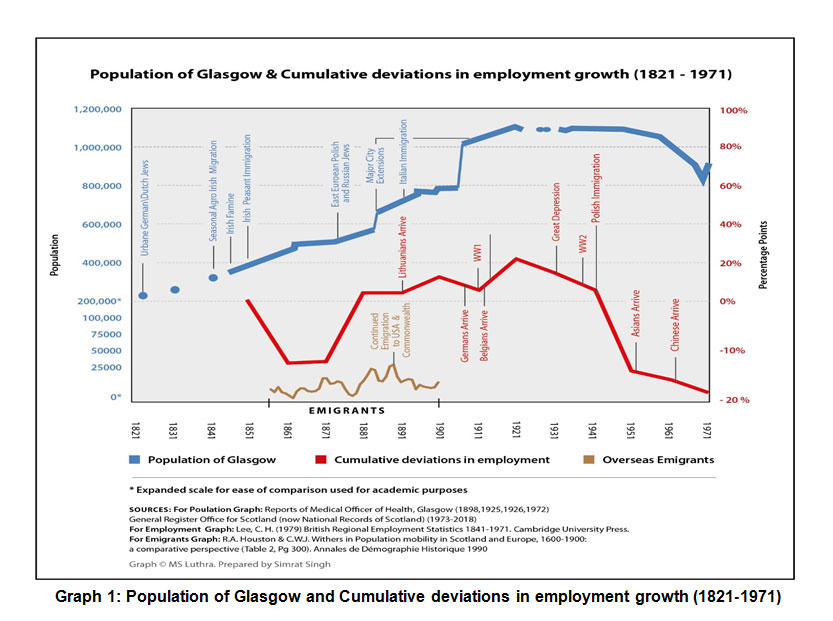 | Graph 1: Population of Glasgow and Cumulative deviations in employment growth (1821- 1971) |
The earliest industries of Scotland's industrial revolution, textiles, clothing and footwear, experienced job losses for two decades in the mid19th century period. Their experience therefore contrasted with the heavy industries of mining, shipbuilding and metal manufacture which created much new employment between 1911 and 1921
but experienced massive job losses thereafter.
Weir (Weir R.1994) observed that between 1901and 1951 in terms of employment changes at Scottish level:
- The share of services and commerce increased particularly after 1921 at the expense of agriculture and Industry
- Mining, quarrying, shipbuilding, metal, manufacture, and chemical all these sectors declined after 1921
- Between 1921 and 1951 Textile clothing and footwear declined stabilising only after 1931
- Construction having lost till 1921 gained some what
- Vehicles electric engineering survived
Except for the period 1851 and 1861 and post 1921 period the Glasgow’s economy did well in terms of employment creation as shown in Graph 1. The Glasgow population grew till 1961 despite employment decline starting in 1921. By the early 1970s, large scale, rapid and prolonged deindustrialisation had
seriously eroded the city’s economic base. It had entered an “arrested development” phase with an ongoing struggle to formulate policies to deal with its “apparently intractable socio-economic problems” (Cameron 1971: 315).
Section II
In this section we provide glimpses of selected migrant group settlement and economic integration histories within a socio-economic framework. The literature is sparse for some groups whilst in other cases, like the Jews and Irish, the history is better chronicled.
The Irish
After Prince William of Orange defeated the Catholic King James III at the Battle of the Boyne in 1690, laws were introduced preventing Catholics from inheriting land from a Protestant, borrowing money to buy land or making a profit of more than 30% from their yearly rental income if they had tenants . When a Catholic died his land had to be divided equally between his sons. In addition, they were banned from all government jobs and were not allowed to have their children educated.
These Laws were finally abolished in 1829 but it impoverished the Irish Catholic peasant community leaving it uneducated and at the mercy of Protestant landowners, only interested in maximising rent. This too at a time when Ireland had doubled its population between 1800 and 1850 and the Catholicowned pool of rural farms became economically unsustainable. They were often evicted or driven out because of new agro-modernisation (enclosure/ new machines) rent hikes. Ireland, underdeveloped industrially by its British colonial elite, had very few industries to create jobs and farm workers’ wages in Scotland, almost as much as six times those in Ireland, were a major economic pull factor
Glasgow has had a long-established history of immigration from Ireland; the Irish were by far the largest group of immigrants to settle in Scotland. Neither the Catholic nor Protestant Irish were very welcome in Scotland, but the latter were smaller in number, somewhat better off and had a lot more common cultural similarities hence had less issues. The United Irishmen's rebellion against the British government in 1798, in which both Catholics and Protestants participated, cast a shadow over Catholic loyalty which fed into further resentment. Unemployment after the end of the Napoleonic Wars in 1815 made things worse.
Nevertheless between 1750 and 1821 Glasgow's population exploded from just under 32,000 to over 147,000 people. A third of this increase took place in the last decade by virtue of migration from Ireland, mostly unskilled Irish Catholics undertaking the heavy physical work involved in improving farmland. Glasgow also attracted Irish Protestants skilled in linen handloom and cotton weaving who worked in the cottage industry around Glasgow making up 30 per cent of the area's weaving population.
A quickly expanding industrial city at the time needed such labourers in large numbers and they began to settle in the less favoured parts of Glasgow. Affordable passage from Ireland to Greenock, with what had been mostly temporary and harvesting seasons- based migration before 1820, then went on to attract an average figure of 7000 Irish arrivals per year increasing to 25,000 during the season over the next decade. In the summer of 1841, nearly 60,000 Irish labourers, entered England and Scotland to help with harvesting continuing the tradition since 1700 of contributing to heavy physical work on farmland.3 A significant number were skilled in linen and cotton handloom weaving, hence worked in the villages round Glasgow, such as Calton and Bridgeton. By 1819 about 30 per cent of the area's weaving population were of Irish origin. There were limited attempts until then to form permanent settlements although, with the development of cotton weaving and the construction of railways in which the Irish workers participated in large numbers, some foundations of Irish settlement patterns were being established in the expanding economy of Scotland.
The potato blight/famine (1846-1848) destroyed most of the harvest in Ireland, killing so many small farmers that corpses had to be thrown into bogs. Many were evicted being unable to pay their rents as the government restricted poor relief to those willing to give up their land. Nearly two million died and a similar number left Ireland to avoid starvation.4
Pre- famine emigration could best be described as a minor one which became a flood of Irish post famine raising indigenous populous concerns. The Glasgow Herald, in early 1847, complained of the ‘expense of supporting the lives of perhaps the most improvident, intemperate and unreasonable beings that exist on the face of the earth, who infest us in shoals and beg our charity’.4 Again, crime and violence were central fears among locals with the Glasgow Herald declaring that the police were ‘overwrought’ by Irish migrants and that they were often ‘robbed and murdered by them’. A deep-seated fear of migration was linked to a much deeper hostility underpinned by sectarianism. The anti-Catholic journal, Scottish Protestant, warned, during the post Famine migration, of the danger of popery and the ‘hordes of her barbarised and enslaved victims ‘arriving in the city.
Even the Scottish Census renumeration documents’ narrative in the late nineteenth century could not resist adopting anti-Irish rhetoric often associating them with a propensity for criminal behaviour. The Church and Nation Committee of the General Assembly of the Church of Scotland produced a report entitled The Menace of the Irish Race to our Scottish Nationality which accused the Irish for subverting local Presbyterian values by excessive drunkenness, crime and financial imprudence fuelling interwar sectarianism (McMahon: 2016), underpinned by a fear that Irish Catholics and their undesirable values would become dominant in local society.
As the 19th century wore on the Irish found their way into some skiled occupations, such as handloom weaving but continued with muscle and strength- requiring jobs increasingly in expanding Industries such as navvying on the railways, working in the docks, and other similar occupations. They remained primarily confined to low paid and unskilled work with little change until after the World War II when both education and the decline in sectarianism improved job prospects for the Catholic Irish population
The data below is indicative as it is Scottish base data rather than Glasgow specific nevertheless a good trend indicator
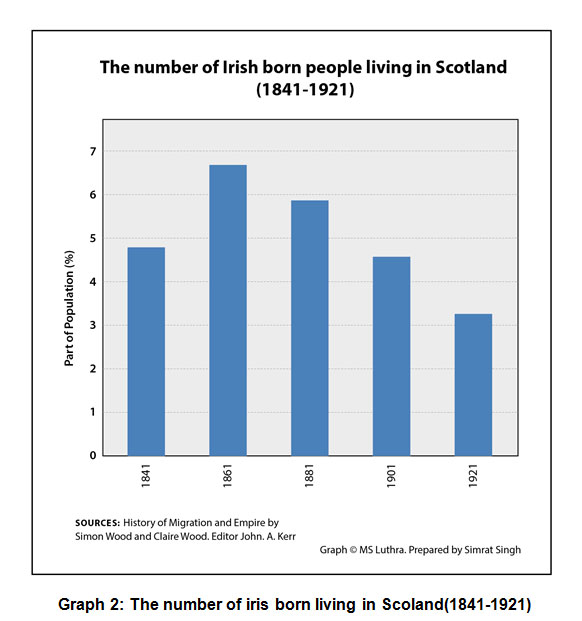 | Graph 2: The number of iris born living in Scoland(1841-1921) |
The Irish migrants were often prepared to work anywhere and helped build canals, railways, roads, bridges, and harbours of Glasgow’s much needed infrastructure for a speedy Industrial development. In some cases they worked for much lower wages than locals with employers often using them to break local strikes this together with the competition in the very poor quality housing rental market, often caused resentment and tension with local Glaswegians.
Despite all the challenges there were many Irish success stories. For instance a Mr Lipton born in 1850 America. The son of Irish immigrants, opened his first grocer’s shop in Glasgow and became a millionaire by the age of 30 by revolutionising the retail grocery chain model with novel marketing techniques. He also owned tea plantations (hence Lipton Tea) and organised the ‘first World Cup’ in football in 1909.
Prior to World War I Glasgow was losing a substantial proportion of skilled workers and part of its better- off populations to out- migration. In the early 1910s almost half of adult male emigrants from Scotland described themselves as skilled, compared with 36% of those from the rest of the UK. Just under one third categorised themselves as labourers most preferring to emigrate to Canada, Australia and the USA, while skilled and middle class workers tended to favour South Africa.6 Many of these emigrants were doctors, merchants and farmers. Subsequently Highlands landless peasants, Lowlands unemployed craftsmen, labourers and small farmers followed, too often aided by assisted fares. The British empire also gave an economic escape route to the Irish as it did to the Scots often labelled as the managers of the Empire. Glasgow had been receiving its share of the poor migrants from the Highlands too who ended up living in its overcrowded poor-quality city tenements. The exodus helped to ease the housing pressure on the city a little.
Post World War II new companies arrived on the scene, usually of foreign ownership, adopting more non-sectarian recruitment policies. Nevertheless, the school in which one studied and the name of the individual remained clues for continued discrimination. Ulster Protestant arrivals found it much easier to be accepted given their historical roots and family connections and having the same religion but also brought with them the baggage of sectarianism. Their children were able to attend the same schools as the local children and they faced a lot less discrimination, than their Catholic counterparts. Whilst all Irish immigrants often faced the challenge of affording school fees, Irish Catholics soon discovered available Protestant Parish and Council schools were not inclusive of Catholic faith teachings. The Catholic Church eventually was able to build Catholic schools which were often well reviewed by independent inspectors for their offering of quality broad education. In 1918 Catholic schools were brought under municipal control with the Church keeping control of the curriculum and of teachers’ recruitment.
Unlike Belfast, Glasgow remained relatively successful in containing sectarian animosity and absorbing the Irish immigrants. Here, our image of the Irish in Glasgow becomes more one of stability amidst hostility rather than that of overt and open conflict. Nevertheless, Catholics of Irish extraction still faced discrimination, when competing for skilled occupations in shipyards and engineering works, the educated ones wanting subsequently to enter the growing white- collar public sector.
A section of the Irish population in Glasgow, although poor earlier on arrival, did eventually manage to establish themselves as entrepreneurs and contractors in some sectors. For instance, some became pawnbrokers, ran betting shops, others became small landowners and hoteliers, as well as pub owners (Gallagher T1987), contractors and builders. By the mid- twentieth century many second and third generation Scots of Irish extraction became educated and moved out of traditional unskilled work or became tradesmen, businessmen and professionals. Discrimination continued well into the eighties, perhaps mostly in recruitment and at work as a matter of general perception at least, as I was informed by many people when I worked there in the eighties. Many Irish doctors, nurses and health workers also migrated from Ireland in the post- war period to work in the UK’s NHS, an important contribution that warrants more study and recognition. It is interesting to note that the Irish, despite being part of the woollen and cotton industry, did not go on to develop enterprise in this arena.
The Jewish Communities
Early records of Jewish presence in Glasgow can be traced back to 1812 onwards with most originating from Germany and Holland. They were often urbane with commercial backgrounds attracted probably to the city’s rapidly developing commerce base. They established a Synagogue and secured a burial ground by 1835. By 1850 they numbered 200 and focused on shop- keeping and commerce for their living. Three decades later a Glasgow Hebrew Congregation was built in Garnethill in 1879 followed by two others in the south side.7 The figure increased to around 1500 –2000 by the mid-eighties as Russian persecutions led to further arrival of Jews and their settlement in Gorbals, alongside Irish and Italians.
By 1915 the Jewish Yearbook put the number of Jews in Glasgow at around seven thousand following new comer’s mostly orthodox scholars, merchants and trained tailors all fleeing persecution in Russia and Poland .They also came from countries in central and Eastern Europe. Other smaller numbers had arrived from Germany and Austria-Hungary, while some had Bulgarian and Turkish nationalities. There is a view that this group was relatively poorer as compared to the pre- 1850 urbane, somewhat better off, arrivals.
Before the 1880s in the Jewish community’s economy a small group of wealthy merchants and manufacturers and people involved in commerce stood at the top of the hierarchy , unlike in England, they were rarely involved in finance. The second identifiable layer was a larger group of shopkeepers, wholesalers, and craft manufacturers. Occasionally some were able to make it into the top echelon but could also slip to the bottom of the pile during economic depressions. The third layer of this hierarchy were numerous small retailers, hawkers, workshop owners and workers, probably half of these working for fellow Jews They were frequently joined by newcomers or by those who fell out of the second group. Right at the bottom were the most deprived, who often relied on Jewish charity, which remained stretched during most part of their history.
In his book, Collins notes the occupational profile of the mostly second and third tier Gorbals’ (see 1951 Map in the Appendix ) Jewish residents in 1881. Out of a total of 76 heads of households (which could be a family head or an independent person), most worked in the clothing industry and retail or were hawkers, some as picture frame makers, jewellers, glaziers, joiners, and shopkeepers. The Census (1814) suggests that almost half of all Jews in the Gorbals pre-1881 residents were still living there in 1891. Most were in drapery, hawkers, and tailors.
To avoid the persecution of the Russian Empire in the 1880s, many Jews migrated to Glasgow and settled in the pre-established base of a Jewish community in Gorbals, alongside Irish and Italian immigrants. Russian Jews tended to come from the west of the empire, in particular Lithuania and Poland, hoping to use Glasgow as a stopping post on-route to North America. Unable to afford further fare many settled in the city. In 1897, after the influx, the Jewish population of Glasgow was estimated to be around 4,000 increasing to 6,500 in 1902. Many of the newcomers, who settled in the Gorbals district, were tailors or furriers.8 A census in 1891 recorded that half of all the Jewish immigrants in the Gorbals were working in the clothing industry, mostly as hawkers, tailors or shopkeepers catering for the local population and expanding their reach into the rest of the city. Unable to afford further fare many settled in the city. In 1897, after the influx, the Jewish population of Glasgow was estimated to be around 4,000 increasing to 6,500 in 1902. Many of the newcomers, who settled in the Gorbals district, were tailors or furriers.8 A census in 1891 recorded that half of all the Jewish immigrants in the Gorbals were working in the clothing industry, mostly as hawkers, tailors or shopkeepers catering for the local population and expanding their reach into the rest of the city.
The older established Jewish settlers assisted new arrivals in a benevolent way. The new arrivals spoke Yiddish or Polish and were of diverse nationalities and were often subjected to vilifying censuring comments by the press for their sharp practices and odd behaviours (Malony .P .2016 p126 ).
The Commercial Directory of Jews in Great Britain of 1894 provided an indication of the rising middle class made up of workshop owners and shopkeepers living in the Gorbals. Less than half of those who had businesses address in the city were situated on the South Side of Glasgow, a traditional immigrant quarter in the old city centre (near the High Street) and Blythswood, an eighth in the new city centre (Buchanan Street Sauchiehall Street) and another eighth further into the West End, including areas such as Cowcadens and Hillhead. The 109 registered businesses were active in 117 occupations, including 53 in retail and small specialist manufacturing (of which 17 were watchmakers, opticians, and jewellers and 7 tobacconists), 48 in the clothing industry and retail.
Some of those who became high profile included Goldberg & Sons founded in 1908 by Bill Goldberg, a Jewish immigrant from Eastern Europe. It is one of only three Scottish-based retailers still quoted on the Stock Exchange. The family were deeply involved as local leaders and innovators in key educational and welfare organisations. Another was Bloch Brothers (Distillers) who founded Bloch Brothers (Distillers) Ltd. in Glasgow which used to produce ‘Ambassador’ premier whisky in the nineteen fifties. Bloch was a vocal leader of the Glasgow community and a major philanthropist. (Collins Kenneth E 2008)
The Jewish Representative Council was formed early in 1914 in Glasgow at a time when occupations were concentrated in the clothing, furniture, and retail trades, and where Jews were active as workers and owners. They were also important in their contribution to the cigarette and furniture industry in Glasgow.
Overall number of employed people declined during 1851-1861 (Graph 3) but increased three times to 1871 to five times in 1901 to dip again in 1901 for reasons unknown. As more Jewish people arrived in this period and they were mostly absorbed by the growing ethnic economy as it widened to other occupation sectors. An increase in tailoring due to the affordability of new clothes probably due to the cotton connection with empire was part of the persistent growth as was cigarette making as smoking demand escalated. However, its cottage industry probably faced challenges from the aggressive marketing of corporate tobacco companies this data also does not seem to record hawkers and peddlers or people in clothing trade and drapery trade unless these were included in another occupation which sustained itself well.
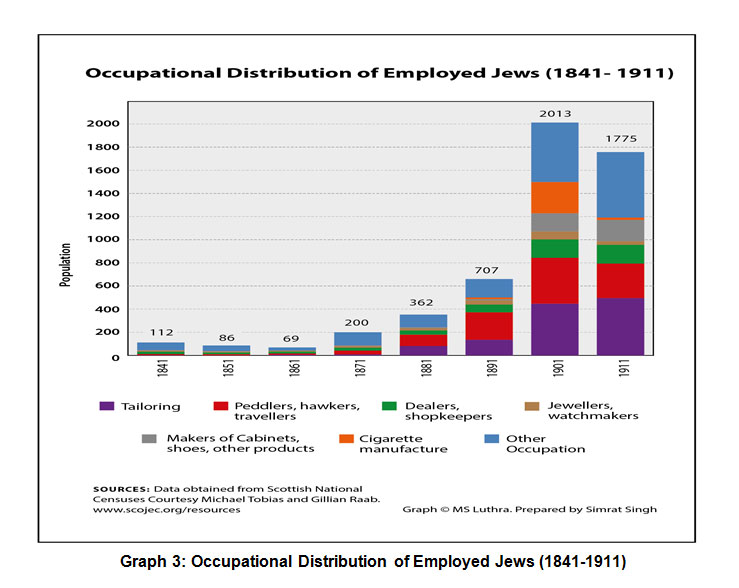 | Graph 3: Occupational Distribution of Employed Jews (1841-1911) |
Shop- keeping steadied as did peddling and hawking after 1891 as a direct high street sales culture evolved and specialist jewellers and watch making sector employment opportunities remained steady, being highly skilled, limited jobs sectors. Overall, the range of occupations in the ethnic economy appear to widen probably a sign of integration with the main economy as many other occupations appeared to attract whilst the older ones were discarded.
An established system of community welfare, which the older Jewish settlers in Glasgow had developed and later on the emergent immigrant middle classes adopted, assisted newcomers and unemployed workers to make use of the local commercial opportunities and gain an economically independent status. Meanwhile self-improvement zeal, relative financial stability and openings provided by the Scottish education system started to help young Jews to move into a professional occupation (Braber 2007 P78–97) while their children were rapidly moving into professions such as medicine and teaching being particularly popular with some other into mainstream commerce. Their socio-economic Integration into local society developed along several lines. From a small group of retailers, wholesalers, merchants and manufacturers in the old city centre and the West End, this commercial community grew to become a significant socially- mixed community living on the South Side of Glasgow and to a lesser extent in the West End.
The Garment and Clothing Trade
The clothing trade, a principal sector of Jewish enterprise economy, expanded and declined and was rescued by the demand for production of uniforms during the First World War. The post-war period departmental stores took over the retail role of wholesalers, new markets were identified and increasingly retail and manufacturing required larger capital investments advantaging larger factories’ survival.
Post 1920 price falls meant that wholesale clothing business suffered. Larger manufacturers however who expanded the outerwear trade with a factory production mode rather than workshop tailoring style of production with direct sales to larger retailers and department stores as well as Scottish Cooperative shops which supplied working class people with clothing did well too. The production section of outerwear industry grew many folds into the later 1930's in which Jewish hawking played a significant outlet role for the industry with flexible credit and payment facilities for the rising local upper working classes. Glasgow Jewry’s increased participation in manufacturing was well aided by large number of new arrivals at the turn of the 20th century, known as the machine- made textile period.
In the nineteen thirties the community’s economic pattern shifted somewhat back to commerce, exploiting Glasgow’s economic opportunities for small businesses and trades, and utilising traditional expertise and cumulative local experience and networks all aided by an established community- based welfare system and outreach sales system. In the period approaching the Second World War the growing economic confidence of the Jewish population supported an emerging generation of young Jews to enter a professional occupation aided by the Scottish education system.
The German Jews
The early first cohort of Jewish settlers who mostly arrived in 1820s were mostly German and Dutch and well-heeled urbanites. The refugee German Jews who arrived in 1939 have been described by KoImel (Kolemel A 1979 pp. 55-84). About a thousand came to Glasgow fleeing the insecurity and intimidations of pre-Holocaust Germany. They found it difficult to adjust to their new environment and they largely remained outsiders with uneasy relations with the existing Jewish community primarily due to cultural differences. At first reluctant to assist them, established Jews in Glasgow, along with local trade unions, nevertheless did, to ease their settlement.
Social Mobility and Integration
The primacy given to learning and a doorstep quality provision of Scottish education system including private schools helped many young Jews to enter higher education and enter a professional occupation. The clothing industry in 1939 still had a large enough contingent of the Jewish ageing workforce which stagnated socially whilst some remained poor. Many young Jews were able to choose higher education, benefiting from the opportunities offered by the well-developed and respected Scottish education system. Unlike English cities in the absence of a Jewish school in Glasgow during 1881 and 1939 the well-heeled Jewish immigrant children studied in public schools assisting their integration into the local middle and upper middle classes and widening a cultural gap between the first and second generation acculturation. As stated before community welfare assisted newcomers and unemployed workers to make use of the local commercial opportunities and gain an economic foot hold and rise speedily, although not all made it.
Taking a summative overview from 1880 to 1939, the Jewish immigrant occupational profile in Glasgow remained significantly concentrated in the clothing and furniture trades. From a largely commercially occupied group before 1880, Glasgow Jewry as a section moved into manufacturing at the end of the century, but after the First World War the patterns seem to have shifted somewhat back to commerce despite post- war economic growth. Why this manufacturing disappeared requires further research.
Members of the Jewish communities tended not to be employed in banks or in government jobs in a growing public sector (Graph6). This continued into the 1930s. Free from persecution, the Jewish community in Glasgow prospered and made an economic and civic contribution to city life particularly in the legal, accountancy and education professions.
Jewish intellectuals played a significant role in the development of the local labour movement too despite their commercial orientation. Manny Shinwell was a leading figure in the Labour Party for more than sixty years. Prominent contributors included Sir Maurice Bloch, Sir Isaac Wolfson, Sir Ian M. Heilbron, Sir Myer Galpern (b. 1903, Lord Provost and Lord Lieutenant of Scotland (1958--60) and labour M. P. (1959), Samuel Krantz (b. 1901) and L.H. Daiches Noah Morris (Professor of Medicine) and many more academics.
The early 19th century urban Jewry established assistance institutions helped the disadvantaged, more diverse, non- English speaking new comers as well as the pre -Second World War German Jews. Unlike the Irish they had a different religion, language and culture to their hosts yet a significant section had a commercial and entrepreneurial back ground and skill set more relevant to the growing commercial dimension of the local economy as well as long established peddler/hawking sales systems. They were able to cope with economic fluctuations partly but significantly by growing the Jewish economy as a cushion for the new arrivals. They also assisted with repatriations to keep their number low to avoid antagonising the local population. The hawkers at times came under pressure from locals and suffered vilification regarding their business practices and had to endure legal exclusion from entry into government jobs and general antisemitism.
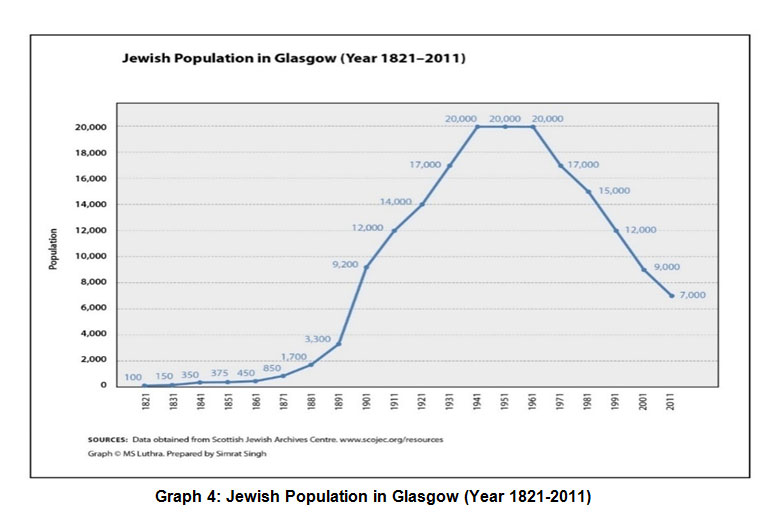 | Graph 4: Jewish Population in Glasgow (Year 1821-2011) |
The evolution of a community-based welfare system meant less reliance on poor relief and state handouts reducing the scope for inflamed local nativist feelings of arrivals living off the state. Being able to network and articulate issues of concern through their institutions, community papers and participating in local institutions- all helped seek concessions for their community. Unlike the Irish they were not competing with the local workforce. The story of what happened to the spawned tobacco, alcohol and textile industry needs further research as does the follow up on the modes of assimilation and integration of post- 1880 and pre -1880 Jewry.
The post nineteen fifties decline of the Jewish population (Graph 4) is probably and mostly down to the demise of the ethnic economy, second generation emigration to Israel or the Americas and third generation migration to the South of England or to the USA and Canada as well as by virtue of increasing intermarriage with non-Jews and general secularisation (over one third of Scots are unaffiliated) affecting their recorded self-identity.
The third generation appears to have totally exited the old enterprise model of the Jewish economy over time mostly entering the professions or skilled occupations. Taking all three generations together those who, according to the 2001 census, identified themselves as Jewish were recorded to be overrepresented in the three top socio-economic groups in terms of jobs, for owning detached quality housing as well as being in higher education and least represented in the lower rungs.
The Italians
Scots-Italians' history can be traced back to the mass migrations of the late 1800s, most probably the 1880s, from six key areas of Southern Italy : Tuscany where they fled famine, corruption, and a crippling economy and the disastrous agricultural condition of their homeland; Province of Lucca –in particular Barga and Garfagnana; Lazio, mainly from the Province of Frosinone –significantly Picinisco; Molise, mainly from the Province of Isernia; Ligure, primarily from the Province of La Spezia); postwar, they originated from Campania; Valdotaro and Borgotaro (mainly from the Province Parma).10
The first to arrive in Glasgow and form a contingent were immigrants from the Ciociaria district as Sereni Bruno(1974-They took the low Road Barga) asserts in a brief history of Italian immigration from Barga to Scotland. In early 1900 one successful entrepreneur, Leopoldo Giuliani, owned a chain of twenty shops and held an interest in at least sixty. He helped many youths from Bargato to come and work for him as many aspired to eventually own a business one day. Indeed, many did manage to do so often mentored and stepped up by their employers. Hence, thereafter, the chain migration continued for some time.
The influx of Italian immigrants also rose further in Glasgow when America modified its immigration policy and restricted entry to many of the poorest Europeans in 1924. Most were economic migrants as poverty and famine were widespread with sluggish industrialisation of agriculture in the South unlike northern Italy. By the early 1900s Italian immigrants were becoming more successful as their businesses, mostly in the shop keeping and catering industry, flourished.11
Early settlers were mostly statue makers and small salesmen who often arrived with a stop- over in London. On arrival they would sell their goods in the ports anything from little statuettes to blocks of ice. Many settled in the port cities of Glasgow, Greenock and Edinburgh, subsequently opening shops and selling dairy ice cream to the working classes in areas such as Garnethill and Paisley. In the beginning the ice cream was served direct from the barrows with loud calls of "Gelati, ecco un poco". Consequently, they acquired the name as the 'HokeyPokey' boys.
From Ice Cream Cart to Cafe to a Restaurant
It was the Ciociari12 who is thought to have laid the foundations for what was later to become Scotland's flourishing ice-cream industry. The necessity to earn more than could be put together by street music itinerant musicians graduated into itinerant ice-cream salesmen. In summer they sold ice-cream in carts at main public parks.
In the 1900s ice cream may well have been perceived to be undermining the work ethic of the city which had established itself as 'the Workshop of the World'. The ice cream shop invented the template for catering for a new form of youthful clientele. Police records show some 336 ice cream shops were in existence by 1905, mostly low-cost shops in the slum quarters. Some Italians diversified into the fish and chip business.
With the abundance of dairy produce and seafood ice cream-serving or Fish 'n Chip shops soon began to multiply, with some turning into cafes. Police records show the number of cafes in Glasgow alone had doubled by 1904. In 1906 the British Women's Temperance Association campaigned against the Sunday trading of ice cream parlours in Scotland. These shops which provided an exotic luxury had overtones of the forbidden. Their very 'foreignness' or exotic aspect of the product was exhilarating to customers as Margaret Visser has noted. It is a food which suggests festivity - a break from work - a saturnalian dish.
Migrants from Barga (Lucca province) settled predominantly in Glasgow and Paisley where they formed the largest contingent of Italians. By 1910, one successful entrepreneur or padrone, Leopoldo Giuliani, owned twenty shops and had interests in at least sixty. To run and staff his shops, he brought over many youths from Barga who hoped to open their own business one day. Many succeeded, and so the chain migration continued.
These outlets gradually expanded into cafes, sometimes offering full meals with confectionery and cigarettes added to the menu. By 1920, with initiative a significant number of such businesses had moved to more presentable establishments including some on the main high Sauchiehall Street as well as the city centre. They remained totally dominant in these markets by 1931 (Colpi 2013). Those with a background in crafts became elite entrepreneurs focusing on sculpture and furniture making. Others clustered into the restaurant and the wholesale and retail trade.
In 1915, when Italy joined the First World War, 8,500 Italian males went back to Italy to serve their country of origin. Italy and Britain being allies, they also served in the British armed forces. A sizeable Italian community base had evolved, over 4,000 strong in Glasgow, becoming the third largest community cluster in Great Britain. The Italians initially settled in areas like the Gorbals in Glasgow but over a shorter period became spatially diffused across Glasgow and Scotland. Indigenous shopkeepers felt insecure by the speedy success of Italian business growth in Glasgow based partly on chain immigration. Britain’s Aliens Registration Act of 1919 and Aliens Order of 1920 restricted further immigration by requiring pre-arranged work permits and police registration. The Fascist Party in Italy also passed laws limiting emigration. Between 1920 and 1940, around 5,000 Italians lived in Scotland with most in Glasgow.
A large percentage of Italians in Scotland including Glasgow in the 1930s had registered as Fascist Party members encouraged by Mussolini. Italy's subsequent involvement in World War II brought Italians many hardships. Mussolini fostered clubs in Glasgow influencing not only political but all associational and social activity within the Italian community. British security services monitored them to assess the perceived categories of the ‘enemy within’.
By this time, the Italians had consolidated their niche business activity. Almost every town hosted at least one Italian family in ice cream or fish and chips. Despite their economic success, Italians experienced prejudice, marginalisation, and social isolation. Their ‘otherness’ was based on attributing to them an inferior stereotype of their religion, language and cultural traits and their religious affiliation to Rome ie the papacy. These dislikes got heightened post Churchill’s edict in 1940 on the declaration of war “collar the lot” which led to the arrest and internment of Italian adult active males mainly on the Isle of Man. British authorities had to disentangle Italian subgroups and the associated security risks, those who were over 60 or under 20, British-born and the naturalised ,Italian diplomats etc. for the purpose of establishing security risks or to develop ‘dangerous characters’ ‘with a view to interning or deporting them. Some were even sent to Australia and Canada. Hundreds died when the ship they were on, the Arandora Star, was attacked by a German U-boat in July 1940-a deeply sorrowful event for the community. Remaining family members of the interned were left to run dilapidated premises and to tackle businesses challenges and to cope with mistrust and persecution. Business premises were vandalized, and many had to be rebuilt following the end of the war.13
An analysis of the internment record card index held in the National Archives indicates that one fifth of those interned experienced severe emotional distress through enforced separation from their families and also suffered substantial economic losses. Often friends, customers and neighbours attacked the Italians’ shops and businesses, fundamentally undermining their sense of belonging. Ugloni notes (Ugloni Wendy 2011) that women bore the brunt of racial hostility on the ‘home front’ having to run family businesses in protected areas and the slightly older age cohort who entered war related work. Only second- generation women, as British subjects, were permitted to stay in their homes. They took on the burden of familial responsibilities (Ugloni Wendy 2011).
The Italian immigrants unlike the Jews appear to have dispersed away from Gorbals in a shorter period probably and principally to acquire cheaper business premises further afield and to live near these to minimise competition with each other. The ice cream wars as they were known in the folklore erupted now and then as the ice cream business sector became saturated. So diversification into cafés became the next step in many cases. Once the cafes were fully operational, it was expected that all family members contribute. The business would often recruit young Italians, from their home village or in the extended family. Once settled in turn they would eventually start their own businesses. Italians also helped build many civic buildings including the magnificent Town Hall.
Over a period, cafes became focal points especially for the younger generation, an alternative to pubs. Unlike their English counterparts they also traded on Sundays as they did not sell alcohol (Macke Franko 1991). The police and local shopkeepers’ associations and religious bodies such as the Temperance Association became allied in submitting evidence to the Parliamentary subcommittee asking for restrictions on opening times and on including gambling machines use, and accused them of encouraging teenage dancing, late staying and youths’ permissive behaviour.
This view was challenged by the theatre group’s chairman who thought the ice cream and cafes were essential for a huge number of people coming out of the theatres in the evening to be able go for refreshments and conclude the evening. Despite this In the Herald a Mr D. Drummond described them as: 'perfect iniquities of hell itself and ten times worse than any of the evils of the public-house... sapping the morals of the youth of Scotland.'14 They were eventually approved by the Temperance Movement in the 1920s.The Italians also set up their own temperance group to fight against possible Sunday trading and other late evening restrictions.
As Colpi (Colp Terri2013) points out Scotland received limited number of Italian immigrants in the post -war era unlike the South of the UK. By the 1970s its proportion of the national total of people born in Italy had dropped to five per cent (Colpi Terri 2013) although this data left out UK -born second generation populations. Those who did arrive were again mostly recruited through ‘chain migration’ coming from the old origins areas to work in the traditional established sector. These subsequent arrivals, together with the Italian Prisoners of War who decided to remain in Scotland after the War, did, however, inject some fresh transforming ideas into the Italian ethnic economy. The dawn of the pizzeria and the trattoria further strengthened the catering aspect of the ethnic economy.
By 1955 as shown in Table1, leaving aside the Jewish community, Italians had established themselves as business owners with a specialism in the restaurant sector and personal services as the never had it so good Sixties consumer and promiscuous culture of the UK eroded the Presbyterian and Calvinistic tendencies of self-denial of the local populations. Many migrants had a strong yearning to earn and build a house back home and South Italy was developing too. We are undertaking some further work to check the diversity of the occupational profile from archives as it seems too narrow, those who were general shopkeepers and those in hairdressing seems to be undercounted.
By the early 1980s back in Italy the Italian political and diasporic policy approach was also changing in regard to Italians abroad. They were permitted to vote for Italian delegates to the European parliament giving legitimacy to leaders to carry out works for community building initiatives such as Italian language teaching, or towards maintenance of ethnic identity. Italian communities across Britain, including Scotland, were again connected to Italy and italianità, italianness, embracing Italian identity to connect with modern Italy, its design, fashion, arts and high culture strengths pioneered by those 3rd generation Scottish Italians ( ColpiTerri 2013 )
Ice cream and Pizza continue to keep an important place in the Scottish leisure and taste landscape despite the poor weather most of the year around. No longer deemed as the official headquarters of lustful teenagers, cafés who serve these products are still opening. Some of the descendants of traditional families still operate often with innovation in modern recipes and flavour combinations to cater for the new generations used to a wider range of products. Many families passed on craft skills to the next generation. Most Italians began abandoning their marry your own notions by the 1940's and often married the members of the of the local rising upper working classes eventually getting absorbed into the main populations but keeping their identity as business owner and culture and life style.
The Poles
There was a small Polish intellectual nucleus settlement in Scotland in the mid- nineteen century. After the defeat of the 1830-31 `Powstanie Listopadowe' (the November Rising) in Poland some members of the `Wielka Emigracja' decided to settle in Scotland. Next, following the defeat of the 1863-64 `Powstanie Styczniowe' (the January Rising) some people migrated to Scotland as voluntary exiles with both economic and political freedom motivations. and sought to work for the liberation of Poland and became known as the 'Wielka Emigracja' because of their generally distinguished social status. They were attracted to the reputation of the 18th century 'Scottish Enlightenment' and its wellrespected higher education institutions.
Most of the Polish men (many ethnic Lithuanians) who came after 1860 were Catholics who found employment in either coalmining or the iron and steel industries mostly in Lanarkshire. There they encountered the opposition of the unionised labour movement as well as experiencing anti-Catholic sentiment. Post the Great War in 1914 they continued to arrive in Scotland to work in building works and in factories mostly as unskilled workers. Polish communities established themselves in villages and towns in Ayrshire and Lanarkshire, as well as in Glasgow. There was an almost three times increase to around 22,000 in the number of foreigners made up of Italians, Russian and Poles, who by 1911 formed the largest group in Scotland along with the Russians.
By 1921 the Scottish Polish population went down to one fourth the original level in 1911 for those both working in mining and metals- the mystery as to why it returned to the pre-19th century demographic profile remains unresearched. By the 1940s they had become quite `assimilated' into Scottish society.
The next major wave arrived during World War II when tens of thousands of Poles were stationed in Scotland. Polish tanks could be seen in Scotland and Polish flight squadrons joined the air war. The Polish Navy also fought alongside the Royal Navy and its destroyers defended the Clyde shipyards -against the Nazi bombers. Around 10,000 Poles stayed in Scotland after WW II.
During 1945 and 1951 the Polish community in Scotland established itself against a background of increasing political terror and oppression in Poland and initial local opposition in many parts of Scotland to their proposed settlement as locals did not grasp that Poland was in Soviet control. The post-war economy needed workers and Britain felt indebted to the Poles for their war effort. Some 30,000 Polish civilians had been admitted to Britain during this period on compassionate grounds, some as part of the Distressed Relatives Schemes or European Volunteer Workers scheme, or on the basis of other circumstances, such as marriage to British subjects. To make provision for the welfare, education and employment of the Polish servicemen, their families and dependants, and other civilian refugees, the Interim Treasury Committee had to be reformed in the interests of administrative efficiency.15
After nearly six years of war, with rationing, restrictions on the free movement of labour and restrictions regarding free collective bargaining and the right to strike, many Trades Unions regarded the proposed settlement of a large number of Poles as threatening employment, housing and food supplies. At the annual Trades Union Congress, held at Brighton in October, 1946, the question of Polish resettlement was thoroughly debated (Kernberg Thesis). On 5 February, 1946, in a Written Answer, the Secretary of State for War, John J. Lawson, stated: (Kernberg Thesis p.165).
''There are 47,362 Polish soldiers served in Scotland. This figure includes 654 members of the Polish Women's Forces. Approximately 28,500 Polish soldiers now in Scotland are known to have served in the German army or Todt organisation, into which the great majority had been compulsorily enlisted. 166 had volunteered for service in the Allied Forces before the German capitulation. ‘Some Scottish trade unionists and people sympathetic towards the Union regarded the servicemen of the Second Corps as 'Fascists and Jew-baiters' who would be paid either to live 'in idleness' or to compete for Scots' jobs. Speech on 6 June 1946, in the House of Commons by J.H. Hoy, the Labour M.P. for Leith.’
On 20 February, 1947, in reply to Mr. Molson, the following Written Answer was given by George A. Isaacs, the Minister of Labour and National Service: 'Poles claiming mining experience were interviewed in Scotland last June by officers of the Ministry of Fuel and Power and 200 of these were willing to consider employment in the mines and were classified as suitable, a number of whom subsequently decided to return to Poland or to emigrate. At that time, however, the industry had not agreed to accept Poles for work in the mines. Agreement in principle was only recently secured subject to further consultation and agreement on detail. This has now been achieved.' (Kernberg Thesis page 171)
To employ Poles and to minimise opposition from the trades unions, the Labour government instituted a policy of controlled resettlement through the Polish Resettlement Corps, and the European Volunteer Workers scheme. Polish servicemen accountable to the British army and their dependants filled the manpower gap for essential undermanned industries, such as agriculture, coalmining, textiles, and the building trades. Polish service personnel who refused to return to Poland from their service areas were demobilised into civilian life too.
An Army Estimate for 1948-49, published on 25 February, indicated that about 30,000 Polish troops were serving in garrisons in the United Kingdom and Europe. Of the total strength of 100,000 resettled men and women 50 percent had found jobs in agriculture and industry, around ten percent had been repatriated to Poland, and five percent had emigrated to other countries, leaving some 30,000 in the United Kingdom still to be resettled ( Kerberg T:1990: 184).
By 1951 a significant base for this newly arrived Polish community in Scotland had been formed with the evolution of their own institutions and organisations to replace the wartime `support society'. The majority of Poles in Scotland settled in areas with good employment opportunities. Between 1951 and 1961 the Polish community in Scotland became permanently established with major centres of settlement in Edinburgh, Glasgow, and Dundee, and gave up the notion some had to return to a liberated homeland. Most Poles were `assimilated' into Scottish society through marriage to Scottish women and to a lesser extent isolation from fellow Poles. They evolved Polish centres in Scotland with some new active organisations run by younger Poles in Glasgow.
The Germans
Germans arrived In Glasgow around the 1870s. In Glasgow business circles’ access to business and employment was often facilitated through family links and quality professional training often arranged in Germany. In commerce, individual Germans led the way and were well respected. Among them was chemicals merchant Paul Rottenburg who headed Leisler, Bock & Co. and was Chairman of the Deutscher Verein from 1893 to 1913 and became President of the Glasgow Chamber of Commerce in 1896–1897 and a member of the Conservative Club. He was remembered as ‘one of the most devoted and loyal of citizens. Apart from Rottenburg, few German migrants or their descendants seem to have been active in politics in pre-war Glasgow unlike the Jews who had a longer establishment period. For instance, in 1883 a Jewish businessman Michael Simons was elected as councillor of the City of Glasgow and he became a leading local politician.20Glasgow Herald, 2 Nov. 1883, 7 Nov. 1883; the Bailie, 7 Nov. 1883, 8 May 1901.
In the 1890s, when the organised activity of the German population in Glasgow reached its peak, most were usually members of the Deutscher Verein or Deutscher Klub, There were two German evangelical congregations; the larger of the two was affiliated to the Prussian state church. Their congregations had links with Protestant churches of Scotland but did not form part of the Church of Scotland. As with the Jews (a section of which supported Zionist activity), the Glasgow branch of the nationalistic Deutscher Flottenverein supported Germany’s naval programme through financial donations.
There was no German umbrella organisation in Glasgow possibly due to lack of ethnic coherence as most came from a wide range of cities and towns in the German Empire. The 1911 Census registered 561 German nationals in the city. The total German group was larger if naturalised Germans (109 according to the Census) and descendants born in Britain are taken into account (Braber: 2009). In addition, the 1911 Census enumerators registered 282 persons from the Austrian-Hungarian Empire, including many German speakers among them. It noted 132 German waiters and 76 wigmakers and hairdressers in Scotland.17 The German butcher was also a familiar sight in several Scottish towns and the presence of many German seamen merchants, clerks, craftsmen, restaurant workers, retailers and musicians was also noted.
The First World War had a devastating effect on the German migrant populations as they got classified as enemy aliens, hence were registered, interned, repatriated, suffered verbal abuse and physical attacks. Their property was confiscated, and they were prohibited from areas..18 Saunders (Saunders 1985 4 pp 5-27), suggested that aliens already had a pre-war troublesome relationship with the native population before 1914 which was further complicated by the war. Panyi( 1991) expanding on this concludes that the destruction of German communities in Britain was a result of a combination of popular hostility and largely consequent upon government policy and animosity towards aliens which was only one aspect of the general intolerance that gripped Britain during the war.
Braber(2009) concluded that Germans in Glasgow were not successful in countering official punitive measures and local prejudice as they were hampered by a lack of political influence and coherence and being geographically widely distributed. Local German business leaders proved ineffective in the hostile wartime climate. Internal diversity also aided the decline of the German community in Glasgow. Furthermore, German associations had a social, religious, or political character, but they lacked a strong unifying institution that could have taken up their cause.
Alluding to the rioting involving the Germans in Greenock Barber suggests that it may have been prevented by the police, but viewed in a wider context it also appears as if in Glasgow the urge to strike out against Germans was processed through public debate hence no such rioting took place in Glasgow . However, newly arrived Belgian refugees at the same time also occupied public debate space as did a local rent strike deflecting attention. Panayi describes riots in Greenock but does not ask the question why these riots did not occur in Glasgow unlike the Northern English cities such as Liverpool and Manchester. She stated that the state lost its ability to protect the Germans, many British communities were cleansed of what was regarded as an unwanted alien presence although she omits Glasgow from her review.19
There was some public support for the Germans in Glasgow, but they did not enjoy the level of sympathy expressed for Belgian refugees, and even those who spoke out on behalf of local Germans met local hostility. Yarrow and Gullace (1990 pp. 97–81) point out that the Germans were not simply helpless victims but were able to organise themselves to provide each other with financial and moral support, sometimes with the assistance of a small number of British sympathisers.
The German community of Glasgow city virtually disappeared; its institutions’ communal life has left little trace for reasons unknown.20 The First World internment was a painful experience. Beginning with the incarceration of soldiers, the scale of the conflict and the size of the armies involved meant that the issue of prisoners of war surfaced in a new manner. Britain essentially carried out ethnic cleansing during the First World War engaging in major incarceration of German males.
The Lithuanians
Lithuanians who came to Britain from the pre- 1917 Russian-controlled empire were mostly Roman Catholics who had been oppressed and their language and literature was forbidden in schools. they were also forced to pay heavy taxes by the Czars and were coerced into accepting the Russian Orthodox Church. They also faced conscription into the Russian army. Some were freedom fighters, some were Jews, all fleeing persecution; most were escaping poverty.
During the early 1890s a severe famine forced a quarter of the population of Lithuania to emigrate. Most desired to reach America, others arrived at the port of Leith in Edinburgh and stayed, with a significant number finding a further fare to America unaffordable. Jewish Lithuanians settled in the poor area of Gorbals in Glasgow, a starting point for most migrants. The Lithuanians of Catholic persuasion sought jobs in coal mining and iron works areas such as Lanarkshire. An estimate is that around 5,000 -6,000 Lithuanians settled in Scotland in the late 19th and early 20th Centuries. Many Scots had no idea where Lithuania was and usually referred to Lithuanians as Poles.
At first Lithuanian workers were not welcomed on account of willingness to work for lower wages than the locals. Indeed, some Scottish iron and steel companies such as Bairds and Dixons recruited Lithuanians as low cost labour to work in its coal mines. Employers also in some cases employed them to break union strikes. The Ayrshire Miners Union leader, Keir Hardie, wanted Lithuanian coal miners to be fired because of their poor English which was regarded as dangerous when working underground.
Apart from wage competition as most Lithuanians were Catholic there was sectarian hostility too. Over time however relations improved and many of the Lithuanian coal miners joined the Scottish miners in fighting for improved conditions. Lithuanian priests in Catholic churches helped to preserve a sense of Lithuanian identity in terms of language, culture, food and even furnishings in home settings were all Lithuanian. Some communities established clubs and societies and even a Lithuanian orchestra. From 1904 to 1911 a Lithuanian newspaper was published in Scotland. Knox (XX) has written a short very lucid account of the Lithuanians (as he did for the Irish)how they were perceived to be dirty and their drinking, habits often associated with long durations weddings and festivities ans consequently were despised by fellow miners.
In WWI Lithuanians refused to join the British Army. Instead 900 men joined the Russian army never to return. During WW1, the Aliens Restrictions Act immigration ended and the post -war dip in employment in the 1920s and 1930s led to heightened hostility against new arrivals. Many Lithuanians altered and localised their names to disguise their identity and improve their chances of accessing employment.
National Archives reveal government and police concerns over socialist tendencies among Lithuanians in wartime influenced the decision not to exempt Lithuanian miners from military service. A Home Office memorandum of August 1917 noted: The great majority, if not practically all the miners of military age have elected for Russia: in the belief, according to the police, that they will somehow or other evade service there. The Chief Constable of Glasgow says of the 500 Lithuanians in Glasgow that they are all regarded as Socialists or revolutionaries.21
The proclamation of Lithuanian independence in December 1917 and the signing of the Brest– Litovsk peace treaty with Germany 1918 left many Lithuanian soldiers who had gone there to fight stranded in Russia with their families unsupported in Glasgow since those who could not prove they had fought alongside the Allies were not allowed back (Jenkinson Jacqueline 2016), In this situation of enforced absence of adult males, many of their families were faced with destitution. Lithuanian women had to take on brick making and work as surface workers in the mines to augment the dwindling family income. Lithuanian families did however receive trade union and left-wing political support.
As to the government’s financial assistance to the impoverished families of those who were deemed to have fought with the enemy, their case for local poor relief was not accepted at first but granted grudgingly in 1918. Lithuanian families formed part of the celebrated ‘speech from the dock’ by John Maclean, Glasgow teacher and Marxist member of the British Socialist Party, in Edinburgh on 9 May 1918 following his arrest for sedition the previous month. He blamed their suffering on the central government decision to ‘send Russian subjects back to Russia to fight’ and the inadequacy of the government aid to distressed families which also placed a burden on local authorities to find replacement housing for those Lithuanian dependants who were evicted.
With a semi-official policy of anti-Catholic discrimination, the "Poles" as they were universally known were all but systemically arm-twisted to integrate. A few had their names changed to something that their bosses found easier to spell, but many others preferred to choose their own disguise.
Today there are few traces of Lithuanian culture remaining in Scotland. Nobody really knows how many of their grandchildren are still here, calling themselves by local names. The old mining communities splintered, and many moved to interwar housing. Marriage with Scots became common. Children attended local schools and the Lithuanian language died out.
The Belgian Refugees
During the First World War Scotland housed around 20,000 Belgian refugees constituting eight to ten per cent of Britain’s wartime Belgian refugee population who arrived following the German invasion in August 1914. Arriving as victims of Nazism in distressed anxious states they got a warm public reception in the early pre-war-casualties period. In early 1914 the first large group of 3,000 refugee arrivals were met with dispersal and their accommodation arrangements made by a hurriedly established committee of local magistrates in Glasgow. The refugees’ committee travelled all round drumming up support for the plight of refugees and raising funds. Other cities helped with their cost of living in designated hostels in Glasgow.
Despite the initial welcome and long-term humanitarian commitment, local authorities remained concerned as they felt the new arrivals had the potential to drive down wages. Minutes of Glasgow Corporation meeting in November 1914 noted that refugee employment was stipulated to be channelled through local labour exchanges on ‘trade union’ rates of wages. A general point here is also that both trade unions and socialist groupings at times supported and at other times challenged their employment rights. For instance, in June 1915 the National Amalgamated Furnishing Trades Association, Glasgow branch, expressed concerns over their employment.
Securing employment meant that refugees could move out of hostels and into private accommodation. Among the 57,000 Belgian refugee workers were 10,000 women (17.5% of the workforce). A 1918 survey discovered that 95% of these domestic servants, an estimated 1,000 ‘girls’, were teachers in Belgian schools or worked in refugee hostels as support staff. The 1914/15 employment register recorded 2,730 females over the age of 12. Of these 668 had listed occupations (24.5%) including domestic service of some kind followed by dressmaking and tailoring. Another survey of Belgians in 1916 noted thirty-two nuns and fifteen fish merchants.
Belgian refugees occupied a distinctive but a transitory position in the Scottish First World War history. Initially warmly welcomed, they were quickly regarded with suspicion as potentially lowering wage rates and then, in particular, the women became absorbed into the domestic workforce. Moreover, they overwhelmingly left Scotland willingly utilising the government repatriation scheme for unresearched reasons. The Scottish census figures recorded a significant increase in residents’ numbers from 137 in 1911 to 1914 in 1921 for those who stayed on after the war - a significant increase at Scottish level but less so when apportioned to Glasgow.
Post War Scenario
As shown below in Table 1, by 1955 approximately 3000 registered aliens (excluding the Irish) were competing in the immigrant economy mostly and in the Glasgow economy in which there is no mention of Belgians .The numbers in this table exclude those who became denizens or naturalized as per UK law and probably young people. Poles, Italian and Russians contributed most of the post second world war aliens working in agriculture, construction, and the personal service industry. It is estimated that one fifth of overseas British nationals were in professional, technical and administrative sectors by the 1950's which needs further research.
The Italians had carved out a niche as indicative from the table below as domestic servant’s waitressing with over 300 cafes and restaurants. The large number of Russian housewives among Russians suggests a prevalent patriarchal orthodoxy of women staying at home followed by the Italians too. There was a high number of elderly amongst the Russians. Jewish Poles were in manual occupations and along with Russians were in a diverse range of occupations.
Table 1: Principal Occupation of Registered Aliens in Glasgow by Principal Nationalities at January 1955
Occupation | Nationality | ||||||||
| I | P | R | G | A | S | B | O | T |
Indoor domestic servants and Other engaged in personal Service | 178 | 100 | 14 | 42 | 10 | 11 | 6 | 6 | 421 |
Proprietors of cafes, Restaurants etc. | 274 | 5 | 2 | - | - | - | 2 | 8 | 91 |
Salesmen and shop assistants | 219 | 19 | 15 | 3 | 15 | 2 | 1 | 11 | 285 |
Unskilled labourers | 16 | 111 | 27 | 14 | 11 | 7 | 26 | 43 | 246 |
Cutters, pressers and other garment and cap makers | 3 | 52 | 56 | 6 | 1 | 1 | 7 | 13 | 139 |
Roads, rail and water transport Workers | 4 | 57 | 4 | 13 | 12 | 11 | 3 | 27 | 131 |
Filters and machine erectors | 25 | 40 | 4 | 12 | 16 | 5 | 2 | 22 | 126 |
Building trade workers | 24 | 51 | 5 | - | 4 | - | 2 | 32 | 118 |
Housewives | 184 | 81 | 376 | 75 | 30 | 9 | 45 | 87 | 887 |
Students | 10 | 7 | - | 19 | 15 | 90 | - | 130 | 271 |
Retired | - | 8 | 105 | 2 | 17 | 7 | 8 | 5 | 152 |
Others | 82 | 415 | 181 | 87 | 77 | 47 | 35 | 212 | 1136 |
Totals | 1019 | 946 | 789 | 273 | 208 | 190 | 137 | 641 | 4203 |
I= Italians, P= Poles, R= Russians, G= Germans, A= Americans,
S=Scandinavians, B=Baltics, O=Others, T=Total.
Source- Cunnison, J et al. 1954 Third Statistical Abstracts of Scotland
Note – People from the New Commonwealth were not regarded as Aliens.
Post war dispersal by virtue Poles, Jewish social and economic mobility and business- led spatial dispersal of Italians and subsequent slum clearance development programs as well as intermarriage reduced invisible immigrants’ clusters. Some communities left little traces like the Belgians. The Polish born population was mainly elderly and became depleted by 2001.
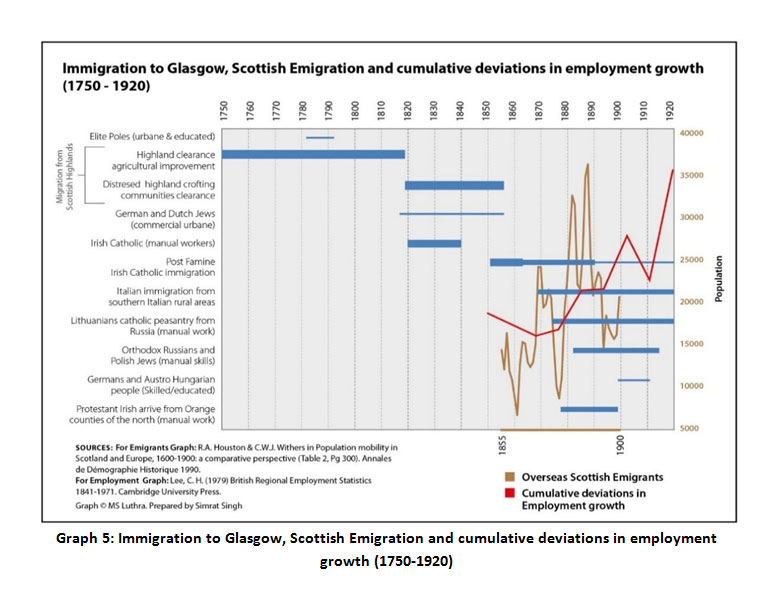 | Graph 5: Immigration to Glasgow, Scottish Emigration and cumulative deviations in employment growth (1750-1920) |
If emigration is an indicator of local economy distress the decades following 1810 and 1890 seems to indicate distress in which the Irish Immigration continued as shown in the first graph 1. From 1851 to 1871 there was a dip in employment opportunities as shown in the graph which shows some dips in correspondence with high peaks of may be primarily due to Scottish level distress rather than a Glasgow level one The Irish immigration continued beyond 1920s although not shown in this Graph but shown in graph 1.
Holligan (Holligan Chris 2011) found that the oldest cohort of those with a Catholic upbringing are disadvantaged as compared to Protestants, in terms of qualifications and representation in professional classes, but hardly any differences in general .Walls 2010 documented the experience of discriminatory practice affecting the current generations attempts to move up the social scale. Aspinwall (Aspinwall B 2013) applauds the role of clergy and laity in cultivating respectability and discipline amongst the Irish settlers and the missions and churches for fostering a communal pride and ethical uplift. Working class enfranchisement, the 1918 Scottish Education Act and the political rise of Labour aided. Taylor attributes the growth of the militant, sectarian Protestant Orange movement in Glasgow and the simmering tensions between Protestant and Catholics, principally to Protestant migration (Taylor Avaram 2013 Page 48).
Rosie M (2015) basing his evidence on the issue of integration concluded
it is now clear that in terms of key life chances – access to education, to jobs, to opportunities for social mobility – there is little evidence of significant, let alone systematic, differences between Protestants, Catholics and the irreligious. Additionally, sectarianism does not seem to be a shaping, let alone a determining, factor in life choices – a person's political and social values, networks of friends and family, and choice of romantic partner. By and large, Scotland's Protestants and Catholics
think and act like each other, and indeed live, work and make babies together, rather more than the truisms around ‘sectarianism’ would suggest. This is likely to be true of the Italians too although the data to analyse it is missing.
If Religious endogamy is an indication of isolation, then it was found to be higher amongst Protestants than Catholics. In Glasgow, although the data is not adjusted for population sizes, Catholics are also more likely than Protestants to cohabit, another indication of their secularisation.
Table 2: Endogamy in Scotland and Glasgow
COS | Catholic | Jewish | Muslim | |
Scotland | 81.3 | 59.4 | 71.3 | 88.7 |
Glasgow | 75.3 | 68,3 | 62.2 | 93.0 |
Source: Census 2001
As evident from the above table the Glasgow Jewish endogamy profile for Glasgow quite resembles the Irish Catholics. Continuing with the census in terms of economic integration Jewish along with the Hindus top most of the occupational categories whilst church of Scotland and RC ranked at the bottom with little difference between them. They were also over represented amongst elementary occupations and both were in the lowest social grades with little difference. RC also had similar proportions of women directors as the other Christians and COS as well as ranking similarly in terms of qualifications and housing, although Catholics still leaned towards catholic areas of dispersal. Jews were least represented in elementary occupations.
Gorbals acted as an initial focal point in hosting migrants due to cheap housing, a small business and amenities hub for new arrivals from Ireland and the Highlands of Scotland, Jews and Italians and many other groups alluded to in this paper with Garnethill and Pollockshields followed by Woodlands, Anderson and Calton as alternative locations of resettlement. We have attached a map showing the distribution of Jewish settlers in 1901. We are working on the archives to unearth the spatial distribution of other groups during this period in what appears to be a few corridors of dispersal over a period mostly determined by affordable housing and kinship and transport links.
Berry’s (Berry J 1997 pp 451-477) famous typology of acculturation: assimilation, integration, marginalisation and separation was critiqued by Taylor(Taylor A 2013).He argued in the conclusion of his paper with particular reference to the Jewish community that the notion of‘ community is a mere medium for the expression of very diverse interests, aspirations and attitudes towards their non-Jewish neighbours. He reasoned that given universal aversion to intermarriage for the Jewish community between c.1890 and c.1945 it was neither a melting pot nor a separate cholent pot ie it contained elements of both and in transition keeping sustaining elements left behind both materially and spiritually while the migrants adjusted to their new lives. This kind of fluid acculturation can also be applied both to the Irish Catholic and the Italian Catholic communities, both originating in rural cultures finding themselves in an industrial economy and culture being subjected to secularisation, consumerism, and post WWI modernity.
Overall this model based on psychology is a bit rigid and has limitations for the strands of integration and assimilation we explored ie social, economic( entrepreneurial as well as occupational) and educational as well as genetic .We are working on a construct to present in the second paper which would also cater for the Asians.
Conclusive Impressions
As this is a working paper as stated at the beginning, we offer some impressions of our forgoing survey as we explore further evidence.
The Scottish people have a long history of out migration for instance to England and Poland pre and post-unification and later on to the new world and to the Commonwealth and a history of transmigration of arrivals on its soil to the USA (aided by shipping links mainly with Eastern Europe) and the Commonwealth. It has also a history of deportations and repatriation of settlers during the 20th century as well as seasonal migration aided by increasing cheap transport links with Ireland. Some specific firm impressions from our survey are;
- Broadly the population growth of Glasgow (Graph1) mirrors employment growth during the 1860 -1915 period when large number of outsiders were absorbed. Post 1870 Glasgow had to absorb relatively poorer Eastern Europeans Jews, the Poles due to WW II, and the Belgian refugees who were victims of Nazism.
- Most arrivals from Eastern Europe and Russia intended to be heading for USA yet a significant number stayed to put down roots in Glasgow as further fares were not affordable.
- Most overseas arrivals who came in waves and trickles were spread over the period 1840-1900 coinciding with the maturation of Glasgow as a second City of the Empire and which became an industrial hub in the early 20th century. Hence it was able to absorb them as well as the internal highland migrations with some ease. Glasgow was not the economic Eldorado for most migrants who came from abroad (for the transmigrating arrivals) with perhaps the exception of early Jewish arrivals or may-be the Germans who may have been economic opportunity seekers.
- A standard push and pull economic factors model would need a significant modification for accommodating the trans-migrants having to balance opportunities and costs in making the decision either to stay on a permanent or an interim basis. In many cases many arrivals had to abandon the myth of return (Anwar 1979) the exception being the Belgians a rare case for refugees and, in other cases, the myth of their destination.
- Early first batch Polish elite arrivals got assimilated and early Jews integrated at the middle and lower end of the local economy and social classes, being urbane and commercially skilled and having the advantage of arriving at the height of the empire led boom in Glasgow. The early Jews fostered a sense of community with the foresight to set up systems to assist others and influence local politics.
- Emigration from Scotland appears to have had little impact on the overall population of Glasgow although it probably led to skill deficits in many cases, often partially filled by the arriving immigrants and refugees. It also gave heart to the residents.
- In the case of the Irish immigrants, destitution, wage gap and disease were the major push factors turning their seasonal immigration into a settlement one. Other groups were often fleeing oppression, poverty, and insecurity or all of these. Some found freedom from persecution or sought economic or intellectual opportunities as was the case with early Poles.
- From 1871 – 1951 (as shown in Graph 1) covering major periods of migration Glasgow’s employment grew till 1961 with a major slow down post first world war and during the great depression hurting Glasgow’s economy disproportionately. The Irish famine of 1841 leading to immigration of the extremely poor added to the local poor population at a time when employment growth was low and remained low which also added to sectarian tensions. Up until the 1930s, the Irish remained mostly in the unskilled demand sector hence did not create job competitions issues in the smaller skilled sector.
- The Repatriation strand was, at times, immigrant community aided, as was the case with Jews who during the pre-second world war contributed monies to keep the numbers down. In some cases, state aid was refused as was the case with Lithuanians leading to destitution. The interment and deportation of Germans hurt them and their families badly weakening their economic base badly as were the stranded Lithuanian families.
- Repatriation refuseniks were denied Poor law relief for some time seeking to end the financial burden associated with paying the destitute aliens’ grant. This was a commendable practice at a time when welfare state was in its infancy and underfunded. Belgians too had some assistance on arrival from Government and the Trade unions as did the Poles. Once the Second World War ended the British state felt it was owed to them by virtue of their contribution to the war. Govorment assistance, transmigration, repatriations and out- migration to England and overseas all kept the economic pressures and acrimonious competition for jobs manageable.
- World War II was followed by further growth in consumer services and employment in general by virtue of a consumer boom. Unfortunately Glasgow did not benefit from post-employment growth unlike many major cities (see Pike Andy Graph in Appendix) Within this decline framework the public sector growth continued whilst manual, industrial and agricultural work opportunities diminished with the exception of some low manual or new skills -demanding employment sectors which survived.
- Not much is known about the Germans who came under fire due to heightened war jingoism during First World War and who left or assimilated or both leaving little trace. Moreover, Belgian wartime refugees overwhelmingly left Scotland willingly as did some Lithuanians. It is clear that wartime restrictions initially intended to curb the freedom of enemy alien nationals were soon extended to friendly alien settlers as evident in respect of wartime employment and military service policies and by the repatriation activity of the immediate post war years. While Belgian wartime refugees overwhelmingly returned home, the other groups stayed on in Scotland, resisting government economic pressure to leave.
- The pre- 1870 Jewish small business enterprise economy acted as an absorbent for many new Jewish arrivals who were often less skilled and poorer and non- urbane and some were financially aided too .On the eve of the First World War Jews formed the third largest group of non-Scottish migrants in Glasgow after the Irish. They had developed an ethnic economy based mostly on their previous commercial and craft skills capable of absorbing new comers which they did well by creating opportunities and evolving a supportive community- based welfare system.The internal support system often remained stretched to suggest that a lot of Jews remained poor for some decades.
- Competition for wages leading to decline in local wages often remained a major issue for the host community and also, in particular, for those arriving communities who did not have a pre-existing ethnic economy or a welfare system as a cushion on arrival. Historical and religious fault lines and extreme poverty and poor education often created an ill-disciplined lumpen proletariat element amongst the arrivals as did the cultural habits as was the case with the Catholic Irish and the Lithuanians which along with their poverty consolidated their negative stereotypes inviting local anger.
- Such competition was serious in relation to skilled manual or dangerous jobs such as those in mining sectors as was the case of Lithuanian arrivals where the local unions were strong and given the post war dip in employment. As we have shown the trade unions played a positive and negative role in relation to the new arrivals. Sectarianism often blended with wage competition. The Jewish community did face challenges but had established links and organizations. Local debates, trade unions and other community help all helped.
- Glasgow’s municipal elite made efforts to raise funds to absorb the refugee arrivals with strategic planning and the central government was responsive too despite depleted government budgets .Repatriation assistance, as in the case of Belgians, was given too which led to their exit from Glasgow and its economy.
- Both Jewish and, two to three decades later, Italian communities were able to develop their own ethnic /commercial economies serviced by arrivals with chain migration. The Jewish community had the longer establishment period advantage and a wider skill base. By the late ‘sixties’ the Italian communities had moved into good quality and ‘up-market’ restaurants, the Jews into the mainstream economy and the entrepreneur Irish into mainstream sectors such as pub keeping, building contracting trades, leaving some spaces in the local economy.
- The Jewish and Italian communities eventually became invisible diffusing communities with strong self-defining cultural and business identities with the Jewish communities’ generations probably integrating at middle class level and the Italians most likely mainly with the local upper working classes as they became less endogamous post ninety forties . This class dimension of integration needs further empirical research
- The absence of Jewish schools and Scottish education systems also created integrating and secularizing opportunities for the first and next Jewish generation. In the Irish Catholics the Catholic schools were able to not only provide good education but instilled pride and discipline too .The diffused ice cream and restaurant business locations of the Italians in their case determined their spatial distribution in the nine thirties and probably also played a key role in their integration.
- The enterprise trajectory of the Italian and Jewish communities suggest a beginning mainly in hawking or peddling to move to low cost shops or service premises as a foot hold often in affordable low cost areas, often employing their own community people for expansion or employing those who came from their respective regions. Peddling and hawking created an outreach network to sustain business in general and in difficult times. Both communities absorbed new, often poor, arrivals as they developed and subsequently these arrivals in turn contributed to further development of ethnic economies The Jewish latter generations have retreated from the frontline business as they became professionals. It is not clear what happened to the Cigarette and whisky industry.
- The Italians created their own product market by way of confectionery shops, ice cream parlors, cafes, and the restaurant sector quite speedily in the period of their arrival despite lacking commercial skills unlike the Jews. It would be interesting to observe if it has been growing in a modern capitalist economy context in the post 1960 period as a source of employment .The Lithuanians and Polish workers who came post 1880 like the Italians also lacked commercial experience like the Italians but failed to utilize their clothing tailoring expertise to build an ethnic economy
- The Irish Catholic immigration initially pre famine a transient rural seasonal guest worker kind of immigration with agrarian skills, the subsequent arrivals settled amongst the working Glaswegians making a huge contribution by doing very hard manual jobs both in the private and in the growing infrastructure public sector. They lived cheek by jaw and intermarried more than the Jewish community despite the sectarian divide. Their coming together was also assisted by the Second World War.
- Despite many similarities in cultures with the host community, Catholic Irish arrivals had a tense relationship it would seem partly on sectarian grounds and were perhaps the most discriminated against of all the groups we surveyed followed by the Lithuanians who did blend into the mining communities after initial difficulty. In the case of the Irish Post famine, the exceptionally large influx for almost over two decades of destitute workers fueled nativist antagonism further. There were moral panics at the time by virtue of their numbers as a threat to the local moral fabric and culture as they struggled to find opportunities for skilled work .They took a long time to develop an enterprise dimension to their settlement profile which remains unstudied. They significantly married into their own community slowing down their integration although many became secularized.
- The two world wars presented both opportunities and setbacks for the settled and arriving migrants The Poles arrived in large numbers around the second world war and were absorbed into the post war manual economy and were settled with state help at a time when Scotland desperately needed manpower.
- Lithuanian and Second World War Polish communities were less successful in fostering an entrepreneurial economic base but still had engaged in good community development. The First World War led to the persecution of the German settlers.
- Braber concluded that the first world war Germans’ arrivals in Glasgow were less successful in catering to its members collectively by tackling official punitive measures and local prejudice as the nationalism and jingoism was hyped by horror stories from Germany and war propaganda at the time. Unlike Jews they came from scattered areas all over Germany hence were unable to develop effective and cohesive structures to engage with the local elite to protect fellow Germans from persecution, both economic and otherwise. The Jews in contrast were able to manage their diversity well and present their case.
Overall, in the period we surveyed in this paper, a range of factors balanced the in and outflow of population keeping it in tandem with economic growth (with the decade exceptions). There was the needful absorption of the Irish in both agro-economy and subsequently in the industrial economy as hardworking unskilled labor. The continuing emigration, repatriations and deportations maintained the pace of growth of population in step with the growth of the economy till the ninety fifties. The interwar need of unskilled work force and postwar economic need of Polish manpower absorbed significant newcomers. In addition, there were economic opportunities and a support cushion provided to the newcomers by the established earlier nucleus of settlers by both the Jewish and Italian communities having evolved their ethnic economies.
Unlike Belfast, Glasgow has been relatively successful (despite the arrival of Ulster protestants some of whom may have carried a strong sectarian baggage) and despite some segregation of areas, in containing sectarian animosity and absorbing the Catholic Irish immigrants. Here, our image of the Irish in Glasgow becomes more one of stability amidst hostility rather than one of overt and open conflict. Nevertheless early Catholic arrivals of Irish extraction faced sectarian discrimination particularly a smaller section of the population which sought to enter skilled occupations in the shipyards and engineering works on Clyde side and subsequently in the public sector as it grew. The emerging empire jobs in the expanding Commonwealth and the local education system also created economic escape routes for some of the Irish and Scots.
Overall the large migrating Catholic population, despite their historical disadvantages and experience of sectarian discrimination, managed to align their socio economic profile with fellow Protestants as they secularised, softened endogamy, became educated with Catholic church help and then by the labour government’s educational policies in the nineteenth century. This is a remarkable accomplishment worthy of celebration. Other groups such as the Italians and the Jewish groups despite some growth in their numbers remained small in terms of city population percentages and created their own small business economies in the early days the basis of a time- tested route to put down roots as well as avoiding job competition with the locals.
The rest like the Lithuanians or the Russians also participated mainly in the growing extremely hard work unskilled job sector hence, in most cases, faced limited competition. They may have either left Glasgow to go back or transmigrated or got genetically and culturally absorbed to leave little trace. The economic, political policy factors we trawled in this paper which shaped the patterns of settlement and integration include the two war economies, the deterring restrictive immigration and Aliens legislation ,exclusion from government jobs( The Irish and the Jewish groups till the 1930s), the continuous transmigration and emigration as well as government’s labour and welfare policies. The principal factors however remain the balance between the economy and growth in the population and continuous economic assimilation of large groups such as the Irish and the number and size of other groups remaining small never creating tipping points for community conflict with the local populations. The ethnic economies also acted as cushions and absorbents keeping the economic competition low.
All the above played their role in managing the balance between population and economic growth and the community relations wittingly or unwittingly as did the settling groups themselves by for instance funding repatriation. Some credit for this goes partly to the emerging welfare state and the local elite. The painful exception to this story are persecution and a sense of diminishing as well as damage to family wellbeing and property inflicted on them ( the Italians and Germans being examples) during periods of WWI and WWI against the back drop of heightened Jingoism and Nativist exclusion eg in the case of Lithuanians, by the Trade unions, who at other times were helpful, and the moral panics in the press are hurtful periods in this story not resonating well with Marxist notions of class solidarity,
We have constructed a construct chart based on our forgoing survey
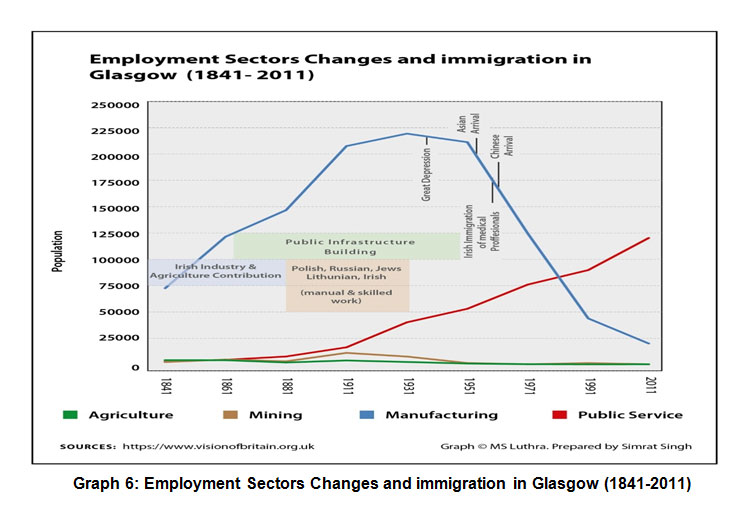 | Graph 6: Employment Sectors Changes and immigration in Glasgow (1841-2011) |
Key Factors affecting Community Relations and Integration (1840-1860)
Primary | Secondary | Tertiary | |
Ecological and Economic factors | Population growth and economic growth remained in tandem
Substantial continuous Emigration | Transmigration -No Eldorado factor | Strong education and entrepreneurial culture |
Community Led initiatives | Ethnic small business niche economies (The Jewish and the Italian communities) | Community Financial support (Jewish community) Psychological support | Acquired secularisation and Increasing Endogamy eg the Irish and the Italians during post 1940s |
Government Role | Alien Acts internments deportations sent hostility messages | Repatriation (The Belgians, Italians and the Germans) damaged comm relations | Government sponsored jingoism damaging to the minorities and causing fear. |
Other organisations role and factors | Most were invisible white Migrants | Catholic Church support in schooling (The Irish) | Government assistance with repatriation and for the families in need or those left behind who went to war |
Source History survey and classification by M S Luthra June 2020
Overall emigration and continuous economic growth with the exception of some in late 19th century creating commercial opportunities, and later on creating unskilled dirty job opportunities in the mid 20th century as well as ethnic enterprise formation acting as a cushion were the major influencing factors in keeping economic competition with locals down in this story. As to the different community advancement models entrepreneurial (Italians and Jewish communities) or occupational (The Irish) or mixed pursued by different communities we will explore these after undertaking a similar exercise for the post nineties sixties Asian settlement in Glasgow.
The overall economic story is summarised in Graph 6. To what extent this applies to the economic immigrants of colour from the Punjab who arrived mainly in the post 1960's a period of decline and how they fared in the city is a narrative we pick up in the second paper of this series. As to how the post war immigrants of colour would fit in the above construct, we will explore that in the next paper in the series as well as list future areas of research.
The question as to why the Jewish community excelled to the apex of the league table of the local socio economic grouping groups The other one is how an Irish community managed to catch up after over a hundred years so damaged and devasted and, to use Frank Gunders term, systematically under developed by the imperial masters but yet to recompose itself and to equalise with the most community. These are challenging questions we address in the next paper picking up the story from 1955 onwards.
The Irish were also deemed by the social Darwinists a ‘white niggers’ of Europe in the age of prevalent pseudo-scientific racism which even the Scottish philosophers like David Hume could not escape. So how the notion of the outsider and othering survived well in a society which had a strong tradition of immigration and emigration and experience of extreme poverty of arrivals of the highlanders who came and lived in terrible conditions. It seems that the othering notions not only survived, simmering away these got laced with anti-Catholicism, antisemitism and economic nativism often further aided by the press.
Mohan Luthra (Manmohan Singh Luthra) has been a Research Fellow at Brunel University London; a Visiting Fellow at the institute of Education London and a Principal Lecturer at London Southbank University. He retired as a Senior Civil Servant from the British Civil Service. He worked in Glasgow as a researcher and community development worker in the ninety eighties
Acknowledgement
I am thankful to Professor Jyoti Atwal for her valuable suggestions to improve this working paper as well as to Ms Simrat Singh for her diligent data work and tricky production of complex graphs .I am also grateful to Ms Maureen Boerma who kindly worked late to do her best in helping with proof reading this paper in a compressed time and at a very short notice. Also thanks to Nigel Karney and Hakim Din for their help too.
Funding Source
The author(s) received no financial support for the research, authorship, and/or publication of this article.
Conflict of Interest
The authors do not have any conflict of interest.
References
- Anwar M (1979) The Myth of Return https://www.amazon.co.uk/Myth-Return-Pakistanis-Muhammad-Anwar/dp/0435820222
- Aspinwall Bernard 2013The Catholic Minority Experience in Scotland: the Poorhouse View, 1850–1914Pages 127-145 | Pub online: 24 May)
- Bailey, D., Sunley, P., Tyler, P., Martin R. and Gardiner, B. (2017) Policies, Institutions and City
- Braber Ben (2009) Within Our Gates: A New Perspective on Germans in Glasgow during the First World War.Journal of Scottish Historical Studies, 29(2), pp. 87–105
- Braber Ben (2007) Jews in Glasgow 1879-1939: Immigration and Integration, Vallen
- Berry John and D. Sam, (1997) ‘Acculturation and adaptation’, in Berry JW, Marshall H. Segall and Cigdem Kagitcibasi eds.,
- Handbook of cross-cultural psychology, volume 3: social behaviour and applications (Boston, MA and London,), 296–7. Classification of acculturation when individuals do not wish to maintain their cultural identity and seek daily interaction with other cultures the Assimilation strategy is defined. In contrast, when the non-dominant group places a value on holding onto their original culture, and at the same time wishes to avoid interaction with others, then the Separation alternative is defined.’21 Marginalisation denotes a state in which the specified group loses contact with their own culture and that of mainstream society as a result of discrimination or withdrawal. Finally, integration involves a desire to maintain the traditional culture of the group in question while accommodating the dominant culture.22 It results in participation in a wider social network and daily interaction with other groups
- Collins Kenneth E with Ephraim Borowski 2008 2nd ed Scotland’s Jews Scottish Council of Jewish Communities Dr https://www.scojec.org/resources/files/jewish_experience.pdf
- Colpi Terry (2013) The Italian Factor in Scotland Today Scottish Parliament 16 April Keynote address
- Colpi T (1986) Italian Migration to Scotland Conference paper Race curriculum and employment Univ of oxford 8the march
- Cunnison, J et al. 1954 Third Statistical Abstracts of Scotland
- Checkland, S. (1976) the Upas Tree: Glasgow 1875-1975: A Study in Growth and Contraction, Glasgow: University of Glasgow Press
- Economic Evolution A Tale of Five British Cities, (! 919) Paper for the Regional Studies Association Winter Conference, London, November.
- Fitzgerald P., Lambkin B. (2008) Irish Migration, 1700–1750. In: Migration in Irish History, 1607–2007. Palgrave Macmillan, London
- Fraser, W. H. (2004) Second City of the Empire: 1830s to 1914, The Glasgow Story, http://www.theglasgowstory.com/story/?id=TGSD0
- Gullace, N. F. (2005), ‘Friends, Aliens, and Enemies: Fictive Communities and the Lusitania Riots of 1915’, in Journal of Social History, 34 pp. 345 ‘Friends, Aliens, and Enemies: Fictive Communities and the Lusitania Riots of 1915’, in Journal of Social History, 34 (2005)
- Gallagher T (1988) Glasgow’s Uneasy space Religious Tension in Modern Scotland Paperback – 16 May
- Holligan Chris (2011) Published online: 20 Sep Sectarianism: myth or social reality? Inter-sectarian partnerships in Scotland Scottish Longitudinal Study)
- Hudson, R. (1989) Wrecking a Region, Pion: London
- Jenkinson Jacqueline (2016) Friendly Aliens on the Home Front: Migrants, Refugees and Colonial Workers in Scotland during and after the First World War University of Stirling
- Kernberg Thomas (1990) PH.D. Inst of Soviet and East European Studies University of Glasgow Oct
- KoIme lR. Kolmel, Pic Geschichtcdculsch-iUdischcr Refugees in Schottland. Heidelberg, 1979 (PhD thesis); R. Kolmel, “German-Jew'ish Refugees in Scotland”, in Collins, Aspects of Scottish Jewry, pp. 55-84).
- Knox WWA History of Scottish Migration 1840-1940 Scran https://www.scran.ac.uk/scotland/pdf/SP2_7migration.pdf
- Lee, C. H. (1979) British Regional Employment Statistics 1841-1971Cambridge University Press
- Lever, W. (1986) “Old policies in a new role” in W. Lever and C. Moore (1986)(Eds.) The City in Transition: Policies and Agencies for the Economic Regeneration of Clydeside, Clarendon Press: Oxford, 44-61.
- Lever, W. and Mather, F. (1986) “The changing structure of business and employment in the conurbation” in W. Lever and C.
- Malony) The Britania Panacpotico Music Hall Cosmo entertainment Centre, Palgrave Mcmillan,Moore (1986)(Eds.) The City in Transition: Policies and Agencies for the Economic Regeneration of Clydeside, Clarendon Press: Oxford, 1-21.
- Mackee Franko (1991in Ice cream and morality in Oxf Symposium on food and public eating prospect books)
- Pacione, M. (1995) Glasgow: The Socio-Spatial Development of the City, Wiley: Chichester
- Pacione, M. (2009) “The view from the tower: geographies of urban transformation in Glasgow”, Scottish Geographical Journal, 125, 2, 127-181Turok, I. and Bailey, N. (2004) “Twin track cities? Competitiveness and cohesion in Glasgow and Edinburgh”, Progress in Planning, 62, 135-204tine Mitchell,
- Panayi P, (1991) the Enemy in Our Midst. Germans in Britain during the First World War (Oxford). For his study of the preceding period see P. Panayi, 1995 German Immigrants in Britain during the Nineteenth Century, 1815–1914 (Oxford,).
- Rosie Michael (2015) The Sectarian Iceberg Scottish Affairs 24.3 (2015): 328–350 DOI: 10.3366/scot.2015.0081 # Edinburgh University Press www.euppublishing.com/journal/sco)
- Saunders D, (1985) ‘Aliens in Britain and the Empire during the First World War’, in Immigrants & Minorities, 4, pp. 5–27. www.scotsitalian.com
- Rosie Michael (2015) the sectarian Iceberg Scottish Affairs 24.3 (2015): 328–350 DOI: 10.3366/scot.2015.0081 Edinburgh University Press www.euppublishing.com/journal/sco
- Taylor Avaram (2013) In Glasgow but not quite of it’? Eastern European Jewish Immigrants in a Provincial Jewish Community from c.1890 to c.1945. Continuity and Change, 28 (3). pp. 451-477. ISSN 0268-4160 Published by: Cambridge University Press URL: http://dx.doi.org/10.1017/S0268416013000350 Volume 28, Issue 3
- Ugolini Wendy (2011) Experiencing war as the 'enemy other Published by: Manchester University Press) in Experiencing the war as the 'enemy other': Italian Scottish experience in World War II Chapter7 entitled ‘My life wasn’t very great’ )women on the home front and in the services
- Walls (2010) The Sectarianism at work: Accounts of employment discrimination against Irish Catholics in Scotland https://doi.org/10.1080/0141987032000087343 )
- Weir, Refresh 19 (1994) Structural Change and Scotland 1918-1939 Autumn https://www.ehs.org.uk/dotAsset/1bb03434-84b5-4c9d-bbea-fbf53b6000a0.pdf
- SCRAN Licensed for Educational Use Only via www.scran.ac.uk (https://www.scran.ac.uk/scotland/pdf/SP2_7migration.pdf for an excellent summary of Irish and Lithuanian migration
- Yarrow, S (1990) The Impact of Hostility on Germans in Britain, 1914–1918’, in T. Kushner, K. Lunn (eds), The Politics of Marginality. Race, the Radical Right and Minorities in Twentieth Century Britain (London, 1990), pp. 97–81
- Young, A. (2015) Forty Turbulent Years, Fraser of Allander Institute: University of Strathclyde
- https://www.ehs.org.uk/dotAsset/1bb03434-84b5-4c9d-bbea-fbf53b6000a0.pdf
- Crowley, john William J. Smyth and Mike Murphy (eds.) (2012) Atlas of the Great Irish Famine, Cork: Cork University Press.
- McMahon,Richard (2016)Images of The Irish and the History of’, May 31, https://headlong.co.uk/ideas/images-irish-and-history-violence-scotland/
Jewish population concentrations
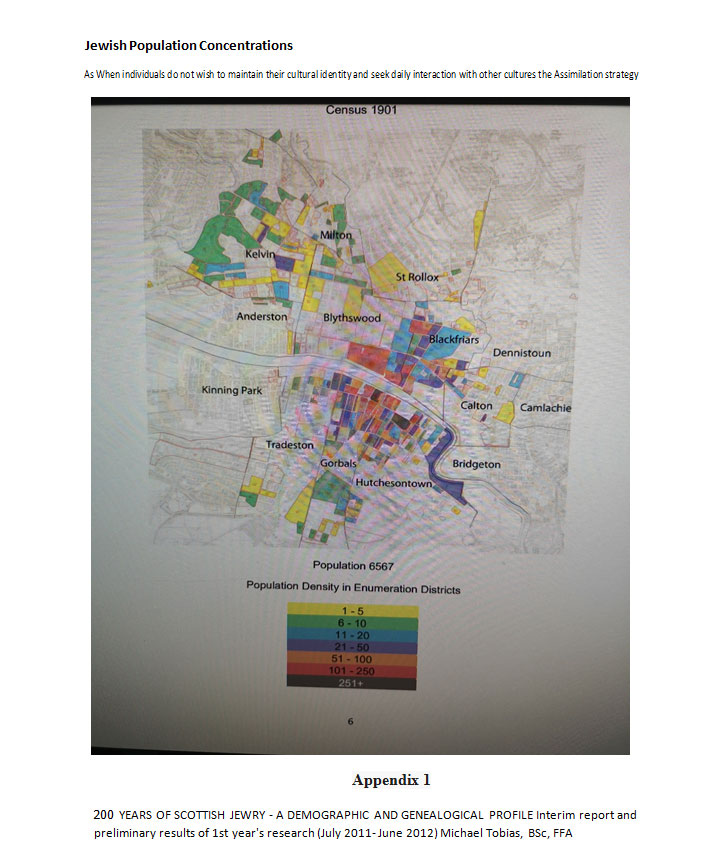 | Appendix 1: |
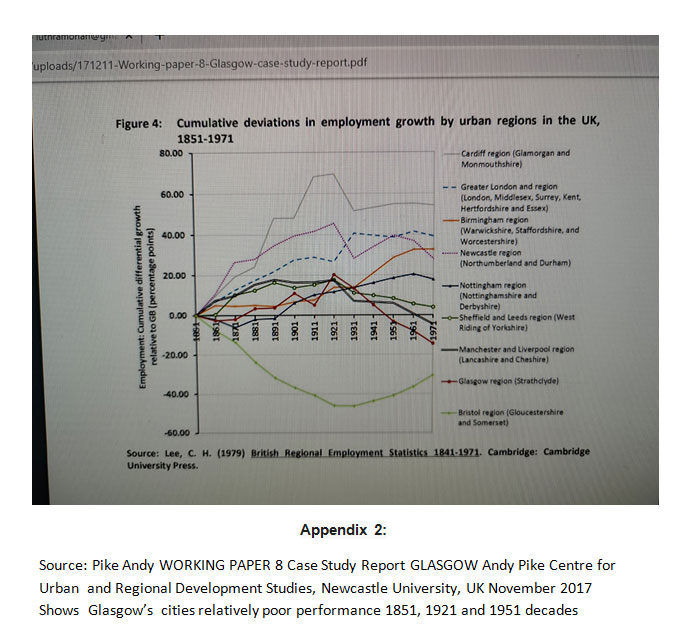 | Appendix 2: |

This work is licensed under a Creative Commons Attribution 4.0 International License.