
Analysis of Government Involvement in Solving Housing Deficit in Ado-Ekiti, Nigeria
Adeyemi O O  , Yoade A.O * and Oladipupo, A.S
1Department of Urban and Regional Planning, Wesley University Ondo, Nigeria .
http://dx.doi.org/10.12944/CRJSSH.5.2.09
This paper examined the role of the government in solving the housing deficit in Ado-Ekiti, Nigeria. Both primary and secondary data were utilized for this study. Therefore, a total number of 600 residential buildings were selected from the Falegan area of Ado-Ekiti, out of which 60 building was mapped randomly for respondents. In all, 60 questionnaires were administered among the residents of the study area out of which 50 of them were correctly filled and returned. Both descriptive and inferential statistics were used for data analysis. Findings revealed that 70% of the total residents were tenants while 30 percent of the total residents were landlords. Findings revealed that 82% of the total population agreed that making credit available for building construction projects will reduce the housing deficit while 18% disagreed. Hence there is a strong relationship between the availability of credit loans and the reduction of the housing deficit in the study area. The paper recommends that government should amend its housing policies to favor the reduction or elimination of the housing deficit in the country.
Copy the following to cite this article:
Adeyemi O. O, Yoade A. O, Oladipupo A. S. Analysis of Government Involvement in Solving Housing Deficit in Ado-Ekiti, Nigeria. Current Research Journal of Social Sciences and Humanities. 2022 5(2).
DOI:http://dx.doi.org/10.12944/CRJSSH.5.2.09Copy the following to cite this URL:
Adeyemi O. O, Yoade A. O, Oladipupo A. S. Analysis of Government Involvement in Solving Housing Deficit in Ado-Ekiti, Nigeria. Current Research Journal of Social Sciences and Humanities. 2022 5(2).Available From: https://bit.ly/3cEiANw
Download article (pdf) Citation Manager Review / Publish History

Introduction
A dwelling, shelter, or home is the construction and intentional use of a house or building to accommodate people. Housing can be defined as a building or other accommodation where people live, where they live, where they live, and as an important element of the social and economic system for the nation (Yoade, 2021). Housing is one of the basic human needs. For most groups, housing means protection, but for others, it means more because it is one of the best indicators of a person's standard of living and their position in society (Ahmed, Perera, & Illankoon, 2013).
The acceptable shelter is the second most important basic human need after food. Housing in all its ramifications is more than just a shelter as it encompasses all the social and public services that contribute to making a community or neighbourhood a liveable environment. Humans demanded this essential commodity for their lives, which even primitive humans could not do without caves as their shelter. Indeed, housing is a real indicator to measure the socio-economic and technological development of a country, "show me the quality of your people's houses and I will say you are a nation." which family" can become a maxim. Housing demand is not only one of the basic human needs but also an indicator of the population's standard of living. It is a topical issue these days that housing should be comfortable, economical, and reasonably maintainable, as well as architecturally and environmentally compliant (Akinbamijo, 2012).
So housing is one of the best indicators of a person's standard of living and position in society. The shelter is central to human existence. He also said that shelter involves access to land, shelter, and amenities necessary to make a shelter functional, functional, aesthetically pleasing, safe, and sanitary. According to him, unsanitary, unsanitary, unsafe, and unqualified housing can affect people's safety, physical health and privacy. Okafor (2016) asserts that housing around the world remains an interrelated phenomenon facing humanity and that it represents one of the most basic human needs that certainly have a profound impact on health, happiness, and productivity of every individual, regardless of society status, economic situation, color, or creed.
This is a priority for achieving living standards and this is important for both rural and urban areas. These characteristics mean that there is no limit to the demand for housing, as population growth and urbanization are increasing rapidly and the gap between housing demand and supply is widening. A deficit is an amount where something is less than what is required or expected, namely, an amount where the total amount received is less than the total amount spent (Collins, 2019). A deficit, also known as a loss, refers to an excess of expenses over income over a while. In other words, it is when a company's expenses exceed its revenue for a period. This is sometimes referred to as running into the red or losing the year (Shaun, 2019).
A housing deficit is a scenario in which the total amount demanded by the housing sector is greater than the amount or resources the government provides to the sector. The housing problem is one of the social problems posed by capitalism, manifesting as a specific form of housing need along with the increase in urban population and the conversion of housing into a commodity. The living conditions of workers deteriorated severely and the number of apartments increased greatly (Ajibola, 2014).
This housing deficit has continued to accumulate over the years due to the poor implementation of housing policies by successive governments in Nigeria. Cultural factors such as preferences and values, social status, tastes, and financial resources also affect the physical characteristics of a home. In developing countries, poor housing supply is due to inadequate land allocation, financing, and infrastructure mechanisms and systems (Yoade, 2021).
However, housing problems and housing needs are manifested by overcrowding, poor and inadequate social amenities, unsatisfactory and unsanitary environmental conditions, the misery of using areas, lack of free space, development of land space leading to overcrowding of buildings, inaccessibility in residential areas, scarcity and high cost of construction materials (Ajibola, 2014). Therefore, the paper specifically examined the government's role in addressing the housing problem in Ado-Ekiti, intending to propose a possible solution to the housing deficit in the study area.
Materials and Methods
Research Locale
Ado-Ekiti is one of the oldest towns in Nigeria, its history dates back to a period before the advent of the Ewi dynasty in 1319 AD. It is a town of repute about 100years ago “ELEWI’’ than is an orator otherwise called Oba joined the princely adventure instituted by the several children of Oduduwa that migrated from Ile-Ife to found their territories. Like other Yoruba towns where people trace to descent through Oduduwa, the origin of Ado-Ekiti was associated with people who migrate from Iremo in Ile-Ife. According to Oguntuyi (2003), Ewi was one of the sixteen direct sons of Oduduwa. He was loved by Oduduwa to the extent that he was made his spokesman. It is pertinent to mention here that the people of Ado-Ekiti were not the first settlers at this location. A well-established settlement, Emure, was under the headship of Elesun.
The head town was Ilesun Ewi and his people settle very close to Ilesun but later, Ewi conquered Elesun and established his hegemony over Emire. This settlement was first at Ori-Ekiti and later Osunleodo Ado this means ‘we camp’ and the suffix. Ekiti simply refers to the top of the mounds where the people first settled. Ado consists of three principal parts which is the seat of Ewi. Oke-Ewi comprises of Irona, Okesa, Igbehin, Okeyinmi, Ereguru, and Ijigbo. Odo-Ado is made up of Idemo, Ilaro, Idolofin, Isamo and Iremo Oke-Ila the third principal part of Ado, consist of Ila, Oke Efon and Ora.The area in question is said to be rich in education as it is educationally advantaged. This has brought high pace in development in the area as a result many prominent graduates and personalities of different professions were produced. Ado-Ekiti has been counting many institutions such as the University of Ado-Ekiti, Federal Polytechnic Ado-Ekiti, School of Nursing, Technical college, Crown Polytechnic, and Afe Babalola private university, and other private and public secondary and primary schools where people in Ado-Ekiti and other areas have access for their careers. The people of Ado-Ekiti are predominantly Christian, Muslim, and Traditionalist but with events of Christianity having many churches with various denominations, traditional worshipping is far giving way for Christianity in Ado-Ekiti. (OLUMOLA, 1984). A thousand years of Ado-Ekiti history and culture, Omolayo Standard Press.
The geographical background of Ado-Ekiti could be referred to within the content of the Ado-Ekiti religion which was located on the latitude of 70 401 North of the equator and longitude 500 161 east of the Greenwich meridian. It shares common boundaries with Irepodun Local Government. Ekiti South West and Gboyin Local Government (Ebisemiju, 2003). Ado-Ekiti is a landlocked town having no coastal boundaries going to the 1991 census, Ado-Ekiti has a population of about 150,000, and after the creation of the state in 1996, this figure raised considerably and has a total population of 403,588 in 2014 as projected from 2006 national population census. The land is over 400 meters above sea level and situated in the tropical rainforest region of Nigeria; Ado-Ekiti enjoys abundant rainfall of about 1,450 millimeters annually during the rainy season from March to October (Awosusi and Jegede, 2013).
The location of Ekiti State in the national setting, Ado-Ekiti in the state context, and Ado-Ekiti map are shown below in Fig 1 and Fig. 2.
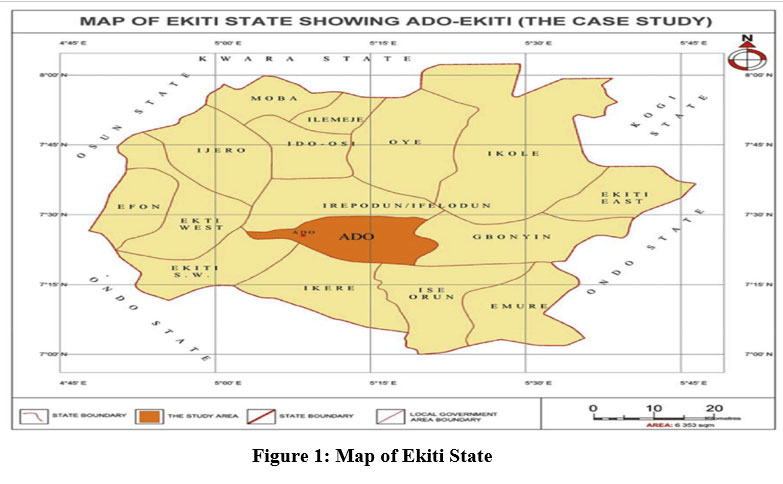 | Figure 1: Map of Ekiti State. Click here to view figure |
Source: https://www.researchgate.net/figure/Map-of-Ekiti-State-showing-the-location-of-Ado-Ekiti_fig1_325064630
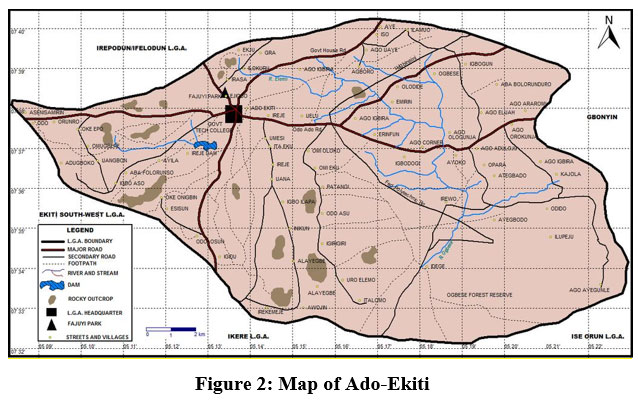 | Figure 2: Map of Ado-Ekiti Click here to view figure |
Source: (Oloidi, 2014)
The Database
Both primary and secondary data were used for this study. Primary source of data was collected directly for the respondents for a particular project while secondary data are the ready-made data that has been previously used for other purposes and later adopted for another project work. The sampling technique for this study was simple random sampling (SRS). With these techniques, everybody in the study area has an equal chance of being selected as a respondent to represent the whole population of the Falegan residents.
This study is focused on Falegan Street in Ado-Ekiti. Falegan is one of the new streets that is occupied by majorly non-indigene most especially, students of Continuing Education Center of The Federal Polytechnic Ado-Ekiti. The street is also characterized by thriving business activities due to the dense population of the area. The street comprises about 600 buildings of which most of them have attached shops or spaces for businesses. Therefore, a total number of 600 residential buildings were selected from the Falegan area of Ado-Ekiti, out of which 60 building was mapped randomly for respondents. One questionnaire was distributed to a resident of each of the selected 60 buildings to represent the total building in the study area. In the course of the research work, 60 questionnaires were administered to residents of the study area out of which 50 of them were correctly filled and returned. Both descriptive and inferential statistics were used for data analysis.
Analysis and Interpretation
Socio-economic Characteristics
Findings established that none of the respondents were below 20 years of age, 8% belongs to the age group between 21 and 30 years also the respondents that their ages fall between 31 and 40 were 14% of the total respondents while 50% of the total respondents were between 41 and 50 years of age leaving remaining 28% above 50 years of age. The analysis above showed that the information given by the respondents will be reliable because they are of mature age.
Findings revealed that 70% of the total residents were tenants while 30 percent of the total residents were landlords. Hence the study area is dominated by tenants.
Findings showed the type of house lived by the respondents. From the responses, it can be deduced that 22% of the respondents were living in Boys’ Quarters while 48% of the total population were living in face-me-I-face-you buildings, also 18% were living in flats leaving 12% of the respondent living in a duplex. From the analysis, a greater percentage of people in the study area are living are not comfortably.
Findings revealed the respondent’s household population. It can be deducted from the responses that 18% of the whole population were living with households of less than 3 persons, 28% of the whole population have households of between 3 and 5 persons leaving the remaining 54% of the whole population having more than 5 persons in their household. We can see that greater percentages of the people in the study area were overpopulated in their respective houses.
Table 1: Socio-economic Characteristics.
RESPONSE | NO OF RESPONDENTS | PERCENTAGES (%) | ||
Age of the respondents | ||||
20 years and below | 0 | 0 | ||
21-30 years | 4 | 8 | ||
31-40 years | 7 | 14 | ||
41-50 years | 25 | 50 | ||
50 years and above | 14 | 28 | ||
Mode of occupancy | ||||
Tenant | 35 | 70 | ||
Landlord | 15 | 30 | ||
Type of houses | ||||
Boys Quarters | 11 | 22 | ||
Face me I face you | 24 | 48 | ||
Flat | 9 | 18 | ||
Duplex | 6 | 12 | ||
Size of the household | ||||
Below 3 persons | 9 | 18 | ||
3-5 persons | 14 | 28 | ||
Above 5 persons | 27 | 54 | ||
Total | 50 | 100 | ||
Source: Field survey 2019.
Housing Characteristics
Findings showed the condition of the respondent’s kitchen. It was revealed that 24% of the total population use indoor/private kitchens, 22% of the total population use outdoor/private, 36% of the total population use outdoor/sheared kitchens while 18% of the total population have no kitchen at all. Hence, only 24% of the whole population of the study area uses a standard kitchen. Findings showed the condition of the respondent’s bathroom. 22% of the total population use indoor/private bathrooms, 32% of the total population use indoor/private, while 46% of the total population uses outdoor/shared bathrooms. Hence, only 22% of the whole population of the study area uses a standard bathroom. Findings showed the condition of the respondent’s toilet. 16% of the total population use indoor/private toilets, 32% of the total population use outdoor/private toilets, 34% of the total population use outdoor/sheared toilets while 18% of the total population has no toilet at all. Hence, only 16% of the whole population of the study area uses standard toilets.
Findings established that responses about the effect of government policies on improving housing quality in the study area. About 34% of the total population agreed that government policy has improved housing qualities in the study area while 66% of the total population disagreed. Hence government needs to amend some of the policies related to housing to improve the housing quality of citizens. Findings revealed that 28% of the total population agreed that Government has aided the provision of building infrastructure in the study area while 72% of the total population disagreed. Hence, the government still has a lot to do in aiding in building infrastructure for the citizens.
Table 2: Housing Characteristics.
RESPONSE | NO OF RESPONDENTS | PERCENTAGES (%) |
Respondents kitchen facility condition | ||
Indoor/Private | 12 | 24 |
Outdoor/Private | 11 | 22 |
Outdoor/Sheared | 18 | 36 |
Not available | 9 | 18 |
Respondents Bathroom facility condition | ||
Indoor/Private | 11 | 22 |
Indoor/Private | 16 | 32 |
Outdoor/Sheared | 23 | 46 |
Not available | 0 | 0 |
Respondents’ Toilet facility condition | ||
Indoor/Private | 8 | 16 |
Outdoor/Private | 16 | 32 |
Outdoor/Sheared | 17 | 34 |
Not available | 9 | 18 |
Has government housing policies improved the overall quality of housing | ||
Yes | 17 | 34 |
No | 33 | 66 |
Government aid in the provision of building infrastructure | ||
Yes | 14 | 28 |
No | 36 | 72 |
Total | 50 | 100 |
Source: Field survey 2019.
Government Involvement in Housing Provision
Findings established that 18% of the total population agreed that the government has promoted local building materials which have reduced the housing deficit, while 82% of the whole population disagreed. The government has not promoted the local building materials. Findings revealed that 24% of the total population agreed that the government has invested in housing to satisfy the basic needs of the study area while 76% of the population disagreed. Therefore, government has not invested in housing to satisfy the basic needs of the study area. Findings indicate that 30% of the total population agreed that the government had mobilized housing finance from both public and private sections to reduce the housing deficit while 70% of the total population disagreed. Therefore, government did not mobilize finance for housing from the public and private sectors.
Findings revealed that about 80% of the total population agreed that the provision of employment for the youths will reduce the housing deficit in the study area while 20% of the total population believed that there is no relationship between housing deficit and unemployment in the citizens. Also, about 66% of the whole population agreed that a reduction in the interest rate on housing loans will reduce the housing deficit in the study area while 34% disagreed. There is a need to review interest on housing loans for the citizens.
Table 3: Government Involvement in Housing Provision.
RESPONSE | NO OF RESPONDENTS | PERCENTAGES (%) | ||
Has government promoted local building materials to reduce the building cost | ||||
Yes | 12 | 24 | ||
No | 38 | 76 | ||
Government mobilizes housing finance from the public and private sectors | ||||
Yes | 15 | 30 | ||
No | 35 | 70 | ||
Provision of employment reduces housing deficit | ||||
Yes | 40 | 80 | ||
No | 10 | 20 | ||
Will reduction of interest rate on housing loans reduce housing deficit | ||||
Yes | 33 | 66 | ||
No | 17 | 34 | ||
Total | 50 | 100 | ||
Source: Field survey 2019.
Possible Solutions to Housing Deficit
Findings established that 78% of the population agreed that participation of public and private businesses in the building sector will reduce the housing deficit while 22% of the population disagreed. Therefore, more participation of public and private businesses in the building sector will reduce the housing deficit. Findings showed that 90% of the total population agreed that dedicating a certain amount of money by the government to secure and made available, building materials, for the citizen will reduce the housing deficit in the study area while 10% of the total population did not agree. Therefore, there is a need for the government to be more active in securing building materials for the citizens.
Table 4: Possible Solutions to Housing Deficit.
RESPONSE | NO OF RESPONDENTS | PERCENTAGES (%) |
Will making credit available for building construction projects reduce housing deficit in Ado-Ekiti? | ||
Yes | 41 | 82 |
No | 9 | 18 |
Will participation of public and private business in building sector reduce housing deficit | ||
Yes | 39 | 78 |
No | 11 | 22 |
Will securing of building material by both government and NGOs reduce housing deficit | ||
Yes | 45 | 90 |
No | 5 | 10 |
Total | 50 | 100 |
Source: Field survey 2019.
Discussion of Findings
Investigation made in Falegan area of Ado-Ekiti revealed that Federal Government still has a lot to do in other to find a solution housing deficit in Ado-Ekiti. It was discovered that the percentage of the Tenants is higher than that of the Landlord, which showed that the majority are still working hard to have their own house.
We can also see from the findings that the condition of the building in the study area is good enough. The majority live in face-me-I-face-you where privacy of the tenants is not guaranteed, most of the building facilities such as Kitchen, Bathroom, Toilets, etc. were shared by the tenants. Also, the percentages of people with densely populated persons were more than people living with a normal population of occupants. It was observed that tenants were just managing the condition of most of the building not that it is up to their taste.
It was revealed from the responses that Federal Government has not performed well considering their roles in solving the housing deficit in Ado-Ekiti. It was discovered that most of the Federal Government policies do not have a significant impact on solving the housing deficit in Ado-Ekiti. We can also see from the responses that Government did not provide significant aid and investments for building infrastructure facilities in the study area. The Government has also failed in promoting locally made building materials to reduce the cost of building in the study area.
Finally, we find out from the findings that the suggested possible solution to the reduction of the housing deficit is; creation of jobs for the citizen, reduction of interest rate on housing loans, making credit available for building construction projects, participation of public and private sectors in the building project, and providing security for building material as prescribed by the responses of the respondent are the likely solutions to housing deficit in the study area.
Conclusion and Recommendation
As housing was described as a veritable index for measuring the social economic and technological development of a nation, it is unfortunate that a higher percentage of the total population of the citizens is faced with its deficits. Although from the literature review, federal government has tried to find a solution to the housing deficit in Nigeria especially, Ado-Ekiti the study area. From the findings, government has not done enough because many people are still living in a defaced building, majority of the senior citizens still rent building for shelter and most building facilities such as toilets, bathrooms, kitchens, etc. were not present in most of the rented buildings in Ado-Ekiti, Nigeria.
Based on the result of the findings, there is a need to end the level of the ever-increasing housing deficit in Nigeria after the failure of some other plans. Hence, the researcher recommends the following as part of the solution to the problem:
- We recommend the participation of both private and public sections in building projects across the nation to provide quality housing for the citizens.
- Government should amend its housing policies to favor the reduction or elimination of the housing deficit in the country.
- Government should promote the production of building materials locally to reduce its cost and make it available by securing it for the citizens especially, the less privileged people.
- Government should make credit available for building construction projects through different kinds of programs across the nation. They should also reduce the interest rate on the existing loan programs.
- Government should create enabling business environment for the citizens most especially the youth which are the leader of tomorrow and get them engaged in activities that generate regular income for them to provide standard shelter for themselves and family.
Acknowledgements
The authors would like to thank Miss Ibikunle Dolapo Suliat for her effort during the process of data collection and analysis of this project.
Conflict of Interest
The authors declare that they have no competing interest
Funding Sources
No Funding was received for this work.
References
- Adebayo, M. A., & Oladipo, R. A. (2014). Towards the highest and best use of residential lands in low and medium density Estates in Lagos. Academic Journal of Interdisciplinary Studies MCSER Publishing Rome-Italy, 3(60):21-26.
CrossRef - Adebayo, W. O. (2003). “Weather and climate” In Ebisemiju (Ed.) AdoEkiti Region: A geographical analysis and Master Plan. Lagos: Alpha Prints.
- Ahmed, M. H., Perera, B. A., & Illankoon, M. C. (2013). In-house versus outsourcing Facilities management: A framework for value-added selection in Sri Lankan commercial buildings. Colombo, Sri Lanka.
- Ajibola, B. (2014). The challenge of housing the urban poor in Nigeria: A case study of Ado-Ekiti. Akure.
- Akinbamijo, O. B. (2012). Urbanization and socio-economic position analysis: an approach to housing and health relationships in residential districts of Nigerian cities. Lagos.
- Akinbode, A. (2012). Introductory Environmental Resources Management. Ibadan: Daybis Publishers.
- Amaefule, E. (2017). Nigeria’s housing deficit too high – Osinbajo. Lagos: The Nation News Paper.
- Amao, F. (2012). Urbanization, housing quality, and environmental degeneration in Nigeria. Journal of Geography and Regional Planning, 5(6): 422-429.
CrossRef - Arku, G., & Harris, R. (2009). Housing as a tool of economic development since 192 International Journal of Urban and Regional Research, 29(4), 895-915.
CrossRef - Awosusi, O., & Jegede, A. (2013). Challenges of Sustainability and Urban Development: A Case of Ado-Ekiti, Ekiti State, Nigeria. International Education Research, 1(1):22-29.
CrossRef - Basorun, J. O., & Fadairo, G. (2012). Government Challenges in Housing the Urban Poor in Ado-Ekiti, Nigeria. Journal of Sustainable Society, 3-4.
- Buckley, R. M., & Kalarickal, J. (2008). Shelter strategies for the urban poor: idiosyncratic and successful, but hardly Mysterious. World Bank Policy Research Working Paper 3427.
- Collins. (2019). Deficit definition and meaning. Retrieved from Collins English Dictionary: https://www.collinsdictionary.com/dictionary/english/deficit
- Ebisemiju, S. F. (2003). “Ado-Ekiti: Definition, Location, Extent, and Setting” In Ebisemiju (Ed.) AdoEkiti region: Geographical Analysis and Master Plan. Lagos: Alpha Prints.
- Fadamiro, J. A., & Adedeji, J. A. (2014). Urban dwelling and environmental quality indicators: An editorial. Architecture Research doi:10.5923/s.arch. 20140.
- Gabriel, E. (2016). Spatial differentiation of housing infrastructure autonomy in Akure, Nigeria. Akure: Unpublished Ph.D. Seminar presented to the Department of Urban and Regional Planning, Federal University of Technology, Akure;
- Nations online. (2019, November 12). Administrative Map of Nigeria. Retrieved from nationsonline: https://www.nationsonline.org/oneworld/map/nigeria-administrative-map.htm
- Oloidi, A. J. (2014). Impacts of Modernization on Cultural Heritage Management and Tourism Development in Ado And Igede Ekiti, Ekiti State. Nsukka.
- Olotuah, A. O. (2009). Urbanization, urban poverty, and housing inadequacy. Proceedings of African Union of Architects Congress, (pp. 185-199). Abuja.
- Olusola, E. C. (2011). Introduction to Research Methodology. Ikeja, Lagos State: Ekon Press.
- Omoniyi, I. M. (2019, November 12). ResearchGate. Retrieved from ResearchGate: https://www.researchgate.net/figure/Map-of-Ekiti-State-showing-the-location-of-Ado-Ekiti_fig1_325064630
- Owoeye, J. O., & Omole, F. K. (2012). Built environment decay and health situation of slum dwellers in residential cores of Akure. American Journal of Human Ecology, USA, 1(2):33-39.
- Rotowa, O. O. (2014). Spatioenvironmental management of fecal-oral waste in the residential zones of Akure, Nigeria. Unpublished Ph.D. Thesis, Department of Urban and Regional Planning, Federal University of Technology.
- Shaun, O. (2019). Accounting Dictionary. Retrieved from What is Deficit?: https://www.myaccountingcourse.com/accounting-dictionary/deficit
- Yoade, A.O. (2021). Assessment of Housing Satisfaction among Women in Nigeria: Experience from Ibadan Municipality; Journal of Urban Culture Research, Vol. 23
- Yoade, A. & Onifade, V. (2020). Housing Affordability in Iwo, Nigeria; African Journal of Housing and Sustainable Development (AJHSD); Volume 1, Number 1; http:\\ujh.unilag.edu.ng/index.php/ajhsd

This work is licensed under a Creative Commons Attribution 4.0 International License.