
Food and Shelter for the Itinerant Pilgrims: Maratha Chattrams in Southernmost India
S Suresh
1Consultant Archaeologist, Archaeological Survey of India, New Delhi, India .
http://dx.doi.org/10.12944/CRJSSH.6.1.12
Copy the following to cite this article:
Suresh S. Food and Shelter for the Itinerant Pilgrims: Maratha Chattrams in Southernmost India. Current Research Journal of Social Sciences and Humanities. 2023 6(1). DOI:http://dx.doi.org/10.12944/CRJSSH.6.1.12
Copy the following to cite this URL:
Suresh S. Food and Shelter for the Itinerant Pilgrims: Maratha Chattrams in Southernmost India. Current Research Journal of Social Sciences and Humanities. 2023 6(1). Available Here:https://bit.ly/3XrIeIn
Download article (pdf) Citation Manager Review / Publish History

Introduction
A chattram or choultry essentially refers to a wayside inn or resthouse for travellers. They may halt here for a meal or for a few hours or sometimes, for a few days or weeks. Throughout history, such chattrams were built in various parts of South and South East Asia, by royal families, ministers and merchants. There are numerous references to such chattrams in South and South East Asian literature and temple inscriptions. But extant chattrams are limited in number as many of them have been simply destroyed or else, completely renovated and refurbished for other uses and their initial role as a chattram forgotten in course of time. In Tamil Nadu, the surviving chattrams are mainly those built by the kings of the Tanjavur Nayak and the Madurai Nayak dynasties (mainly sixteenth-seventeenth centuries) and a few more built by the Marathas who ruled after the decline of the Nayaks. Rani Mangammal (1689-1706), the Nayak dynasty queen of Madurai, is historically well-known for erecting chattrams in her kingdom (Aiyar, 1980, p. 165,166). As Madurai and its neighbouring areas had innumerable temples, many pilgrims passed through this region. They made good use of these chattrams.
Maratha Chattrams—A Historical Overview
The Marathas originally hailed from western India (Maharashtra region). They emerged as a major political power in the seventeenth century (Gordon, 1998, p. 1-89) (The book furnishes a fairly detailed account of the rise of the Marathas.)
From Maharashtra, they gradually extended their political influence to many places in northern, central, western and even southern India. By the mid-nineteenth century, their power declined throughout India.
Venkaji or Ekoji, a half-brother of Chatrapati Sivaji (1630-1680 CE.), the famous Maratha king, captured Tanjavur in present-day Tamil Nadu in southern India around the year 1676 and thus, established Maratha rule in Tamil Nadu. The dynasty that Venkaji founded is generally called the Tanjavur Maratha dynasty mainly to distinguish it with the other Maratha dynasties that ruled mostly in western and northern India. The last ruler of the Tanjavur Maratha dynasty was Shivaji II who died in 1855. Soon after his death, the British took over his kingdom.
The Marathas built palaces, forts, temples and chattrams or choultries in many parts of India. In North India, they built some chattrams for the benefit of the pilgrims visiting the holy city of Varanasi (also called Banaras and Kashi). The Tanjavur Maratha dynasty built several chattrams in different parts of Tamil Nadu. Many of these chattrams appear to have been established to cater to the requirements of the pilgrims, from both North India and elsewhere, travelling to the famed pilgrim centre of Rameswaram and other neighbouring temple-towns in southern Tamil Nadu. Those days, from Tanjavur, there were two major routes to reach Rameswaram. One route was through the region of Pudukkottai. Some of the areas between Tanjavur and Pudukkottai were, in those days, covered with thick jungles and further, Pudukkottai was under the control of a non-Maratha ruler and hence, the Marathas could not build any chattrams on this route. The other route was through the main highway linking Tiruvaiyaru, Tanjavur, Orathanad (Orattanad) and Pattukkottai. The latter route was mostly within the kingdom of the Tanjavur Marathas and hence they built many chattrams on this route. Due to these chattrams, this route became more popular than the other routes. In course of time, this route began to be known as the ‘pilgrim route’ (Suresh, 1993, p. 6-17). This road-route runs almost parallel to the southern Coromandel coastline and at places, the road is barely a few feet away from the sea (the Bay of Bengal). Incidentally, this route was also a major trade route frequented by merchants including those proceeding to Sri Lanka and South East Asia from the Maratha port near Manora and other ports on the coast of Tamil Nadu (Bhosale, p.11).
Field explorations have revealed several more chattrams that have never been documented or published so far. These chattrams appear to have been used not only by the pilgrims but also by other travellers proceeding from one place to another within the Tanjavur Maratha kingdom. Mapping the location of all these chattrams, one is able to infer that the above ‘pilgrim route’ was a part of a larger network of trade routes and pilgrim routes crisscrossing the kingdom. The northernmost chattram is at Malliyam, barely 5km from Mayiladuturai, close to the northern border of the kingdom. This was probably the first halting place for anyone coming to the kingdom from the north. The next chattram is at Ammachattram. The chattrams at Malliyam and Ammachattram are now partially destroyed. After Ammachattram, we have large chattrams at Darasuram (near Kumbakonam) and Tiruvaiyaru, both of them fairly well-preserved. According to some of the elderly residents of this region, there were one or two major chattrams at some places between Darasuram and Tiruvaiyaru but we have no archival or archaeological evidences for the same. Tiruvaiyaru with its large Panchanadisvara Temple and other shrines, is itself a significant pilgrim centre and thus, a major ‘pilgrim route’ commences from this place and extends right upto Rameswaram. Thus we have a series of chattrams all along this route—mainly at Tanjavur, Orathanad, Pattukkottai, Rajamadam, Sethubavachattram, Manamelkudi (also called Manalmelkudi), Mimesal (or Mimisal) and finally, at Rameswaram itself. Shorter pilgrim routes linked each of these places to certain other sacred towns in the region.
The precise number of chattrams built by the Tanjavur Marathas is not clear. While one estimate gives the number as 16 (other than the chattrams at Mimisal, Manamelkudi and Rameswaram), many of the traditional accounts give different numbers—15, 18, 20, and sometimes as high as 550. The earliest chattram seems to have been built around 1728 (Krishna, 1994, p. 17-18). The locals generally believe that the location of the major chattrams was planned in such a way that one chattram was separated from the next by a day’s travel by walk or bullock-cart. This would mean that the distance between one chattram and the next was always equal. But field explorations reveal that this is not always the case. For instance, the distance between the chattram at Ammachattram and the one at Darasuram is around 8km while the chattrams at Mimesal and Manamelkudi are separated by 17km. This plausibly indicates that several chattrams on these routes no longer exist. On date, around 25 chattrams survive, some in various stages of extinction. These have been erected by various kings of the Tanjavur Maratha dynasty. Among these chattrams, the most noteworthy include : the Draupadi Ammal Chattram at Manamelkudi, the Vennar Chattram at Tanjavur (1749), and the Yamunabayi or Yamunambal Chattram at Nidamangalam (1761)—all built by Pratapasimha(1740-1764); the chattram at Ammachattram, the Rani Rajambal Kalvi Chattram at Darasuram, the Mohanambal Chattram at Rajamadam and the Rajakumarambalpuram Chattram at Mimesal—all erected by Tulajaji II(1764-1787) ; the Kalyana Mahal Chattram of Tiruvaiyaru and the Muktambal Chattram of Orathanad—both constructed by Sarfoji II(1798-1832); and the Sreyasi Chattram of Tanjavur (1837) (Fig. 1) founded by Shivaji II(1832-1855). In addition, local merchants and even British officials founded smaller chattrams in the region.
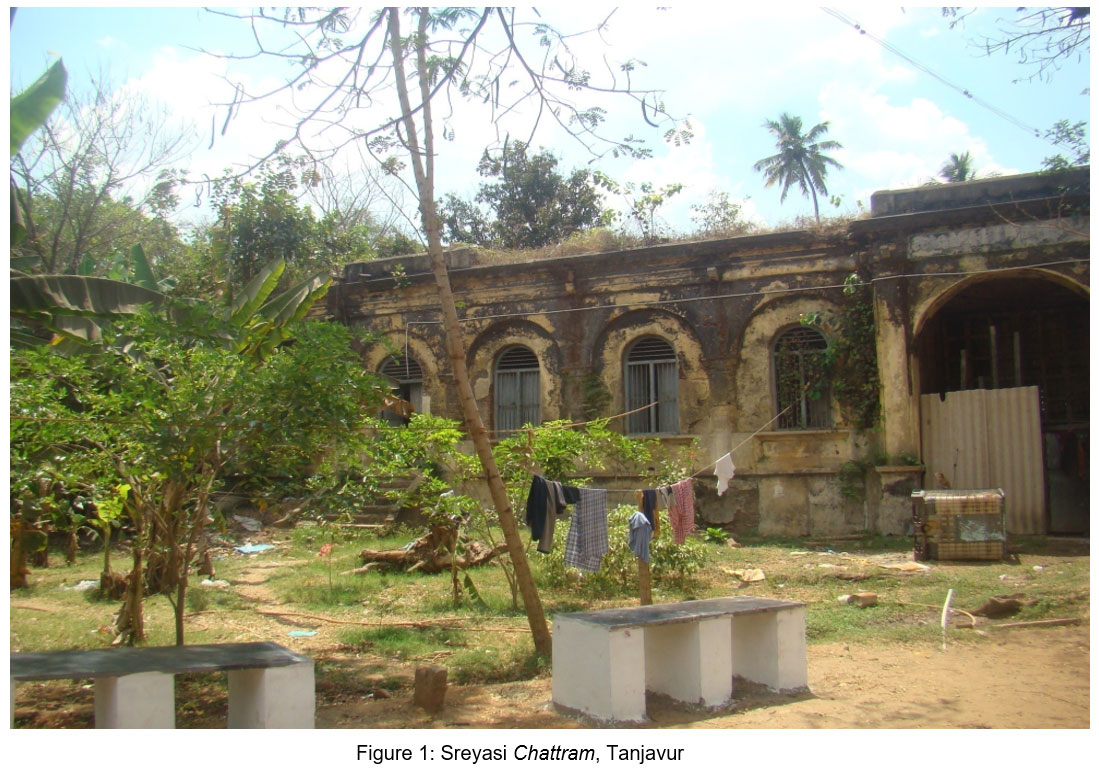 |
Figure 1: Sreyasi Chattram, Tanjavur. Click here to view Figure |
Tanjavur Maratha Chattrams—A Survey of their Architecture and Art
Hitherto, studies on Maratha architecture have been mostly confined to their palaces, forts and to a lesser extent, their temples. The Marathas are particularly known for their defence architecture. Indeed, Chatrapati Shivaji has been hailed as one of the greatest fort-builders. But the Maratha chattrams, although not adequately studied, are equally important from the perspectives of both architectural innovations and the artwork within them.
Like the Maratha palaces, the Maratha chattrams reflect the peculiar socio-political conditions of their times. From a historical perspective, the Marathas originally hailed from Western India and were undoubtedly 'foreigners' with their own distinctive art and cultural traditions, when they first settled in Tanjavur. But they appear to have quickly adjusted themselves to the new environment and their chattrams naturally contained elements of both the Maratha style and the native Tamil tradition. Many of these chattrams appear to have been modeled on the region’s Hindu temples of an earlier period, mainly the Medieval Chola and Vijayanagar period temples. In fact, some chattrams actually house a temple within their premises. Simultaneously, atleast some of these buildings also exhibit Islamic architectural features including long rows of Islamic style columns and cusped arch openings. These buildings were erected at a time when the European Colonial powers, mainly the British, were rapidly colonizing large parts of India including Tamil Nadu. Thus, these chattram buildings occasionally even display certain elements of the British or Colonial architecture.
The Tanjavur Maratha chattrams are normally massive buildings. They are brick-built and lime-plaster structures. They have spacious pillared halls (dormitories), dining rooms, kitchens, open courtyards and bathrooms. The roof of the chattrams are generally of three types: vault roof, tile roof and the Madras terrace roof which is a flat roof composed of a series of wooden beams, parallel to each other, and covered by a layer of bricks held in position with lime mortar. Often, a single chattram displays two or more types of roofs. The vault roof is seen in certain sections of the chattram of Orathanad. The inclined tiled roof is seen in the Rajamadam chattram which, however, earlier had a thatched roof. The Madras terrace roof (flat roof with wooden reapers) is mainly seen in the Kalyana Mahal and other chattrams built by the last two Tanjavur Maratha kings--Sarfoji II (1798-1832) and Shivaji II(1832-1855). The pillars in the various chattrams also display wide variety in form and design. Plain as well as profusely carved circular, square and octagonal pillars are seen in different chattrams.
A few of the Tanjavur Maratha chattrams are known not merely for their architectural grandeur but also for their exquisite artwork such as stucco and brick-cut sculptures and wall paintings. Some of the chattrams also had excellent woodwork decoration such as octagonal wooden pillars with crockets and sculptures of warriors and horses as in the chattram at Rajamadam. Most of these wood carvings have, however, been destroyed.
A detailed architectural analysis of the three biggest and well-preserved chattrams is furnished below:
Yamunambal Chattram, Nidamangalam
From the perspectives of history and architecture, this is one of the most important chattrams of the region. It is one of the earliest and biggest chattrams of the Tanjavur Marathas. In terms of art and architecture, it served as a forerunner for many later chattrams. . But unfortunately, due to its rather obscure location and various other reasons, it is not as well-known as the chattrams in Tanjavur and Tiruvaiyaru.
It is believed that Pratapasimha(1740-1764) built the Yamunambal Chattram in memory of his queen Yamunambal who died during pregnancy. This is a large chattram with massive solid walls. The brick and plaster walls have been raised on a granite plinth. Two ornate colonnades project on either side of the front hall or entrance court and appear to be like moving chariots, having been provided with strong stone wheels. Each colonnade has atleast two wheels, some of them broken. The Marathas appear to have borrowed this idea of ‘wheeled structures’ from both the Chola and the Vijayanagar kings who built such chariot-shaped chambers or mandapams in some of their temples (The Medieval Chola dynasty king Rajaraja II erected a chariot-shaped chamber, with wheels moved by horses, within the Airavatesvara Temple (twelfth century) at Darasuram near Kumbakonam, within the Tanjavur Maratha kingdom. This is the most famous wheeled structure in this region. There are a few more chariot-shaped or wheeled structures, probably built around the same time, in the temples at Tiruvalanjuli, Kumbakonam and other places in the region. Krishnadeva Raya, the famous Vijayanagar monarch, erected a chariot-shaped structure made of a single piece of stone, complete with wheels, in the Vithala Temple at Hampi in Karnataka(early sixteenth century).
The present chattram is one of the few chattrams to have underground rooms or chambers that were accidentally discovered in 1897 when the building was undergoing major alterations. (Hemingway, 1906, p. 228). The chattram displays sculptures on the ceiling, walls and pillars. The balustrades flanking the small flight of steps, leading to the front hall or entrance court, feature elephant figures. This hall exhibits sculpted brickwork wherein the red bricks themselves are carefully cut and carved and placed as part of the pillared structure. This brickwork art is overlaid with stucco and paint. These columns have prominent brackets fashioned to resemble banana flowers and the domes over them are also intricately carved. In the chamber behind this front hall, the vaulted ceiling exhibits sculptures displaying swans and parrots in stucco. The exterior wall displays stone sculptures featuring various themes such as warrior on horse and woman playing the vina, a very popular musical instrument of the Maratha period. The figures of warrior on horseback are strikingly similar to the sculptures featuring the same theme in the Vijayanagar-Nayak temples of a slightly earlier period. Some of the sculptures in this chattram feature love scenes. Such sculptures are not common in Tamil Nadu but are occasionally seen in temples and other buildings in Central India and the Deccan.
Muktambal Chattram, Orathanad
This is the largest and one of the most beautiful among the chattrams of the Tanjavur Marathas. It was built by Sarfoji II around 1802 A,D. There are many accounts pertaining to the origin of this building. According to one such account, this was originally a small palace that Sarfoji built for his favourite queen or mistress Muktambal. On her request, the palace was later converted into a chattram. According to another account, the king established this chattram to fulfill the last wish of Muktambal. It is believed that the building also served as a royal camping place when the king and his officials visited this area from Tanjavur. This explains the chattram’s unusually large size and elaborate artistic ornamentation unknown in any other Maratha building in this region. During the Maratha period, apart from its use as a chattram and as a royal camp or retreat, a Veda patasala (Veda school) also functioned in this building (Krishna, 1994, p.17-18). The school had hundreds of students on its rolls(Krishna, 1994, p.17-18). During the reign of Sarfoji, priests performed several Vedic rituals and sacrifices in one of the bigger halls of this chattram (Somasundaram, 1935, p. 58-59).
As regards architecture and art, the Muktambal Chattram shares several common characteristics with the Yamunambal Chattram of Nidamangalam. Probably, the latter served as the prototype for the former. The Muktambal Chattram has a granite plinth, and the brick walls and columns are raised over this plinth. The chattram has two large courtyards at the entrance. One of them is partially enclosed by two ornate colonnades, parallel to one another. Each of these colonnades is shaped like a chariot, with stone wheels having twelve spokes each, drawn by horses. There are four wheels at the base of each colonnade. Behind these courtyards, there are a series of smaller courtyards and halls that comprise the living quarters. The kitchen and the rear yard are further behind. The first floor has ornate halls with columns. Like the chattram at Nidamangalam, this chattram also boasts of exquisite sculpted brickwork that adorns the entrance court. These brickwork columns, unlike the ones at Nidamangalam, have been left unpainted and unplastered, and thus, when sunlight falls on them, a magnificent red glow fills the hall. As in Nidamangalam, these columns have conspicuous brackets in the form of banana flowers and the domes over them are also richly carved. Again, as at Nidamangalam, the balustrades, flanking the small flight of steps leading to this hall, display elephant figures. The granite plinth bears a profusion of sculptures. The slender pilasters, rising above the plinth, exhibit charming female figures playing musical instruments.
Kalyana Mahal Chattram, Tiruvaiyaru
This is one of the most well-known and well-preserved chattrams in the region. It was definitely built by Sarfoji II who built many of the other buildings in the neighbourhood. But the exact date of the chattram is not clear. He probably built it as a small chattram around the same time when he built the Muktambal Chattram in Orathanad (around 1802). After his pilgrimage to Varanasi in northern India (early 1820s), he appears to have enlarged or renovated the Kalyana Mahal chattram. This renovation may have been a part of Sarfoji’s bigger program to build and expand several buildings on the banks of the rivers in his kingdom after his observation of the riverbank architecture of Varanasi (Suresh, 2015, p. 68-75). It is said that this building was initially erected for use by the 24 queens or concubines of Sarfoji before it became a full-fledged chattram.
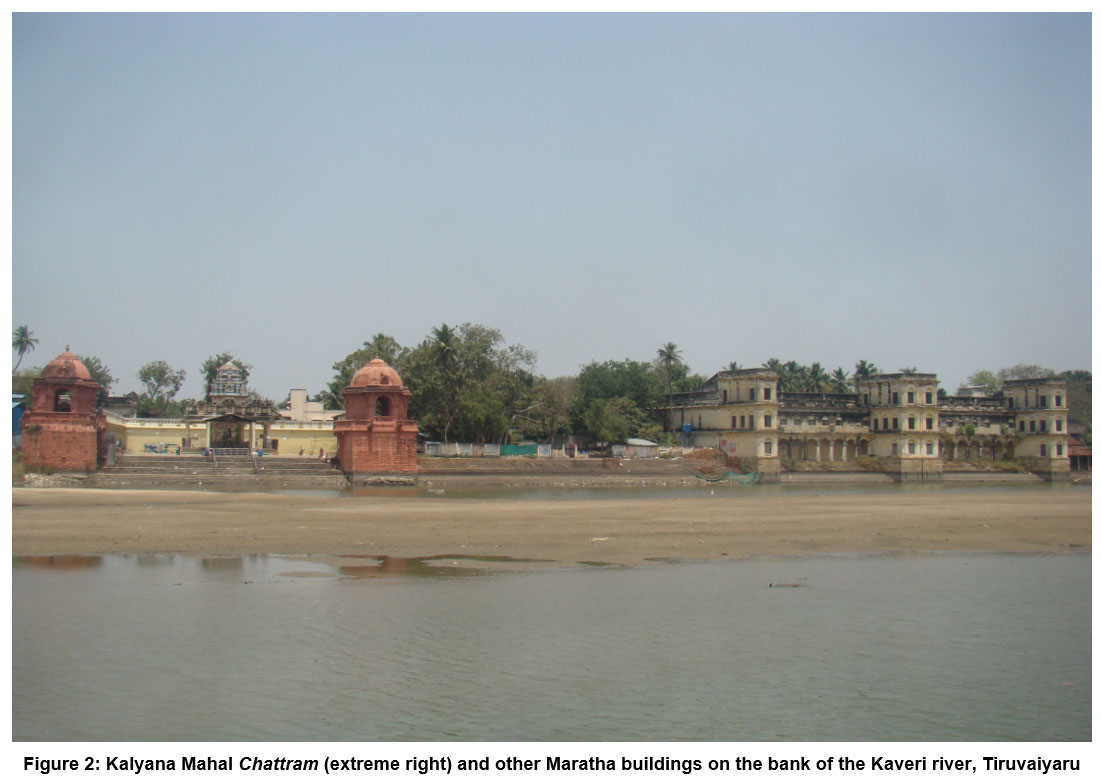 |
Figure 2: Kalyana Mahal Chattram (extreme right) and other Maratha buildings on the bank of the Kaveri river, Tiruvaiyaru. Click here to view Figure |
Interestingly, the Kalyana Mahal building within the fort at Gingee (Tamil Nadu) was also meant for the use of the queens. One may recall that this fort was under the Marathas in the late seventeenth century. Plausibly, the Kalyana Mahal of Gingee inspired the Kalyana Mahal of Tiruvaiyaru since both share certain stylistic and design features (Suresh, 2015, p. 68-75).
The Kalyana Mahal Chattram is located on the banks of the river Kaveri, with some sections of the structure actually projecting into the river bed (Fig. 2, building on right). The building mainly consists of three distinct sections or bays linked to one another by pillared verandahs and rooms. The living quarters consist of rooms and corridors surrounding courtyards. Some sections of the building exhibit wall paintings featuring Hindu deities. Stucco sculptures featuring peacocks and dancing figures are seen above the archways between the pillars.
Chattram Administration
The Tanjavur Marathas had a very efficient administrative system to maintain the chattrams. The chattrams were under the overall administrative control of the senior officials stationed in the capital city of Tanjavur. In addition, the local officers within each chattram managed the day-to-day affairs of that particular chattram. Sometimes, the local residents provided voluntary service for the maintenance of the chattrams in their neighbourhood.
The chattrams yielded substantial revenue by means of royal grants and donations from the travelling public. The chattram officials maintained meticulous records of the institution’s income and expenditure including details of the accounts relating to the purchase of rice and other foodstuffs. These records, mostly in the Marathi language, were periodically sent to the Sarasvati Mahal Library in Tanjavur (Fig. 3) where they are preserved to this day. Some of the chattrams mentioned in these records are, however, now not traceable.
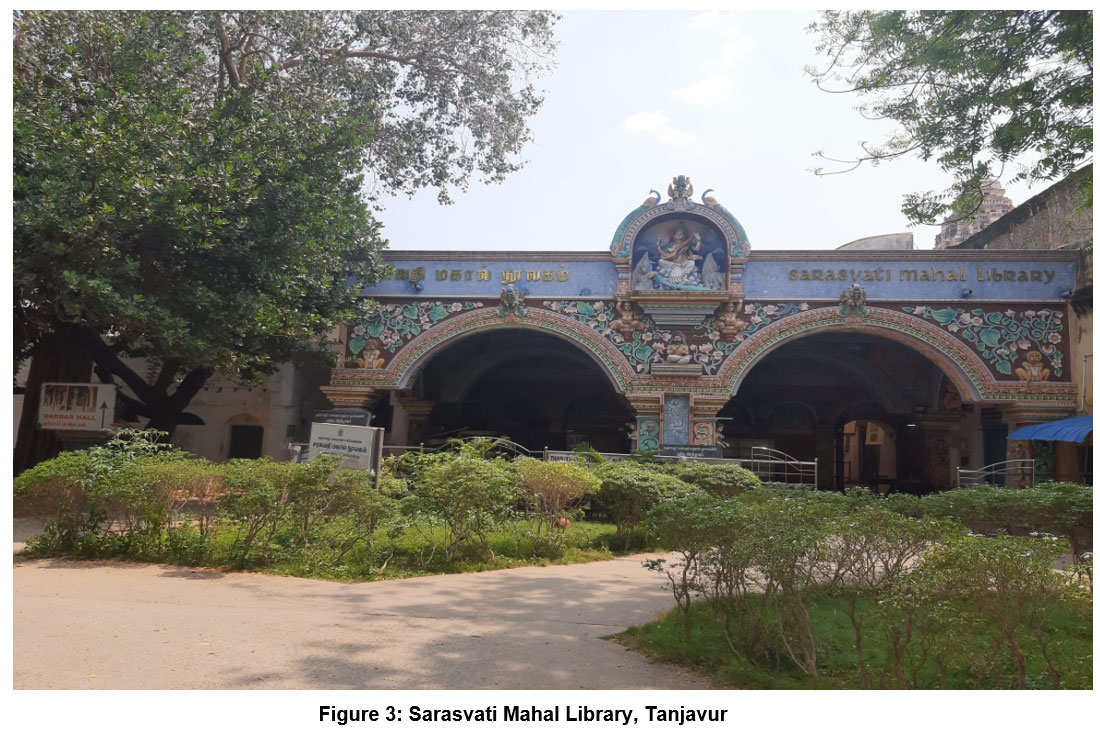 |
Figure 3: Sarasvati Mahal Library, Tanjavur Click here to view Figure |
The Chattram as a Socio-economic Institution: Discussion
The basic concept of a chattram is that of a resthouse-cum-feeding house. But in the Tanjavur Maratha kingdom, the chattram reached its most mature stage of evolution and often became a large self-contained institution with its own source of water-supply, kitchen gardens, poultry farms, hospitals, dance auditoriums and even small temples attached to it (Suresh, 2015, p. 68-75). The manifold activities of the chattrams included feeding the poor and the needy and provision of separate accommodation for different classes of travellers such as Brahmins, traders, soldiers and even foreigners. While some people stayed for a few hours or days, others halted for a few weeks or even months. Families that wanted to stay in the chattrams but desired to cook their own food were permitted to do so and were provided with grains, vegetables and firewood. Sometimes, the chattrams hosted special feasts for the inmates and neighbours. The chattrams also offered special facilities including highly nutritious diet to pregnant women and lactating mothers. The hospitals inside the chattrams were, in most cases, offering options of Western and the traditional Indian systems of medicine. These hospitals served those staying in the chattrams and others. The doctors in some of these hospitals regularly corresponded with their counterparts in the Dhanvantri Mahal, the big hospital established by the Maratha king Sarfoji II within the palace in Tanjavur. Sometimes, doctors in the chattram hospitals referred seriously sick patients to the Dhanvantri Mahal. The chattrams also provided shelter, food and medical facilities to the animals such as cows and horses accompanying the travellers. Often, schools and colleges functioned within the chattrams. These educational institutions catered to the children of the inmates of the chattrams and also the neighbouring public. Many of these schools and colleges had a playground where the students were given training in sports and athletics, mainly wrestling. The chattram at Malliyam even had an auditorium where performances, mostly by female dancers, were regularly held. Even the Maratha king, during his visits to this area, witnessed these performances.
The Tanjavur Maratha queens appear to have played a significant role in the establishment and maintenance of many of the chattrams. Several chattrams bear the names of the queens. For instance, the Mohanambal Chattram at Rajamadam is named after Mohanambal, the queen of Tulajaji II (1764-1787) who built this chattram. Again, some of the villages and settlements adopted the name of the local chattram. To mention an example, the area around the Muktambal Chattram (in Orathanad) is called Muktambalpuram. Invariably, the queens administered the chattrams. Many of the chattrams were endowed with large tracts of lands and hence, the king often gifted these chattrams and the lands surrounding them to some of his queens and concubines and in return, these queens and their children were not supposed to claim the throne or any other property of the king. Thus, the chattrams often avoided succession disputes.
The chattrams exercised profound influence on the socio-cultural life of the Marathas. These institutions provided employment to hundreds of people. The chattrams also promoted the growth of various arts and crafts. Sculptors, carpenters and painters could display their skills on the doors and walls of these buildings.
The Marathas were immensely proud of their chattrams. They considered the erection and maintenance of these institutions as a meritorious service, a noble act of charity that will bring good to them in this life and in the next. These gorgeous chattrams, with their lush gardens and airy courtyards, were indeed indispensable to the local public and the weary travellers traversing the region during the inhospitable tropical summers in the pre-motor car age.
Conclusions
When the Tanjavur Maratha rule ended in 1855, the royal family’s properties including the temples and the chattrams came under the British Colonial administration. A protracted legal battle ensured the return of the temples to the legal heirs of the erstwhile rulers. The administration of the chattrams, however, continued to remain with the government14. At present, the District Collector of Tanjavur district—the district’s seniormost administrative official—administers the chattrams and their properties. Tanjavur is the only district in Tamil Nadu, probably in the whole of India, to have a separate chattram administration department. With the introduction of railways and other contemporary means of transport and communication, and hotels and hostels suiting all budgets, the role of the chattrams has considerably diminished. Most of them no longer serve their original purpose. The income from the lands belonging to the chattrams is not always adequate to maintain these huge buildings. Many of the chattrams are now rented out to schools or are used as shops or warehouses for storing rice or salt. A few are kept locked or else, the buildings have been simply destroyed or demolished.
Presently, Tanjavur region is the only place in the entire country to have a large network of chattrams erected by a single dynasty. In recent years, local heritage lovers and voluntary cultural organizations such as INTACH (the Indian National Trust for Art and Cultural Heritage) have been trying to enlighten the local people and the administration about the historical and architectural importance of these chattrams. Thanks to these efforts, atleast some of the bigger chattrams such as the Muktambal Chattram of Orathanad are now being restored and preserved as archaeological monuments for tourism. Simultaneously, there are plans to convert some of these buildings into museums. Such adaptive reuse will ensure the long-term survival of these valuable heritage buildings.
Acknowledgement
I have been researching on the art, architecture and culture of the Tanjavur Marathas from my college days. I gratefully acknowledge the help and guidance that I received from several senior scholars during different stages of my research. In particular, I acknowledge the help of Prof. Indira Viswanathan Peterson and Prof. N.S. Rangaraju.
Conflict of Interest
The author does not have any conflict of interest
Funding Source
The author has received no financial support for the research and/or publication of this article.
References
1. Aiyar, R. S. (1980) History of the Nayaks of Madura, Madras, University of Madras, 165-166.
2.Gordon, S. (1998) The New Cambridge History of India—The Marathas 1600-1818, New Delhi and Cambridge, Foundation Books (by arrangement with Cambridge University Press), (pp. 01-89).
3.Suresh, S. (1993) “Along the Pilgrim Route”, The India Magazine XIII (12), 06-17.
4. Bhosale, S. Babaji R. (date not stated), Raja Serfoji II, Tanjavur, published by the author, 11
5. Krishna, N. (1994) Painted Manuscripts of the Sarasvati Mahal Library, Tanjavur, Thanjavur Maharaja Serfoji’s Sarasvati Mahal Library,17-18.
6.Hemingway, F.R. (1906) Madras District Gazetteers—Tanjore, Volume I, Madras, Government Press, 228.
7.Krishna, N. (1994) (Supra N.4) 17-18.
8.Somasundaram, J.M. (1935) The Great Temple at Tanjore, Madras, published by the author(?), 58-59.
9. Suresh, S. (2015) The Tanjavur Marathas—Art, Architecture and Culture ,New Delhi, INTACH and Aryan Books International, 68-75.

This work is licensed under a Creative Commons Attribution 4.0 International License.