
Mixed Method Approach to Assess the Current Research Practices in Higher Education Institutions in Khyber Pakhtunkhwa
Faheem Khan1 * , Sadia Bibi2 , Asif Minhas3 , Ishrat Fatima4 , Ume Ruqia Saadat2 and Naila Noreeen Kanwal5
1Regional Professional Development Center (RPDC), D. I. Khan, Pakistan .
2Gomal University , D. I. Khan, Pakistan .
3Qurtuba University of Science and Information Technology, D. I. Khan, Pakistan .
4Department of Special Education, AIOU, Islamabad Pakistan .
5Govt. Girl High School, Bashir, Jhang, Pakistan .
http://dx.doi.org/10.12944/CRJSSH.6.1.13
The current research paper aimed to investigate the current research practices in Higher Education Institutions (HEIs) in Khyber PakhtunKhwa (KP). The study was Mixed Methods Research (MMR) and thereby convergent Parallel design was used. A sample 254 participants were taken out of 695 individuals through Yamanes (Yamane, 1967) formula. A self-developed questionnaire, checklist and semi-structure interview were developed. Analysis of variance (ANOVA) was used as inferential statistics to analysis the quantitative data while thematic analysis was used to analyze the qualitative data. The result of study indicates that collaborative research environment in the HEIs. HEC approved supervisors available in the institutions. Thesis evaluation process found transparent but lengthy. The study found that paper publication is one of the difficult tasks for the teachers and students.
Copy the following to cite this article:
Khan F, Bibi S, Minhas A, Fatima I, Saadat U. R, Kanwal N. N. Mixed Method Approach to Assess the Current Research Practices in Higher Education Institutions in Khyber Pakhtunkhwa. Current Research Journal of Social Sciences and Humanities. 2023 6(1).
DOI:http://dx.doi.org/10.12944/CRJSSH.6.1.13Copy the following to cite this URL:
Khan F, Bibi S, Minhas A, Fatima I, Saadat U. R, Kanwal N. N. Mixed Method Approach to Assess the Current Research Practices in Higher Education Institutions in Khyber Pakhtunkhwa. Current Research Journal of Social Sciences and Humanities. 2023 6(1). Available from:https://bit.ly/45HBqtO
Download article (pdf) Citation Manager Review / Publish History

Introduction
The 21st century is regarded as the era of new discoveries, innovations, and knowledge. Universities are essential for producing knowledge based on research, which is knowledge that springs from research. Universities are thus thought of as the hub of knowledge and research (Zafar, 2013). Higher education institutions must do research as part of their core mission, and the quantity and calibre of such research are determined by its status. Because knowledge generation (research), knowledge management, and knowledge transformation are three of higher education institutions' primary goals, universities, in particular, play a key role in teaching and conducting research (Ali et al., 2018).
Research is one of the fundamental components of universities' functions all over the world, along with teaching and service, which are the three main functions of higher education institutions. (Ullah et al., 2011) The progress of knowledge is one of the HEIs' main responsibilities, and this can only be accomplished by engaging in real research procedures across a variety of disciplines and levels of study. Genuine research methods in HEIs not only improve the standing of the institutions and the state's economy, but also serve as a reliable yardstick for teacher promotion (Riaz et al., 2017).
All Higher Education Institutions and all Degree Awarding Institutions (DAIs) operating under HEC's supervision and direction are governed by the Higher Education Commission (HEC), which is the primary regulatory agency in Pakistan. Enhancing educational standards and carrying out real research projects that adhere to international norms are HEC's two main goals. HEC has therefore implemented a number of efforts to support the capacity for research in HEIs, making it a powerful organisation. Professors at HEIs have a variety of voices, and the government or HEC considers their concerns about the standard of the research conducted at HEIs (Muborakshoeva et al., 2015). Faculty members are expected to do their part in carrying out research activities by HEIs. High research output and a solid research culture are two of the administration of HEIs' top priorities. As a result, HEIs are under constant pressure to improve their research output (Mirza et al., 2012). In addition, HEC supports research initiatives by funding them and publishes their findings in prestigious journals. HEC provides workshops and training sessions to improve faculty members' research abilities. Such initiatives are made to instill a research culture inside HEIS (Iqbal et al., 2018) There are different research practices employed in the HEIs but the most common research practices are employed in the universities including Environmental Research Practice (ERP), Institutional Research Practices (IRP), Personal Research Practices (PPP), Thesis Evaluation Research Practices (TERP) & Paper Publication Research Practices (PPRP) (Batool et al., 2018) (Haq et al., 2020). The current research paper looks at how social science departments now conduct their research and investigates the challenges that academics and faculty face when doing their own research. However, there is no proof that these research are carried out in social science departments, despite the fact that there have been a number of uncommon studies done in this area. However, the current study was conducted in higher education facilities in Khyber Pakhtunkhaw, where research studies are typically conducted. Following research objectives are made to achieve:-
- To examine the present research practices through stakeholders’ views in perspective environmental, institutional, individual, thesis evaluation and paper publication practices.
- To find out the barriers and challenges face by the stakeholders in existing research practices
Significance of the Study
A thorough image of several areas of contemporary research practises, including environmental, institutional, personal, thesis evaluation, and research publication, would be provided by the current study. The current study would offer a fresh perspective on new scholarly research trends. The study will also give a thorough picture of the areas where the government should concentrate its efforts and where other parties can contribute to the establishment of high-quality institutions of higher learning in the nation. The results of this study would provide thorough documentation for university policy makers, who may use it to advance academic institutions and eliminate flaws in the current research system.
Literature Review
Higher Education in Pakistan
Pakistan only has one university, the University of Punjab, Lahore, since its independence. The University of Karachi was founded in 1950, following independence. In the years that followed, HEIs began to grow. The first private university was founded in 1984 by Lahore University of Management Sciences (LUMS), and Agha Khan University followed in 1985. From 1971 to 1977, public university enrollments experienced their first significant growth. In 2007, there were 18 private universities and 50 state universities; by 2012, there were 145 universities; and by 2019, there will be 195 universities (Batool, 2018).
Based on the suggestions made by educators and other participants in the first national education conference, which was presided over by Quide-Azam Muhammad Ali Jinnah, the University Grant Commission (now known as the Higher Education Commission) was established as a federally regulated department in 1947. Both the public and private sectors of HEIs have experienced expansion, especially after the establishment of the Higher Education Commission (HEC) in 2002. Assessing, enhancing, and promoting higher education through articulating the research culture at HEIs across the nation is a crucial function of HEC. For the purpose of promoting socioeconomic development, HEC also establishes policies, rules, and regulations that apply to all HEIs and Degree Awarding Institutions (DAIs) in the nation (Ali, Saeed, & Munir, 2018).
Existing status of research culture in HEIs in Pakistan
A governing and financial authority for higher education institutions in Pakistan, the Higher Education Commission (HEC) has implemented numerous reforms to strengthen the research capacity and created policies to create a vibrant research culture in the universities. However, despite such reforms, there are still dissident voices from university professors who are worried that HEC or the government are doing nothing to address the major barriers to raising the calibre of research at universities. Additionally, like other emerging viewpoints, those worries about the improvement of university research quality and the majority of academics scarcely have the freedom for critical dialogue on the major difficulties faced by HEIs (Subhani et al., 2017)..
Numerous research studies have examined the national origins of the positive and negative features of university research excellence. The access rate in Pakistani universities was only 2.6%, but according to (Naoreen et al., 2014) it has improved to 8.3%. This increase is remarkable. Even in many affluent nations, such the UK, Korea, and the USA, the access rate has increased to 90%. The main cause of the low rate is the government of Pakistan's low budget allocation of merely 0.2%. In contrast, the budget for entry rates in European nations is greater than all of Pakistan's HEC financing.
The growth of meaningful and purposeful research in comparison to earlier practices is another notable shift in the research sector; claim (Haq et al., 2020). Universities have never before received funding from HEC to file patent applications or to renew them. The total number of research papers published reached 12,000, with 8163 of those publications appearing in journals with high impact factors. Furthermore, according to HEC, 32 university-related patents have been issued, with 9 of them coming from various Lahore institutions and the rest ones coming from various HEIs in Karachi and Islamabad. Natural and biomedical sciences account for the majority of patents issued. Only four universities publish extremely influential research, although they are not among the top ten nations for research paper publication rates. To improve the quality of HEIs' research, the government and HEC change the regulations and offer them more freedom. The establishment of private universities in Pakistan since 1980 has been made possible by this flexibility. Agha Khan University, Lahore University of Management Sciences, and other private universities with active research agendas are only a few examples. HEC, however, is the primary source of new research in Pakistani universities (Muborakshoeva et al., 2015). In addition, HEC supports research initiatives by funding them and publishes their findings in prestigious journals. HEC provides workshops and training sessions to improve faculty members' research abilities. Such initiatives are made to instill a research culture inside HEIS (Iqbal et al. 2018). Lodhi (2012) highlighted that since 2002, the number of PhDs generated by public colleges has been steadily rising. These data demonstrate the public universities in Pakistan's acceptance of a vibrant research culture. But there is still more work to be done to change the focus of the teaching staff in Pakistani institutions from the prevalent teaching culture to a strong research culture. At order to maintain a strong research culture in Pakistani institutions, new rules and reforms are therefore still being implemented.
Research Practices in HEIs in Pakistan
The quality research output and standards of institutions, according to (Nguyen et al., 2014) are significantly influenced by a supportive and encouraging research environment. There are several aspects that influence the productivity of research, and one of those that has an impact on the entire research process is the environment. Due to strong and poor research environments, respectively, the productivity of research may improve or decline at the organisational level. In order to increase research productivity, a good research environment should allow staff members to collaborate and have access to essential tools. Such a setting raises academics' levels of motivation and creativity at the university (White et al., 2012).
The institutional variables might comprise a variety of elements, such as policies, administration, management, objectives, and facilities, among others. The institutional research methods also include workshops and activities that are research-focused. Additionally, it entails publishing research articles and sending several letters and emails to instructors and other staff members asking for information on the research project (Ali et al., 2018). (Nguyen et al., 2014) stated that a major obstacle to conducting research is a lack of time and resources. Appropriate time management is a prerequisite for proper research efforts. Making plans for allocating the appropriate amount of time for research tasks is therefore crucial.
Research productivity is influenced by a variety of personal characteristics, including research knowledge, encouragement for research-based activities, and research experience (Haq et al., 2020).(Iqbal et al., 2018) claim certain faculty members are unwilling to conduct research because they lack the necessary research abilities. Programs for developing research skills should be strengthened for staff members who lack these capabilities so they can undertake research work and improve their research abilities. HEC was founded in the nation to help the country reach its goal of high-quality research. The HEC's primary goal was to harmonise Pakistani universities. Universities receive funding from HEC in order to accomplish the goals of high-quality research. It is vital for the PH.D thesis to be examined by international examiners in order to attain the goal of excellent research. It means that producing high-quality research rather than just a lot of theses is valued more highly (Khan et al., 2017).
Pakistan is a developing nation with limited resources, and its colleges lack the necessary equipment and facilities, according to (Yusoff et al., 2013). As a result, Pakistani academics have many difficulties when doing their study. They have to deal with a number of other obstacles in addition to financial ones. For instance, when students wish to publish their research paper or thesis, they are unsure of how and where to do it. Regarding the publication of their research article, they lack any reliable information. They haven't come across any reliable advice. They therefore face numerous difficulties in this regard (Hashmi, 2015).
Research Methodology
The current research aimed to investigate the current research practices in HEIs in KP. Therefore, Mixed Methods Research (MMR) was used. There are different designs of MMR but researcher used Convergent Parallel research design. MMR is method of research in which a research problem is investigated through qualitative and quantitative data collection and analysis. Convergent parallel design involves simultaneously gathering quantitative and qualitative data, combining the data, and using the outcome to comprehend the study challenge (Sahin et al., 2019).
Population and Sampling
The population of the study consisted of all lecturers, assistant professors, associate professors, and professors employed by eight public universities in Khyber Pakhtunkhwa. Out of the 692 faculty members that made up the population, a sample of 254 was chosen using the stratified sampling method. The sample size was established using the mathematical procedure proposed by Yamani in 1967.
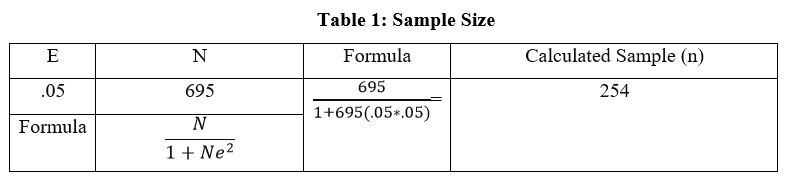 | Table 1 Sample Size Click here to view Table |
Research Tool
Three research instruments used for the data collection i:e questionnaire, checklist and semi-structure interview. For the aim of gathering data, a self-created questionnaire was used. There were two sections to the questionnaire. The instrument was divided into two parts: the first section dealt with the demographic characteristics of the respondents, such as age, gender, and level of experience. Information about five research practices was included in the second part. There were 68 itemes contained in the questionnaire on five point Likert scale based on five existing research practices.
Validity and Reliability of Research tool
Item Congruence-Objectives Index was used to validate the questionnaire (IOC). Cronbach's Alpha was used to assess the instrument's internal consistency. The IOC's primary goal is to assess the research instrument's content validity. Cronbach's alpha and IOC scores are shown in Table 2.
Table 2: IOC and Cronbach’s Alpha Score
Dimension | No. of Items | IOC | Cronbach’s Alpha |
ERP | 13 | .05-0.9 | .879 |
IRP | 13 | 0.7-0.9 | .737 |
IRP | 14 | 0.5-1.0 | .815 |
TEP | 12 | 0.7-1.0 | .879 |
PPP | 16 | 0.6-0.9 | .769 |
In order to determine the validity of qualitative data, triangulation is frequently used. Data from the current study's questionnaire, checklist, and interview were triangulated. By using several data collection sources, the triangulation procedure was applied in this study to assure the quality of qualitative data and limit the possibility of conclusion bias. In order to ensure the accuracy of the data in this study, the researcher included deans, heads of department, faculty members, and MPhil and PhD scholars in the data collection process.
Data Analysis
Analysis of Variance (ANOVA) was used as inferential statistics to analyze the statistical hypotheses whereas thematic analysis was used to analysis the data gathered from interview.
Table 3: Position wise Information of Respondents
Position | Frequency | Percentage (%) |
Dean | 7 | 1.1 |
HODs | 21 | 9.4 |
Teachers | 62 | 35.9 |
MPhil/PhD Students | 164 | 53.5 |
Total | 254 | 100.0 |
Information on the participants is shown in Table 4.1 in terms of their status and position. According to the table, there were 615 participants in the study, of which there were 7 deans (or 1.1%), 21 heads of department (9.4%), 63 faculty members (5.9%), and 164 students (or 53.5%).
Table 4: Views of stakeholders regarding current research Practices
Dimensions | df | F | Sig. |
ERP | 251 | .054 | .000 |
IRP | 251 | 26.54 | .000 |
IRP | 251 | 16.98 | .001 |
TEP | 251 | 13.94 | .000 |
PPP | 251 | .032 | .287 |
Table 4 shows the views of respondents regarding research practices in the selected HEIs in KP. The result indicates that there is significant difference among the views of respondents regarding environmental research practices (p=.000<.05), institutional research practices (p=.000<.05), individual research practices (p=.000<.05) and thesis evaluation research practices (p=.000<.05). The table shows that there is no significant difference in the views of stakeholders regarding paper publication practices (p=.287>.05).
Table 5: Respondents Views regarding research practices across selected Universities
Sum of Squares | df | Mean Square | F | Sig. | ||
ERP | Between Groups | 3.305 | 6 | .551 | 9.565 | .000 |
Within Groups | 35.011 | 608 | .058 |
|
| |
IRP | Between Groups | .467 | 6 | .078 | 1.195 | .307 |
Within Groups | 39.618 | 608 | .065 |
|
| |
PRP | Between Groups | .295 | 6 | .049 | 1.124 | .347 |
Within Groups | 26.564 | 608 | .044 |
|
| |
TEP | Between Groups | .471 | 6 | .079 | 5.763 | .599 |
Within Groups | 62.550 | 608 | .103 |
|
| |
PPP | Between Groups | 119.315 | 6 | 19.886 | .020 | .000 |
Within Groups | 527.511 | 608 | .868 |
|
| |
The results of an analysis of variance (ANOVA) to determine the mean difference between respondents from particular higher education institutions (HEIs) with relation to various research procedures are presented in table 5. The results show that there was a significant difference between the respondents' perspectives on ERP (p=.000.05 with F=.551). The outcome also shows that there were no statistically significant differences between respondents' perspectives on IRP, PRP, and TEP (p=.599>.05, F=5.764), IRP (p=.307>.05, F=1.19), and PRP (p=.347>.05, F=1.12), respectively. The results show that there was a significant difference between the respondents' perspectives on PPP (p=.000.05 with F=.020).
Table 6: Result of Checklist
S# | Statement | No. University | Yes | No | % |
1 | Availability of Seminars room. | 07 | 07 | 0 | 100% |
2 | Availability of IT room. | 07 | 07 | 0 | 100% |
3 | Availability of labs. | 07 | 07 | 0 | 100% |
4 | Established Students Research Committee | 07 | 04 | 03 | 57% |
5 | Up-to-date library. | 07 | 02 | 05 | 71% |
6 | Availability of internet facility. | 07 | 07 | 0 | 100% |
7 | Photocopier facility | 07 | 05 | 02 | 71% |
8 | Availability of HEC approved Supervisors | 07 | 07 | 00 | 100% |
9 | Turnitin account for Scholars. | 07 | 02 | 05 | 28.7% |
10 | SPSS Software | 7 | 7 | 0 | 100% |
11 | Newsletters | 07 | 0 | 02 | 28.7% |
12 | HEC recognized (W,X,or Y)Journal | 07 | 00 | 07 | 0% |
Qualitative data Analysis
The table 6 shows that all of the selected HEIs (100%) have well-equipped labs and internet access, but that the libraries only have outdated books (71%). Only a small percentage of colleges (57%) have a student research committee (SRC). Only 28.7% of universities give students access to Turnitin accounts. Additionally, just 28.7% of universities published newsletters for their research activity. The table demonstrates that there is not a single HEC-recognized journal from any of the selected universities (0%).
The interview's recorded data was converted into research language. The following text was converted into codes and developed themes. For the sake of secrecy and anonymity, pseudonyms were employed in place of participants' real names.
Theme 1: Environmental Research Practices
One respondent uses the following words to express his thoughts on ERP:
"Universities have joint research and development environments." Institutions have supervisors on hand to help students talk through research-related difficulties. HODs organised official gatherings of supervisors and scholars to discuss research issues. Additionally, supervisors are accessible to students who need technical support for their research thesis. (Rspnd#4)
An additional interviewee provided his ERP-related experiences:
“The university administration provided supervision and support to scholars and supervisors. Collaboration in research is a good sign for a university. Researchers have several possibilities to participate in various research activities, such as lectures and workshops, to hone their research techniques. The department does not have any organised research clubs, but meetings are scheduled through boards that have been informed (Rspnd#8)
Theme 2: Institutional Research Practices (IRP)
One participant provided the following responses when asked by the researcher about the current IRP:
"The institution has its own facility with a fully-stocked IT lab. Because the institution's library has obsolete literature, I encountered issues as a supervisor with updated materials. Because books are so expensive, neither I nor my students can afford them. On the other hand, although we have access to the HEC digital libraries, sometimes opening them was problematic. Most online journals offer high-quality research, but at a hefty cost that makes it difficult for everyone to buy these papers. In order to improve research output, it is the obligation of the institution to make these reputable journals accessible (Rspnd#2)”.
When the researcher inquired regarding the issuance of a monthly magazine, the participant responded, "Yeah, this is a drawback that institution still isn't able to print a monthly magazine (Respnd#14)".
Theme 3: Individual Research Practices (IRP)
One of the interviewees stated the following regarding PRP after the interview: "I directly allocate work to MPhil and PhD students, and then thoroughly check it. Most students struggle with report writing, developing instruments, and data analysis techniques. Yes, I concur that pupils are not aware with how to utilize SPSS. In 2019, I also taught a class about SPSS and developing synopses with the financial support of HEC. Additionally, I would want to point out that most students depend on their supervisors, and very few of them are interested in doing research. Since a lack of student interest in research is one of the major problems facing HEIs, I believe that universities should host workshops to increase student interest in research (Rspnd#20).
A response from a respondent mentioned the employment of the pledgrism method.
“To be quite honest, the university didn't give us a Turnitin account to assess the originality of our theses or research papers. Because only supervisors have accounts on Turnitin, we are entirely dependent on them. Due to the absence of a Turnitin account, we are unable to verify the originality of our own thesis. Thus, the university should make a Turnitin account available (Rspnd#22).”
Theme 4: Thesis Evaluation Practices (TEP)
One of the respondents described the plagiarism and evaluation process as follows:
"The similarity index are preliminary checked through Turnitin and the report is sent to student (if similarity index is greater 19%) to reduce the similarity index but if the similarity index are less than 19% then the report are sent to Quality Assurance Cell (QAC) for final plagiarism. The plagiarism report is forwarded to the QAC representative (Rspnd#6).” When the researcher questioned about the length of the plagiarism process, one of the respondents said, "It depends on the workload on QUE since sometimes plagiarism procedure cost time and sometimes they alerted swiftly (Rspnd#10)."
Theme 5: Paper Publication Practices (PPP)
In the following words, a faculty member described her experience with paper publication: "Paper publication is one of the challenging tasks in Pakistan. The HEC Journal Recognition System (HJRS) is a search engine in Pakistan that ranks a selection of HEC-approved journals in the schedule categories (W, X, and Y) based on several ranking criteria. There is fierce competition among scholars, and there are very few Pakistani journals on the HJRS list. The foreign journals on the HJRS list have high prices that are out of reach for both scholars and instructors (Rspnd#9).
One of the scholars shares her experience regarding paper publication practices in the given words:-
“Three issues I encountered while publishing my research publication. The supervisor does not provide adequate direction or guidelines, there was no instruction on how to write and publish a research paper, and the publication procedure is where the final issue arises. While overseas journals didn't respond appropriately, local journals had too much competition. The journals' fee rate (Rspnd#20) was also too high (Rspnd#14).”
Discussion
According to the current study's findings, stakeholders are satisfied with the environmental practices. The findings from the qualitative research support the notion that university environments, including those for collaborative research, the free exchange of ideas in formal gatherings, and the organisation of workshops and seminars, are up to par. Similar result was given by (Heng et al. 2020). They looked at the collaborative atmosphere that existed in universities. The majority of university supervisors are found cooperative reported by (Javed et al., 2021). For assistance with their theses, supervisors are always available to research scholars. The current study's findings suggest that institutional practises are deemed to be satisfactory. The conclusions of the quantitative research are supported by the findings of the qualitative data. Both physical facilities and IT resources are accessible to students. The findings of the present study are in line with those of (Batool, 2018) and (Nguyen et al., 2016). According to the study's findings, stakeholders have similar opinions about how these are evaluated. Supervisors also review student theses before final submission. They consider the thesis examination process to be open.
Conclusions
The study indicated that similar opinions were held regarding the methods used in environmental research. Universities have a collaborative environment for research. In the institutions, supervisors are available to help academics talk about research-related difficulties. HODs organised official gatherings of academics' supervisors to discuss research issues and information. The investigation came to the conclusion that institutions have physical resources including classrooms, labs, libraries, and internet access. Additionally, the majority of institutional libraries contain out-of-date books. The study concluded from the qualitative data that one of the major obstacles in conducting literature searches for theses is that scholars have trouble accessing digital libraries. The study concluded that the process of thesis evaluation are transplant but lengthy. The study came to the conclusion that one of Pakistan's most challenging tasks is research publication, and the main cause is the culture of the research paper. Poor academic writing results in a research paper being rejected from a high-index journal. English is spoken as a second language in Pakistan, thus pupils have less vocabulary and weaker grammar skills, which results in subpar academic writing. This is the second factor. The study also found that publishing a research paper in a local publication is highly competitive, whereas paying for a foreign magazine is prohibitively expensive.
Recommendations of the study
According to the study, universities are having trouble getting the money they need to support a research culture. As a result, it is advised that the provincial government raise the grant to universities in order to improve the culture of research. It is recommended that HEC and universities provide incentives for the publication of high-caliber research papers in regional or local journals with a high impact factor.
Acknowledgement
The author would like to thank my mother, wife and my children (Muhammad Azan khan, Muhammad Farhan khan, Aiza Khan and Muhammad Rohan)
Funding
No Funding was received for this work
Conflict of Interest
The authors declare that they have no competing interest.
Reference
- Ali, A., Saeed, A., & Munir, A. (2018). “An Instrumental Perspective of Higher Education in Pakistan: From Public Good to Commercial Commodity.” Bulletin of Education and Research, 40(3), 95-114
- Batool, A. (2018). Relationship of Personal and Institutional Factors with Research Productivity among Faculty Members of Public and Private Sector Universities of the Punjab (Doctoral dissertation, University of the Punjab, Lahore).
- Hashmi, A. M. (2015). “Obstacles to Publishing and what to do about them.” Journal of Pakistan Psychiatric Society, 12 (2).
- Haq, I. U., & Tanveer, M. (2020). “Status of research productivity and higher education in the members of Organization of Islamic Cooperation (OIC).” Library Philosophy and Practice (ejournal), 3845.
- Heng, K., Hamid, M., & Khan, A. (2020). “Factors influencing academics' research engagement and productivity: A developing countries perspective.” Issues in Educational Research, 30(3), 965-987.
- Hoodbhoy, P. (2009). “Pakistan's higher education system—What went wrong and how to fix it.” The Pakistan Development Review, 48(4), 581-594.
CrossRef - Iqbal, M. Z., & Mahmood, A. (2011). Factors related to low research productivity at higher education level. Asian social science, 7(2), 188.
CrossRef - Javed, Y., Ahmad, S., & Khahro, S. H. (2020). “Evaluating the research performance of Islamabad-based higher education institutes.” SAGE Open, 10(1)
- Khan, N., & Aajiz, N. M. (2017). Assessment of MPhil/PhD education scholars in public and private universities in Pakistan
- Lodhi, A. S. (2012). “A pilot study of researching the research culture in Pakistani public universities: the academics’ perspective.” Procedia-Social and Behavioral Sciences, 31, 473-479.
CrossRef - Mirza, N., Qazi, W., & Rawat, K. J. (2012). “Research culture in Teacher Education: a study of the perception of university teacher educators in Pakistan.” European Journal of Social Sciences, 28(4), 559-568.
- Muborakshoeva, M. (2012). Islam and higher education: Concepts, challenges and opportunities. Routledge.
CrossRef - Naoreen, B., & Adeeb, M. A. (2014). “Investigating academic research culture in public sector universities of Pakistan.” Procedia-Social and Behavioral Sciences, 116, 3010-3015
CrossRef - Nguyen, Q. H., & Klopper, C. J. (2014). “The influences of research environment within a university on research productivity of academic staff-a case study in a research-oriented university in Vietnam.” International Journal of Arts & Sciences, 7(2), 189.
- Riaz, H., Jabeen, N., Salman, Y., Ansari, N., & Moazzam, A. (2017). “A study of higher education reforms in Pakistan: Key reforms and drivers.” Journal of the Research Society of Pakistan, 54(2)
- Sahin, M. D., & Öztürk, G. (2019). “Mixed Method Research: Theoretical Foundations, Designs and Its Use in Educational Research.” International Journal of Contemporary Educational Research, 6(2), 301-310
- Subhani, M. I., Osman, A., & Nayaz, M. (2017). “Role of higher education commission (HEC) in promoting research output in Pakistan.” The EUrASEANs: journal on global socio-economic dynamics, (3 (4)), 93-100
- Ullah, M. H., Ajmal, M., & Rahman, F. (2011). “Analysis of quality indicators of higher education in Pakistan.” Canadian Journal of Social Sciences, 1(1), 1-5.
- White, C. S., James, K., Burke, L. A., & Allen, R. S. (2012). “What makes a “research star”? Factors influencing the research productivity of business faculty.” International Journal of Productivity and Performance Management.
- Yamane, Taro. (1967). Statistics: An Introductory Analysis, 2nd Edition, New York: Harper and Row.
- Yusoff, R. M., Khan, F., Mubeen, A., & Azam, K. (2013). “A study about factors influencing the university performance.” Jurnal Teknologi, 64(2).

This work is licensed under a Creative Commons Attribution 4.0 International License.