
The Dialogic Relations between Text and Image: The Grimms’ Snow White in Tarsem Singh’s Creative Film Adaptation
Sayaka Oki *
1Faculty of Global and Regional Studies, Doshisha University, Kyoto, Japan .
http://dx.doi.org/10.12944/CRJSSH.7.1.05
The folktale of Snow White, penned by the Brothers Grimm in 1810, has been adapted to various media since its original handwritten manuscript. In examining the intermedial transition of fairy tales, this paper focuses on the process by which the literary genre of fairy tales is, in principle, based on adaptation: oral traditions, texts, illustrations, and films. Therefore, this paper focuses on the definition of the term adaptation. Intersemiotic transpositions from words to images have a specific sense of transcoding. This paper explores the manner in which the iconography of Snow White is interpreted in relation to gender discourse in Tarsem Singh’s contemporary film Mirror Mirror (2012) and how the film transposes and expands aspects such as characters’ passive and active roles, their expression of emotions, and morals. The analysis is based on Linda Hutcheon’s adaptation theory (2006). Considering this film thematizes female empowerment as a significant aspect, it also cites Laura Mulvey’s gaze theory (1975). This study concludes that a visual narrative is created through dialogic relations between text and images, aiming to create an immersive effect.
Copy the following to cite this article:
Oki S. The Dialogic Relations between Text and Image: The Grimms’ Snow White in Tarsem Singh’s Creative Film Adaptation. Current Research Journal of Social Sciences and Humanities. 2024 7(1).
DOI:http://dx.doi.org/10.12944/CRJSSH.7.1.05Copy the following to cite this URL:
Oki S. The Dialogic Relations between Text and Image: The Grimms’ Snow White in Tarsem Singh’s Creative Film Adaptation. Current Research Journal of Social Sciences and Humanities. 2024 7(1). Available here: https://bit.ly/4fy0isO
Download article (pdf) Citation Manager Review / Publish History

Introduction
The year 2012 marked the two-hundredth anniversary of the publication of Grimms’ Snow White (1812) and the seventy-fifth anniversary of the release of Walt Disney’s Snow White and the Seven Dwarfs (1937). In 2012, four film adaptations were released by directors from different nations: Mirror Mirror (US) by Indian director Tarsem Singh; Snow White and the Huntsman (US) by English director Rupert Sanders; Blancanieves (Spain) by Spanish director Pablo Berger; and Miroir mon Amour (France) by French director Siegrid Alnoy. A creative adaptation of Grimms’ primary text is evident in the 1937 Disney film, particularly in the alteration of the fearful element present in the queen’s three attempts to kill Snow White, which is condensed into just one attempt with the poisoned apple. Additionally, the film accentuates her yearning for true love, notably in the enchanting scene where she first encounters the handsome prince by the wishing well. “Some Day My Prince Will Come” sung by Adriana Caselotti livens up the portrayal of romance (Johnson and Ghez, 2018, 1-12).
Parallel to this perspective, all four films from 2012 explored the motif of anxiety. This concept significantly shaped the dynamics between the protagonist and the queen in these 2012 films. Juez (2021) conducted a comprehensive study in this field, examining the factors that contributed to the differences between the Grimms’ source text and its cinematic adaptations. To summarize the primary research results, the following aspects of the differences between source text and films are highlighted in her study (Juez, 2021, 373-385): 1. More or less explicit scenes of sexual intimacy. 2. The protagonists’ age changes — “Schneewittchen” in the original tale means “Little Snow White” and she is a seven-year-old girl. However, in the version by Disney and others, the protagonists are between the ages of 16 and 18. 3. Snow White (with the seven dwarfs) and the wicked queen are depicted as polar opposites; and 4. Regarding the third point, the motif of female empowerment and representation of women and minority groups have been underlined.
In this context, Juez cited Singh’s message in the film, highlighting that “girl empowerment is such an issue […] I believe in it, and I come from a culture where they really don’t hold women very high […]. I think the pendulum was so swung against women for eons, and now it’s probably like taking a big lash to the other side and I happen to be in the middle of that swing” (Juez, 2021, 382; Gilchrist, 2012). This study aligns with Juez’s findings and aims to analyze the abovementioned creative film adaptation from a gender perspective. Understanding how cinematic methods produce visual and narrative effects needs to be examined.
The aspect of female empowerment emerges as the central point of discussion regarding the film, a notion emphasized by Gilbert and Gubar. They state that the image of “the angel in the house” was conceptualized from the male perspective in the 19th century (Gilbert and Gubar, 1979, 20). There is a large variety of female figures in the Grimms’ fairy tales who are characterized in contrast to the womanly “Biedermeier” ideals of the 19th century; for instance, an intelligent mother who can rescue her children from the evil wolf in The Wolf and the Seven Young Goats (KHM 5), an aggressive princess who hurls the frog angrily against the wall in The Frog Prince (KHM 1), a princess who does not want to accept a difference in social status in marriage and looks actively for a husband in The White Snake (KHM 17), a female cook who wins a competition against the male characters through wit and wisdom and acquires delicious chickens in Clever Gretel (KHM 77), or a widowed queen who arranges the wedding of her daughter without accompanying her to the bridegroom in The Goose Girl (KHM 89) (Classen, 2008). The women who appear in Grimms’ fairy tales are diverse and present a variety of psychological essences. Compared to the other female figures in the Grimms’ fairy tales, the iconography of Snow White reflects female submissiveness. The prince, as a lover, does not appear during Snow White’s life in the Grimms’ handwritten text from 1810 and in the final edition published in 1857. The prince makes his first appearance when Snow White lies in the glass coffin. There are no elements of romance to be found in the original text. The concept of connection through endogamy is common in pre-Christian Teutonic values and symbolic expressions, suggesting this custom can be found in the Grimms’ fairy tales (Weber-Kellermann, 1974, 36). Snow White’s case can also be recognized through this concept, as symbolized in the depiction of a wedding in the Grimms’ Snow White, as well as the scene where the prince declares his intention to take the glass coffin because the gold inscription on the coffin shows that “she was a king’s daughter” (Grimm, 1812, 257). From this perspective, the source story represents the protagonist’s selfless position since she cannot choose her spouse. This point of her life is exemplified when she escapes the huntsman’s attack and stumbles upon the dwarf’s cottage in the forest: “At the same time, however, her life with them is an important part of her education in submissive femininity, for in serving them she learns essential lessons of service, of selflessness, of domesticity” (Gilbert and Gubar, 1979, 40). Singh’s Mirror Mirror considers this aspect of the story and transforms the gendered nature of the text so that Snow White learns not only housekeeping in the cottage in the forest but also swordplay to fend off the queen’s attacks. She was an eighteen-year-old young woman who acted in accordance with people’s wishes living in a poor village under the rule of the wicked queen.
Given the adaptation’s consideration of the issue of a woman’s existence in the Snow White folktale, in terms of interpretation, one point of view is concerned with how to portray Snow White’s personality in the film. Snow White’s good morals, wit, and physical strength are highlighted in Singh’s film. This perspective characterizes the protagonist’s initiative toward the story. Her active use of gaze in particular contributes to this point. In the 1970s, film theorist Laura Mulvey discussed the gendered composition of films, specifically focusing on the aspect of the gaze. Mulvey explained that film composition traditionally adhered to the psychoanalytic dichotomy, where “[…] pleasure in looking has been split between active/male and passive/female. The determining male gaze projects its phantasy on the female figure which is styled accordingly” (Mulvey, 1975, 837). Singh’s film should be interpreted as depicting scenes in which female empowerment is achieved: The (de)construction of this binary structure of active/male and passive/female through the characters’ act of viewing becomes the film’s main strategy. Another specific film by the director also addresses this issue. The Cell (2000) explores the destiny of psychologist Catherine Deane in a futuristic society. She gets access to the subconscious mind of the serial killer Carl Stargher, whereby she realizes that the domestic violence within the patriarchal order he experienced in his childhood had caused psychopathy. Thus, his subconsciousness was visualized and reconstructed from Deane’s perspective.
Singh’s Mirror Mirror was based on the Grimms’ text (1812) while also incorporating the elements of Disney’s film (1937). For example, the soundtrack was composed by Alan Menken, renowned for his compositions in Disney films, who also composed music for Mirror Mirror. Singh’s film can be viewed as a commitment as well as a homage to these two works, whereby it creatively transforms their content according to modern values. Another focus point in this film is the visualization of the characters’ emotions. Since the purpose of Grimms’ fairy tale is to teach the reader morals and cause an educational effect, the story uses devices that evoke fear and provide a lesson (Ehrhard, 2015, 6). In the case of Snow White, it depicts the fear of facing a life-threatening force and the joy of a happy ending. These emotional antinomies are creatively adapted in this film through the use of verbal dialogs, facial expressions, color effects, and the introduction of the triad principle, which is typical of fairy tales.
Theorist Hutcheon, in her philosophical book A Theory of Adaptation (2006), noted that the relation between original and adaptation is often perceived in terms of hierarchizing impulse, whereby there is “the explicitly and implicitly negative cultural evaluation of things like postmodernism, parody, and now, adaptation, which are seen as secondary and inferior” (Hutcheon, 2006, 14). This is because an original can be recognized as the first and an adaptation is, contrarily, associated with “kitsch” and seen as secondary. However, “the act of adaptation always involves both (re-)interpretation and then (re-)creation” (Hutcheon, 2006, 8) and since it is based on dialogic relations, “adaptation is a form of intertextuality” (Hutcheon, 2006, 8). In this sense, “an adaptation is a derivation that is not derivative—a work that is second without being secondary. It is its own palimpsestic thing” (Hutcheon, 2006, 9).
Fairy tale as a literary genre based on adaptation: Snow White through telling and showing modes
Adaptation has gained importance, particularly with the emergence of new cinema media. Although it is evident that some adaptations stem from lengthy novels, whereby “the adapter’s job is one of subtraction or contraction” (Hutcheon, 2006, 19), not all adaptations are simply about cutting content. Conversely, “short stories, in particular, have often inspired movies […]. Short story adaptations have had to expand their source material considerably” (Hutcheon, 2006, 19). In the case of the fairy tale Snow White, the original text is short. Therefore, a film adaptation can be defined in relation to the director’s creative interpretation and interpretive creation, emphasizing the translation aspect: “In many cases, because adaptations are to a different medium, they are re-mediations, that is, specifically translations in the form of intersemiotic transpositions from one sign system (for example, words) to another (for example, images). This is translation but in a very specific sense: as transmutation or transcoding, that is, as necessarily a recoding into a new set of conventions as well as signs” (Hutcheon, 2006, 16).
Three patterns of adaptation have been identified (Hutcheon, 2006, 38-51): the most common adaptations involve a transition from telling to showing modes, which entails adapting literary texts to movies or stage performances such as musicals, theater, or opera. The second pattern entails transitioning from showing to another form of showing; for instance, films adapted into stage performances. The last form involves interacting with both the telling and showing modes. This third pattern can be interpreted as the adaptation of a novel or a computer-generated animation movie into a game with a gaming theme. This paper will discuss the aspects of the most common adaptations from telling to showing modes because the source texts are Grimms’ folktale in the handwritten text of 1810, the first published volume of 1812, and the last edition of 1857, and the showing mode is Singh’s film. In this context, the degree of immersion becomes significant because these three modes of engagement attempt to measure proximity to tales.
The source for Snow White remains uncertain; however, considering that Ferdinand Grimm’s handwritten text was passed down in 1808 and the folktale was recorded twice by Jacob Grimm, it is speculated that Marie Hassenpflug (1788-1856) was the original storyteller and that the story was told before 1808 (Rölleke, 1975, 380; Rölleke, 2022, 535). The oral tradition became a written form of a fairy-tale collection. Initially, the Brothers Grimm did not intend to write a children’s book but rather to collect authentic materials for the history of German literature. The collection began with a call to action by Achim von Arnim and Clemens Brentano in the autumn of 1805, when they published an anthology, The Boy’s Magic Horn: Old German Songs, aimed at collecting oral tales and stories that had been passed among people. The Grimms maintained close contact with Marie Hassenpflug. Hassenpflug knew an array of stories, including tales handed down from France (Michaelis-Jena, 1970, 68). Collecting folktales and publishing them as a volume can be recognized as a process of adaptation from oral composition to print. In a previous study, Stone explored three media types: oral, print, and film. Through the Brothers Grimms’ efforts in recording the tale, one version of Snow White emerged as the most renowned, that is, the “final” Snow White, “which became [the] ‘authoritative’ version” (Stone, 1991, 58), thereby preserving it from obscurity. Stone explained that “the brothers combined both oral and written traditions to produce a new literary form […] and apparently they were sincerely committed to re-creating what they conceived as a pre-Christian Teutonic literature” (Stone, 1991, 57).
One of the most symbolic features of pre-Christian Teutonic values in the Grimms’ Snow White is its direct relation to the description of marriage. The prehistoric values of the family are characterized by the description that marriage is the connection between two clans (Weber-Kellermann, 1974, 20-21). Therefore, romantic relationships between individuals are not a prerequisite. The legal contract was more important because the clans expected the birth of the male offspring from the bride “who continued his [the groom’s] lineage, could fulfill the duties of blood revenge and pay him homage after his death, and thus ensure his peace of mind” (Weber-Kellermann, 1974, 21). Snow White is forced to leave the castle because of her stepmother’s jealousy. The reason for this can be perceived in Snow White’s social role as the only legal child of the king; if she grows up, she will continue her father’s lineage. In this sense, Snow White becomes an obstacle to the stepmother’s existence. This idea persists in Singh’s film, shown in the scene where Snow White provokes the queen and decides to kill her.
[Snow White] You have no right to rule the way you do. And technically, I’m the rightful leader of this kingdom.
[Queen] Probably not the best thing you could have said just there […] I want her killed. […] She is a threat to everything. Take her to the woods and feed her to the beast. (Mirror Mirror 00:30:53-00:31:53)
This issue of marriage, synonymous with family lineage, is predominantly depicted in the climax of the fairy tale, where the miracle occurs. Miracles have long been understood as one of the most emphasized features the Grimms sought in their fairy tale genre from the outset (Rölleke, 1986, 40-41). An interesting fact is that magical fairy tales, which are defined by miracles, constitute at most one-third of Grimms’ fairy tales; however, nearly all of the most famous Grimms’ fairy tales are based on these magical fairy tales (Rölleke, 1986, 38). Snow White is counted as a magical fairy tale because the protagonist overcomes death.
The scene depicting the miracles surrounding Snow White’s death by the poisoned apple and her subsequent revival can be interpreted from the perspective of gendered social roles. The rescuer, the prince, arrives as Snow White dies and lies in the glass coffin; however, he does not appear as a lover in the story (Gilbert and Gubar, 1979, 21). The golden inscription of her name and ancestry as a king’s daughter can be seen on her glass coffin in Grimms’ 1812 text and their final edition in 1857. A marriage must not only show the woman’s name as an individual but also her ancestry. It can be interpreted that the prince would have taken the glass coffin to his castle because of her beauty and status as a princess. The golden inscription of Snow White as a king’s daughter written on the glass coffin guarantees Snow White’s sophisticated behavior and, at the same time, her beauty. It should be noted that instead of the prince, her father removed Snow White’s glass coffin in Grimms’ handwritten text of 1810. It is most likely that the father would have found a prince as her daughter’s groom at the end of the tale as it is written in a passive form that “Snow White was married off to a handsome prince and at the wedding, a pair of slippers were burned in the fire, which the queen had to put on and dance to death” (Grimm, 1810, 250). The woman’s intention regarding marriage is not described; therefore, the implication of the appearance of a handsome prince equals a happy ending. The last scene connotes the judgment of the red-hot iron: if the person concerned is guilty, the burned iron has a harmful effect. The wedding also serves as a scene of judgment for the tale. The earliest known text of Snow White from 1810 depicts Snow White’s mother, instead of her stepmother, as a villain who attempts to kill her. According to Bruno Bettelheim’s psychological study, the tale explores parent–child problems: the mother wants to kill her daughter with a poisoned apple (a symbol of sexuality because of its red color, which can be connected with sexual desire through sexual bleeding, i.e., menstruation) and rule over her country as the fairest woman, and the daughter leaves the parents’ house to grow (Bettelheim, 1976, 201). Snow White’s life in the dwarf’s cottage is free of inner conflicts which suggests “a pre-oedipal existence,” and the mother’s assassinations initially awaken her to sexual desires that were repressed (Bettelheim, 1976, 210). Acquiring sexual desire signifies a change from a latent, pre-oedipal life with the dwarfs to adolescence as a princess, symbolized by marriage. It is evident from a psychoanalytic point of view that the Grimms’ story is set up to represent Snow White’s growth and marriage, which secures her status as a princess.
By exploring features of the three medial modes—oral, print, and film—this transformation from one medium to another can be understood as a natural process of altering storytelling’s forms in the literary genre of fairy tales (Stone, 1991, 52). Remarkably, one medium that was not mentioned by Stone emerged between print and film. With the introduction of illustrations, several symbolic scenes in the fairy tale became representative rather than non-visualized scenes to immerse the audience in the plot. In the case of the Grimms’ Snow White, it is noteworthy that the last text passage, where the princess lies in the glass coffin, was selected from the story at first by Ludwig Emil Grimm (1790-1863) in the Grimms’ edition Kleine Ausgabe der Kinder- und Hausmärchen (1825). Following this, the motif of “Snow White in the glass coffin” continued to be a central theme in illustrations by artists such as Ludwig Pietsch (1824-1911) in 1858, Albert Louis Ulrich Hendschel (1834-1833) in 1871, Alexander Zick (1845-1907) in the book Märchen für Kinder published in 1886, and Heinrich Lefler (1863-1919) in 1905. The caricaturist George Cruikshank (1792-1878) illustrated the English edition of German Popular Stories in 1823. Two years later, the Grimms published the Small Edition of their fifty selected fairy tales, Kleine Ausgabe der Kinder- und Hausmärchen; this edition was designed with seven illustrations by Ludwig Emil Grimm, including an illustration for Snow White (Lauer, 1998). His illustrations were first authorized by the Grimms. Therefore, within the tradition of illustrating Snow White, Ludwig Emil Grimm’s illustration can be considered primary. It describes the scene in which the princess lies in the coffin and is being watched by a dwarf in the dark. This Small Edition contributed significantly to the success and dissemination of the Grimms’ fairy tale collection. However, the Brothers Grimm remained opposed to illustrating their books throughout their lives (Lauer, 1998).
The oral materials were initially collected as academic materials deeply rooted in the local area, accompanied by the Grimms’ preface and footnotes. After their publication in the second edition in 1819, the illustrations were included by Ludwig Emil Grimm at Arnim’s suggestion, signifying that the earliest volumes of Grimms’ work appeared to target an academic audience (Michaelis-Jena, 1970, 71). Ludwig Emil Grimm, known as the youngest brother of the Grimms and a painter, played a significant role in this aspect. Following this period, the practice of illustrating folktales gained popularity. Subsequently, editions published abroad provided decisive inspiration for illustrating fairy tales: In 1820, a fully illustrated partial edition of the Children’s and Household Tales was published in Amsterdam, and in 1823, the edition of German Popular Stories designed by Cruikshank was published in London (Lauer, 1998). Including illustrations in a book enables visual images to define the story. Consequently, the volume began to attract the attention of a new readership (Stone, 1991, 52).
With the visualization of the folktale, the creators reach a new audience that experienced varying degrees of immersion in the story. The critical view expressed in the discourse on transforming stories into films, advocated by Pauline Kael, is that intense engagement with a film can limit one’s critical sense (Peary and Shatzkin, 1977, 3). Films provide the audience with a clear story progression through visual and acoustic experiences (and with 4DX cinema, additionally olfactory and sensual experiences), so that the audience feels more present at the moment of the story when it is visualized and has images directly in front of them. Compared with movies, novels invite more interpretations through imagination. Novels are thought to depict the characters’ minds in detail, and readers can develop their minds by reading at their own tempo. Although Hutcheon introduces this view of the visual media’s difficulty in dealing with the mind space, she discusses the expressive potential of films through the “idea of a heterocosm or visual world as well as other aspects of the story” (Hutcheon, 2006, 14-15).
Singh’s film is based on the Grimms’ Snow White, and by incorporating effects unique to the film, it conveys the characters’ minds through “a double process of interpreting and then creating something new” (Hutcheon, 2006, 20). The fear and joy which are evoked as typical emotions in the fairy tale are represented by changing colors in the backgrounds and close-up shots of the characters’ facial expressions. The image of a static female figure in a glass coffin depicted in the illustrations in the 19th century, which showed the readers an image of womanly submissiveness as an idealized female beauty, is transformed into an active female figure using cinematic techniques; the film focuses on her courageous spirit through the frequent use of the dagger as a symbol. Before Snow White’s father went missing, he presented it to her, hoping that his still young daughter could protect herself against evil. The protagonist takes the dagger through her destiny, whereby it symbolizes her independence and self-consciousness. This dagger is displayed repeatedly when she fights the villain.
Balancing the iconography of Snow White with modern values of female empowerment: Degrees of immersion through transculturation, emotions, and close-up in the film Mirror Mirror
Transculturation and gender politics
Singh’s Mirror Mirror focuses on Snow White’s romance and her fight against the queen, showcasing her strengths. As a creative adaptation, the tale was expanded to 106 minutes in length with a specific sense of humor. Right from the beginning of the film, Prince Alcott of Valencia appears, influencing the plot significantly. Snow White’s father, the king, remarries after her mother dies, and later disappears into the forest. Thus, the king, who is usually perceived as the authoritative symbol of family lineage, is absent until the end of the story. A battle ensues between the queen and Snow White over the prince that directly concerns the ruler of the country. In this context, the power balance observed in the relationship between Snow White and the prince is particularly distinctive. This element of romance is associated with Disney’s film, in which the motif of romance is first introduced with an anonymous prince. The singing scene in front of the wishing well is dramatically portrayed with the song “I’m Wishing/One Song” featuring both female and male voices. However, in Disney’s film, the prince only appears after all adventures have concluded when Snow White lies in the glass coffin. In Singh’s film, Prince Alcott appears in the beginning and constantly intervenes throughout the story as one of the main characters.
From a gender perspective, Snow White’s dominance in relationships is remarkable. For example, she rescues a half-naked prince from being hung up by dwarfs, awakes him with a kiss after being given an aphrodisiac, and takes the initiative with the queen’s messenger, the beast. These scenes can be interpreted as reflecting the protagonist’s ability to manage difficult relationships. Unlike the passive and unconscious iconography of Snow White in a glass coffin, she exhibits consciousness in Singh’s films. During an interview with The Hollywood Reporter on March 31, 2012, the director explained his reasons for choosing women as the main characters in his film and how they play an active role, as follows:
I mean, before the Brothers Grimm there was never Snow White and her stepmother; it was Snow White and her mother. It was a very cautionary tale about girls living at home past a certain age. And then when the Brothers Grimm came along, they were like the original studio executives, and they kind of went “wait a minute, this isn’t good, it should be a stepmother.” But also, everybody knows it’s shortcut that you can take with an audience if you stick to a certain amount of what we expect from it—it allows you to move on. So it’s safe to say the stepmother, she’s allowed to be evil. And when you watch her as an old woman giving an apple to [Snow White], you’ll know it’s poisoned. But if that is the only tale you want to tell, that being a stepmother makes you evil, then I just think you need to stick to the original one […] (Gilchrist, 2012).
Singh’s creative field is wide-ranging, from personal projects to commercials. His artistic aspirations find resonance in the versatile career of Roman Polanski (Gilchrist, 2012), who has adeptly navigated studio films, personal films, and various other genres. It is within this context that the image of women in the film was created, with both Snow White and the queen depicted as charming characters (Gilchrist, 2012). In an interview, Singh expressed, “the pe[n]dulum was so swung against women for [eons]” (Gilchrist, 2012), indicating that despite advancements, the gender gap persists. According to the Global Gender Gap 2023, which includes scores for all 146 countries, none have achieved complete gender parity, even in modern times. However, the top nine countries (Iceland, Norway, Finland, New Zealand, Sweden, Germany, Nicaragua, Namibia, and Lithuania) have closed at least 80% of their gender gap (World Economic Forum, 2023, 10). A report on the Gender Wage Gap 2023 also highlights significant pay disparities between male and female workers based on race, ethnicity, education, age, and geographic division; on average, women in America are paid roughly 22% less than men (Gould, 2023).
In keeping with the concept of women playing active roles as protagonists, Singh’s depiction of the evil queen has important characteristics, which are comparable to the main character, Snow White. The queen assumes the role of the first-person narrator within the story—as she introduces “This is my story. Not hers” (Mirror Mirror 00:02:14), thus asserting her authority over the narrative. She begins by recounting the history of Snow White’s birth from her omniscient perspective at the beginning of the film and also depicts the result of the conflict between the queen and Snow White at the end of the film through the voice of the mirror, which is the shadow of the queen. In response to the question of whose story it is, the phrase “So it was Snow White’s story, after all” (Mirror Mirror 01:35:10) suggests a change in the narrator, such that the narrative frame structure shapes the film. Furthermore, the film creates a special immersive effect by establishing a separate virtual space within the story, an island with a “magic mirror” where only the queen can enter. Following the fixed formulas of the European folktale, the queen enters this mirror island three times. The triad episodes have a structural function in the Grimms’ fairy tales: “To a high degree, this preference for formulaic round numbers imparts a rigid quality to the folktale. Unlike the real world, the folktale knows nothing of numerical diversity and randomness; it aspires to abstract certainty” (Lüthi, 1982, 33). Through this triad principle, the queen is positioned in the film as a special representation of the significance of magic associated with the secret mirror’s power on the island.
The queen’s authority is visually emphasized by creating this virtual space, wherein she legitimizes using her beauty for marriage due to the financial gain from controlling the country. Female beauty is one of the film’s key features. In this sense, the beauty symbolized by the queen is “manufactured beauty” through the mirror’s magical power, whereas Snow White’s beauty can be interpreted as “natural beauty associated with the good morals” (Schul, 2015, 545). Snow White’s good morals are evoked in her choice of words, which embodies her personality: she prefers asking for things rather than ordering others to do them, and frequently uses the word “please.” She does not seek to become the leader of the country to satisfy her own vanity, but rather to help her people who are suffering. When she meets the prince at the ball held by the queen, she asks him to lend her his power to free the suffering people. This expression depicts Snow White’s conscience. In contrast, the magical island symbolizes the queen’s dominion over the country and is connected to the castle, the story’s primary setting, by a door; when she enters the island, the queen is visualized as suddenly emerging out of the sea. As Hutcheon presents the concept of “bridge cultures” (Hutcheon, 2006, 139) or describes it with the term “transculturation” (Hutcheon, 2006, 145-148), as one of the adaptation’s immersive effects, this film visually allows for a transition from a Western castle with the Oriental onion-shaped roofs (Fig. 1) to the southeast Asian “magic mirror” island (Fig. 2). This shift in locations indicates a magical realm unique to fairy tales, and at the same time, it also symbolizes that the magical power transcends boundaries.
This film mostly did not change in terms of time compared to the Grimms’ source text, as it begins with the phrase “once upon a time, in a kingdom far, far away a baby girl was born” (Mirror Mirror 00:00:48). However, it changed the place (a castle village, the queen’s wedding venue, and the queen’s magical mirror island are added to the castle, forest, and dwarf’s cottage, which are the main locations depicted in the source text) and the characters’ names (the anonymous prince became Alcott of Valencia and the seven dwarfs became Butcher, Napoleon, Grub, Half Pint, Wolf, Chuck, and Grimm). A focus on gender roles is one of the primary themes in this film, as it is pointed out that “transcultural adaptations often mean changes in racial and gender politics” (Hutcheon, 2006, 147). The reason for transcultural changes made in an adaptation can be considered from the perspective that the context of the social reception of the work has been involved: “cultures change over time. In the name of relevance, adapters seek the ‘right’ resetting or recontextualizing. This too is a form of transculturation” (Hutcheon, 2006, 146).
Emotions and close-up
The exploration of visualizing emotions as a feature of film adaptations was the next focus. One might inquire about the pivotal scene in Snow White, where the main character’s emotions are highest. It is arguably the anxiety depicted in the scene where the hunter attempts to kill her in the woods (Klein, 2021, 161). Additionally, in the film, one can observe the interplay of sadness and joy in her affair with the prince. Kael highlights that intense engagement in the film limits the critical sense (Hutcheon, 2006, 133). This sentence suggests that “movies are good at action; they’re not good at reflective thought or conceptual thinking. They’re good for immediate stimulus, but they’re not a good means of involving people in the other arts or in learning about a subject […] Movies don’t help you to develop independence of mind” (Peary and Shatzkin, 1977, 3). While some argue that texts or novels are suitable media to describe characters’ thoughts in detail and immerse the reader in vivid imaginary worlds, it can be pointed out that this film effectively visualizes the characters’ emotions through the use of cinematic techniques.
The emotions commonly depicted in the Grimms’ fairy tales or evoked by reading them should be indicated. The Grimms’ fairy tales have been a significant source of inspiration and influence on fantasy, particularly in the cinematic genre of horror. “Fairy Tales and horror films are kindred genres […] Numerous horror films have explicitly acknowledged their debts to the Grimms’ tales, and numerous writers […] have made the link between the two” (Kord, 2009, 203). The Grimms’ fairy tales often depicted both happy and cruel scenes as moral lessons. Originating from an oral tradition, where tales were passed down through generations, these stories played a dual purpose in educating children and adults. They served to entertain and uplift with pleasant narratives while also instilling a sense of unease through their darker themes (Ehrhardt, 2015, 6). Wilhelm Grimm’s letter to Achim von Arnim on January 28, 1813, reveals his awareness of the educational value of instilling fear: “When I was little, I heard my mother tell the fairy tale about the slaughter. It made me cautious and anxious while playing” (Ehrhard, 2015, 6). The depiction in the Grimms’ Snow White evokes terrifying emotions, as it is noted that “the anxiety [is regarded] as the basic element of the fairy tale” (Klein, 2021, 152). Leslie A. Fiedler points out that the genre of fairy tales tends to comprise a dichotomy of joy and fear, which also exists in the roots of popular literature: “It is easy enough to understand the meaning of ‘Getting Married,’ but the significance of ‘Being Eaten’ is less obvious. Yet cannibalism is an obsessive theme in the fairy tale […]” (Fiedler, 1973, 14).
The theme of cannibalism can be found in the Grimms’ fairy tales; Hansel and Gretel (KHM 15) provides a clear example of this as the witch intends to butcher and cook Hansel for her nourishment (Classen, 2021, 168). Cannibalism as the fearful motif in the Grimms’ fairy tales could have been influenced by a historical material. The Grimms were aware of a horrifying account about cannibalism from the historical facts of the Middle Ages provided by a Hessian traveler to the New World, Hans Staden (ca. 1525 – ca. 1579) who described a cannibalistic ritual ceremony by the members of the Tupinambá tribe near Curitiba, Brazil; his report was published as Wahrhaftige Historia und beschreibung eyner Landtschafft der Wilden Nacketen, Grimmigen Menschfresser-Leuthen in der Newenwelt America gelegen (1557) (Classen, 2021, 168). While the Grimms’ may not have immediately integrated narrative elements from Staden’s report into their story, their awareness of the historical fact may have influenced the theme and motif on the literary scenes filled with fear (Classen, 2021, 168). In the context of Snow White, the motif of cannibalism marks a crucial feature in the protagonist’s struggles during the rivalry between her and the queen. The act of having her life threatened by her (step)mother, who is supposed to be the person she is closest to and trusts, arouses such fear. The image of cannibalism is written in Grimms’ first edition as follows: “Take the Snow White out into the forest to a far, remote place, where she will die and as a landmark bring me her lungs and her liver, I will cook them with salt and eat them” (Grimm, 1812, 247). By portraying the girl as a child as young as seven years old, the inevitable tragedy is expressed. As if to suggest this, the story in the handwritten text of 1810 is entitled “Snow White. Unfortunate Child (Schneeweißchen. Unglückskind)” (Grimm, 1810, 244). According to the statements made by the Grimms, Snow White was one of the most famous fairy tales of their time in Germany (Kawan, 2005, 134). The story is well known and widespread, and many variants are documented throughout Europe; for example, in Greece (over 200), Latvia (around 165), Lithuania (over 70), Ireland (around 60), Italy (54), Estonia (almost 50), and the East Slavic region (almost 50) (Kawan, 2005, 133). The fact that stories such as these are being passed down from generation to generation means that similar sorrows must have occurred historically and have reflected the fundamental themes of human existence. The fairy tales themselves are written in a symbolic language through “sublimation” (Lüthi, 1982, 73) with pure, light, and transparent elements so that they include all the general human problems of existence, such as the term “world-encompassing (Welthaltigkeit)” which describes this constellation (Lüthi, 1982, 74).
When considering the scene in the film where Snow White’s life is threatened after evading a hunter’s attack, the audience experiences anxiety. The scene in which she runs away alone through a forest visually represents her struggle with fear. The blue-black trees embody the color of fear, while Snow White’s pure white dress and her black hair symbolize her innocence, as it follows that “the folktale prefers clear, ultrapure colors” (Lüthi, 1982, 27)—the scene where she escapes through the forest and collapses in front of the dwarf’s cottage (Fig. 3). The motif showing Snow White’s organs as proof of murder in front of the queen is retained.
[Brighton] Just as you instructed. That’s her liver, her kidneys, her spleen….
[Queen] That’s disgusting.
[Brighton] …and a few other assorted parts […].
[Queen] Wow, I feel amazing! Positively lightheaded. (Mirror Mirror 00:33:22-00:34:38)
In addition, whereas the Disney film reduces the number of attacks by the wicked queen to one, involving a poisoned apple, to avoid a cruel depiction, Singh’s adaptation aligns with the Grimms’ Snow White, featuring three attacks directly involving the queen: the first attack was by black magic using puppets (Mirror Mirror 01:04:31-01:07:43), the second attack takes place when the king is provoked and magically transforms into a beast (Mirror Mirror 01:22:32-01:30:00), and the third attack is presented with a poisoned apple as a gift during Snow White’s wedding (Mirror Mirror 01:33:45-01:35:08). All three attacks are filmed as Snow White herself fights the queen, having learned tactics from the seven dwarfs. As Gilbert and Gubar highlighted, while Snow White takes on the household in the dwarf’s cottage, as in the classical iconography of womanly existence in the 19th century (Gilbert and Gubar, 1979, 40), Singh’s adaptation reduces these scenes to one. There is only a single scene depicting Snow White’s domestic chores, where the seven dwarfs are welcomed for dinner after work (Fig. 4). The dwarfs, who were historically “the Freaks par excellence” (Fiedler, 1978, 81) and represented minorities, are progressive in this film. Namely, beyond domestic chores, they impart the art of living and, especially, the art of swordsmanship to the protagonist (Mirror Mirror 00:48:46-00:50:53). Faced with these attacks, the protagonist’s previously compliant state of mind undergoes a transformation, gaining mental strength. Thus, the painful attacks serve an educational purpose, empowering the main character to preserve life and champion justice for the people in the poor villages.
In Mulvey’s gaze theory on narrative cinema, it has been noted that a power relationship exists between the viewing (male) subject and the viewed (female) object— “woman as image, man as bearer of the look”—satisfying the manipulation of visual pleasure (Mulvey, 1975, 837). Films that are unconsciously structured in a patriarchal society allow the male protagonists to control events by using “the active power of the erotic look” (Mulvey, 1975, 838). In this context, female characters respond to male narrative control and play roles that resonate with the male gaze. Since the audience of the films identifies psychologically with the heroes, the female characters become objects to be viewed by the male protagonists as well as the audience. Female characters are therefore “isolated, glamourous, on display, sexualized” (Mulvey, 1975, 840). In Shin’s film, this viewing and viewed composition is deconstructively reversed between female and male characters. In the first half of the story, the queen controls the narrative events. The prince is portrayed as the character who symbolizes the youth and the handsome candidate of her idealized husband. For example, as the prince visits the queen in the castle for the first time, it is the queen who looks at the prince from the throne and interrogates him (Mirror Mirror 00:19:09-00:20:24).
In parallel to this, Snow White is the heroine who dominates and takes control of the story as her competition with the queen accelerates. When Snow White utters the gentle word “please” when asking for things, which is associated with her good morals, she is often shown in close-up shots, and her gaze is filmed directed toward the object. For example, in the scene where Snow White requests permission from the dwarfs to stay in their cottage, this theoretical consideration applies. The dwarfs said that unanimity was necessary for her proposal to be accepted, but one dwarf dissented. In that moment, Snow White’s face is filmed in close proximity, her gaze directed toward the dissenting dwarf (Fig. 5). The conventional close-up of a face can “integrate into the narrative a different mode of eroticism” (Mulvey, 1975, 838), but the effect of the female gaze in this scene serves to control the narrative structure from a female perspective. The effects of the gaze can also be acknowledged in the fight against the queen. Snow White led the queen’s first attack using black magic, resulting in victory. At the end of the battle, the protagonist was filmed looking down at the roof of the dwarf’s cottage, which was destroyed by the queen’s magical power (Fig. 6). This scene implies that the queen holds the upper hand as the subject through which this battle is viewed. Furthermore, although the situation is reversed from the Grimms’ source text, the scene where the princess kisses the prince to break his curse is also depicted in a close-up from the princess’s gaze (Figs. 7 and 8).
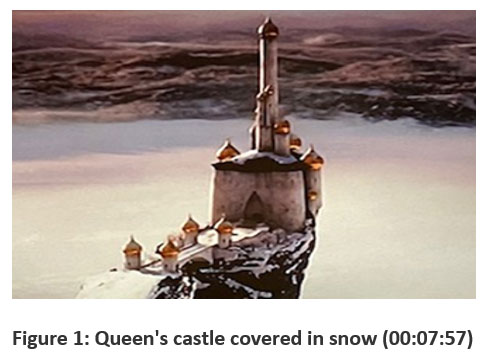 | Figure 1: Queen\'s castle covered in snow (00:07:57) |
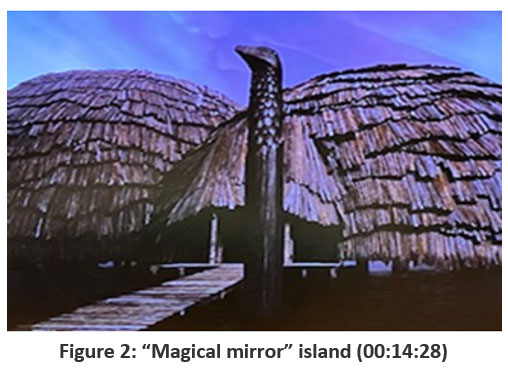 | Figure 2: “Magical mirror” island (00:14:28) |
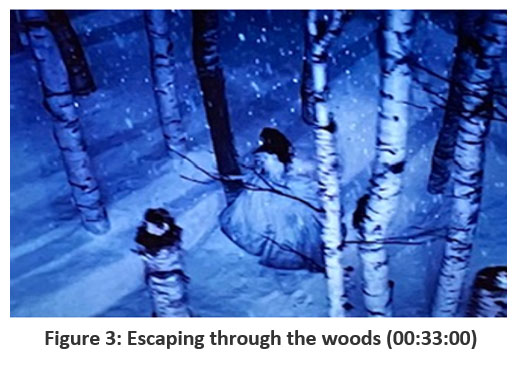 | Figure 3: Escaping through the woods (00:33:00). |
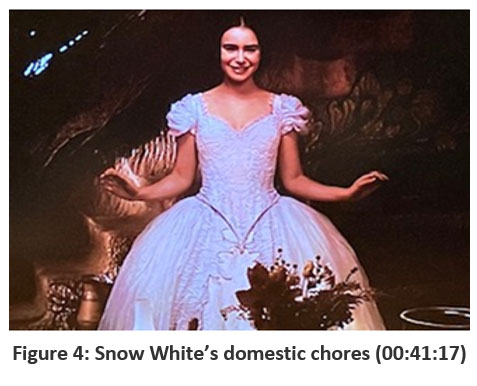 | Figure 4: Snow White’s domestic chores (00:41:17) |
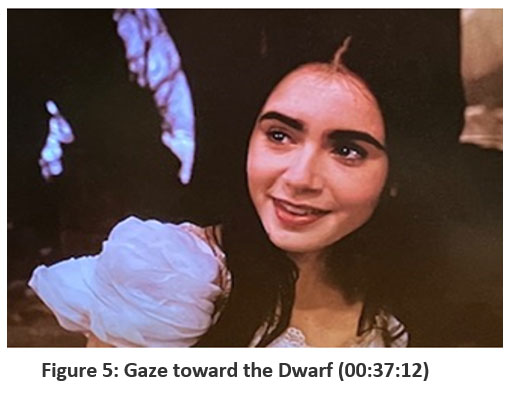 | Figure 5: Gaze toward the dwarf (00:37:12) |
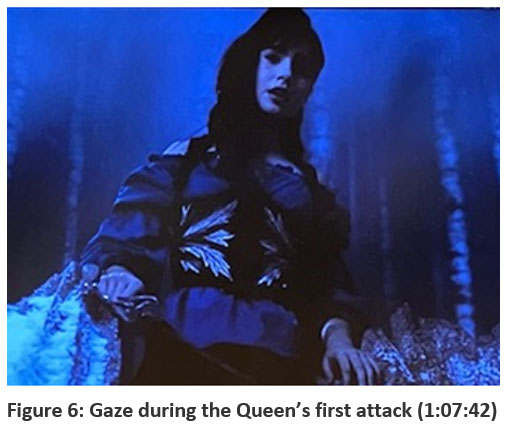 | Figure 6: Gaze during the queen’s first attack (1:07:42) |
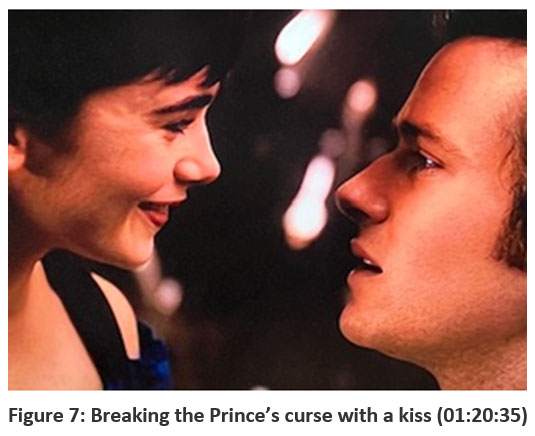 | Figure 7: Breaking the prince’s curse |
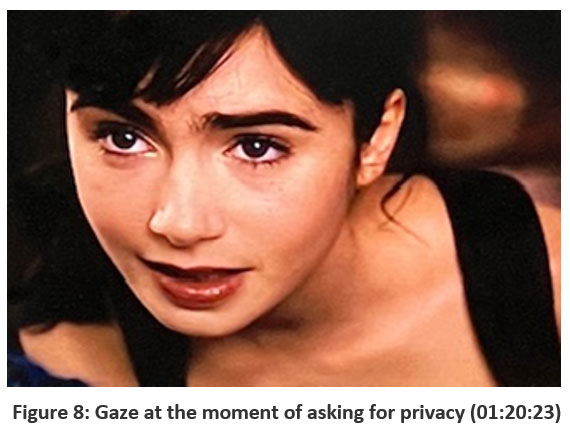 | Figure 8: Gaze at the moment of asking for privacy (01:20:23) |
The symbols presented as codes in the film contribute significantly to the visual expression of the characters’ emotions. The first code mentioned in the opening narrative frame is the crescent moon necklace, which symbolizes the magic produced in the relationship between the king and the wicked queen. Since the moon and stars often embody beauty and choice in German fairy tales (Horn, 2005, 154), the crescent moon necklace in the film serves the function of vindicating the queen who wears it as the most beautiful woman. Throughout the film, the crescent moon appears three times, serving to justify the queen’s authority: 1. In the queen’s narrative at the film’s outset (Mirror Mirror 00:02:24); 2. During the dance party and when the queen decides to kill Snow White (Mirror Mirror 00:31:12); 3. When Snow White breaks the curse placed on her father against the queen’s second attack (Mirror Mirror 01:24:10, 01:29:58). In the end, it is revealed that the relationship between the king and the queen was nothing more than deception; however, during the queen’s second attack, the crescent moon shines on the neck of the cursed beast. When Snow White notices this, she successfully breaks the curse, restoring him to his true form. Snow White’s bravery is characterized by the dagger, another symbol introduced in the opening narrative frame. This dagger also came into hand during the queen’s attacks. Notably, during the third attack involving the poisoned apple, Snow White discerns the queen’s tactics and uses the dagger to cut the apple. In this context, the dagger symbolizes her determination and courageous spirit.
Conclusion
This paper examined the gender discourse surrounding Snow White and analyzed the relationship between the Grimms’ source text and Singh’s creative film. Specifically, this paper considered that the literary genre of fairy tales lends itself well to adaptations, such as oral, text, illustration, and film. In this sense, the dialogic relations between text and images became significant. In addition, four films were produced in 2012 to mark the anniversary of Grimms’ fairy tale, including Disney’s film. Among them, Singh’s Mirror Mirror provided an opportunity to consider contemporary gender issues; one of the most popular motifs of the fairy tale illustrations in the 19th century, “Snow White in the glass coffin,” was an unconscious woman, a symbol of static beauty on display, which let the readers anticipate a happy ending. This glass coffin did not appear in Singh’s film. This fact reveals that the iconography of Snow White is changing from an object to be looked at to an active subject symbolized by the dagger. In addition to verbal expressions through their words, the female characters’ emotions and morals were visualized through the use of specific film techniques, such as the setting and change of locations, effective use of colors, and the use of the protagonist’s gaze. The queen’s authority and vanity stood in opposition to Snow White’s status as a princess, which was based on her strong conscience and sentiment toward her people. The characteristic triad repetition that frequently appears in the Grimms’ fairy tales as a fixed formula (Lüthi, 1982, 33/67) was preserved in the film, metaphorically demonstrating the queen’s magical power in the fictional realm. Film analysis was conducted through the following perspectives: 1. transculturation, 2. gender politics, 3. emotions, and 4. close-up. The analysis demonstrated that a female image was created in terms of female empowerment.
Acknowledgments
The author would like to thank Ludwig-Maximilians-University of Munich, Germany for granting the Ph.D. and would like to thank Doshisha University Kyoto, Japan.
Funding Sources
The author(s) received no financial support for the research, authorship, and/or publication of this article.
Conflict of Interest
The author(s) declares no conflict of interest.
References
- Mirror Mirror. Directed by Tarsem Singh, performances by Julia Roberts, Lily Collins, Armie Hammer, Nathan Lane, Relativity Media etc., 2012.
- The Cell. Directed by Tarsem Singh, performances by Jennifer Lopez, Vincent D’Onofrio, Vince Vaughn, Radical Media, 2000.
- Bettelheim, Bruno (1976) The Uses of Enchantment. The Meaning and Importance of Fairy Tales. London: Penguin Books, 199-215.
- Classen, Albrecht (2021) “The Fairy Tales by the Brothers Grimm and their Medieval Background.” The German Quarterly 94.2, 165-175.
CrossRef - Classen, Albrecht (2008) “Women in the World of the Grimms’ Fairy Tales.” Futhark: Revista de Investigación y Cultura 3, 125-154.
- Ehrhardt, Holger (2015) “Einleitung.” Märchen, Mythen und Moderne. 200 Jahre Kinder- und Hausmärchen der Brüder Grimm. Claudia Brinker-von der Heyde, Holger Ehrhardt, Hans-Heino Ewers, and Annekatrin Inger, ed. Teil 1. Frankfurt am Main: Peter Lang, 3-13.
- Fiedler, Leslie A. (1978) Freaks: Myths and Images of the Secret Self. New York: Simon and Schuster, 13-90.
- Fiedler, Leslie A. (1973) “Introduction.” Beyond the Looking Glass. Extraordinary Works of Fairy Tale & Fantasy. Jonathan Cott, ed. New York: The Stonehill Publishing, 11-20.
- Gerrig, Richard J. (1993) Experiencing Narrative Worlds: On the Psychological Activities of Reading. New Haven: Yale University Press.
CrossRef - Gilbert, Sandra M. and Susan Gubar (1979) The Madwoman in the Attic. The Woman Writer and the Nineteenth-Century Literary Imagination. New Haven/London: Yale University Press.
- Gilchrist, Todd. “Mirror Mirror: Director Tarsem Singh Talks about Subverting Snow White and Making Julia Roberts ‘An Evil Person You’ll Like.’” The Hollywood Reporter 31 March 2012. Retrieved from https://www.hollywoodreporter.com/ movies/movie-news/ mirror-tarsem-julia-roberts-snow-white-fall-306490/; last accessed on March 31, 2024.
- Gould, Elise (2023) “Gender Wage Gap Persists in 2023. Women are Paid Roughly 22% Less Than Men on Average.” Economic Policy Institute, Working Economics Blog 8 March 2024. Retrieved from https://www.epi.org/blog/gender-wage-gap-persists-in-2023-women-are-paid-roughly-22-less-than-men-on-average/; last accessed on March 31, 2024.
- Grimm, Jacob und Wilhelm (1857) “Schneewittchen” Brüder Grimm. Kinder- und Hausmärchen. Heinz Rölleke, ed. (2022), Vol. 1. Stuttgart: Philipp Reclam jun., 257-266.
- Grimm, Jacob und Wilhelm (1812) “Schneewittchen (Schneeweißchen).” Die Älteste Märchensammlung der Brüder Grimm. Synopse der handschriftlichen Urfassung von 1810 und der Erstdrucke von 1812. Heinz Rölleke, ed. (1975) Geneva: Bodmeriana, 245-265.
- Grimm, Jacob und Wilhelm (1810) “Schneeweißchen (Schneewitchen. Unglückskind.) ” Die Älteste Märchensammlung der Brüder Grimm. Heinz Rölleke, ed. (1975), 244-252.
- Horn, Katalin (2005) “Schön und häßlich.” Enzyklopädie des Märchens. Handwörterbuch zur historischen und vergleichenden Erzählforschung. Rolf Wilhelm Brednich, Hermann Bausinger, Wolfgang Brückner, Helge Gerndt, Lutz Röhrich, and Klaus Roth, ed. Vol. 12. Berlin/New York: Walter de Gruyter, 153-161.
- Hutcheon, Linda (2006) A Theory of Adaptation. New York/London: Routledge.
CrossRef - Johnson, David and Didier Ghez, ed. (2018) Snow White’s People. An Oral History of the Disney Film Snow White and the Seven Dwarfs. Vol. 2. United States of America: Theme Park Press.
- Juez, Brigitte Le (2021) “Modern Film Adaptations of Fairy Tales: An Examination of Four 2012 Versions of Snow White.” Dialogues between Media. Paul Ferstl, ed. Berlin/Boston: Walter de Gruyter, 373-385.
CrossRef - Kawan, Christine Shojaei (2005) “Schneewittchen.” Enzyklopädie des Märchens. Rolf Wilhelm Brednich, ed. Vol. 12. Berlin/New York: Walter de Gruyter, 129-140.
- Klein, Leonie (2021) “Die Darstellung und Funktion von Angst im Märchen Schneewittchen.” Angstkonstruktionen. Kulturwissenschaftliche Annäherungen an eine Zeitdiagnose. Natalia Filatkina und Franziska Bergmann, ed. Belin/Boston: Walter de Gruyter, 149-178.
CrossRef - Kord, Susanne (2009) “Bad Blood: The Cost of Sexual Curiosity in Archetypal Tales.” Oxford German Studies. Vol. 38 (2), 203-217.
CrossRef - Lauer, Bernhard, ed. (1998) Die Märchenwelt der Brüder Grimm. Illustrationen aus zwei Jahrhunderten. Kassel: Brüder Grimm-Gesellschaft.
- Lüthi, Max (1947) Das europäische Volksmärchen. Form und Wesen. Bern: Francke. (Translated by John D. Niels (1982) The European Folktale: Form and Nature. Philadelphia: Institute for the Study of Human Issues.)
- Michaelis-Jena, Ruth (1970) The Brothers Grimm. 2015 edition. London/New York: Routledge.
- Mieder, Wolfgang (2020) Schneewittchen. Das Märchen in Literatur, Medien und Karikaturen. Vienna: Praesens Verlag.
- Mulvey, Laura (1975) “Visual Pleasure and Narrative Cinema.” Film Theory and Criticism: Introductory Readings. Leo Braudy and Marshall Cohen, ed. (1999) New York: Oxford University Press, 833-844.
CrossRef - Peary, Gerald and Roger Shatzkin, ed. (1977) The Classic American Novel and the Movies. New York: Frederick Ungar Publishing.
- Rölleke, Heinz, ed. (2022) Brüder Grimm. Kinder- und Hausmärchen. Vol. 3, Originalanmerkungen, Herkunftsnachweise, Nachwort. Stuttgart: Philipp Reclam jun.
- Rölleke, Heinz (1986) Die Märchen der Brüder Grimm. Munich/Zurich: Artemis.
- Rölleke, Heinz (1975) “Erläuterungen.” Die Älteste Märchensammlung der Brüder Grimm, Heinz Rölleke, ed. 380-384.
- Schul, Susanne (2015) “‘Wer schön sein will...’ – Schönheit und Intersektionalität in Grimm’schen Märchenadaptationen des aktuellen Hollywoodkinos.” Märchen, Mythen und Moderne. Claudia Brinker-von der Heyde, ed. 543-555.
- Snow White and the Seven Dwarfs. Remastered Original Soundtrack Edition. Produced by Randy Thornton, Songs composed by Frank Churchill, Leigh Harline, Larry Morey, and Paul J. Smith, Walt Disney Records, 2006.
- Stone, Kay (1991) “Three Transformations of Snow White.” The Brothers Grimm and Folktale. James M. McGlathery, Larry W. Danielson, Ruth E. Lorbe, and Selma K. Richardson, ed. Urbana/Chicago: University of Illinois Press, 52-65.
- Uther, Hans-Jörg (2021) Handbuch zu den “Kinder- und Hausmärchen” der Brüder Grimm. Entstehung-Wirkung-Interpretation, 3. Aufl. Berlin/Boston: Walter de Gruyter.
CrossRef - Weber-Kellermann, Ingeborg (1974) Die deutsche Familie. Versuch einer Sozialgeschichte. Frankfurt am Main: Suhrkamp.
- World Economic Forum, ed. (2023) “Global Result.” Global Gap Report 2023, Insight Report June 2023. Retrieved from https://www.weforum.org/publications/global-gender-gap-report-2023/; last accessed on March 31, 2024.

This work is licensed under a Creative Commons Attribution 4.0 International License.