
The Effect of Expected Socioeconomic Status on the Willingness to Have another Child among Contemporary Chinese People of Childbearing Age
Jiaqi Chen *
1Department of Social Work, Shandong University, China .
http://dx.doi.org/10.12944/CRJSSH.7.2.07
In the global context, China's shift toward bearing fewer children and a longer life expectancy has brought the willingness to have another child into the spotlight. This study revealed the effect of the expected socioeconomic status on the willingness to have another child and its influencing mechanism among the contemporary Chinese population of childbearing age and further tested the moderating effect of relative deprivation. A binary logistic regression model was constructed using 2982 observations of the reproductive age population, and the relationship between the willingness to have children and expected socioeconomic status was examined. The stepwise regression method and bootstrap method were used to test the mediating effect. The results demonstrate that the expected socioeconomic status was positively related to the reproduction intention of people of childbearing age, the educational burden due to existing children played a partial mediating role between expected socioeconomic status and the reproduction intention of people of childbearing age, and the sense of far deprivation played a negative moderating role between the expected socioeconomic status and the reproduction intention of people of childbearing age. The present study contributes to the existing literature regarding the factors affecting the intention to have another child, which almost always starts with existing conditions, such as family income, and neglects the fact that the expected socioeconomic status of people of childbearing age is also a prospective variable that affects the intention to have another child. These findings imply that the supporting system of fertility policy and the sense of accessibility for people of childbearing age should be improved.
Copy the following to cite this article:
Chen J. The Effect of Expected Socioeconomic Status on the Willingness to Have another Child among Contemporary Chinese People of Childbearing Age. Current Research Journal of Social Sciences and Humanities. 2024 7(2).
DOI:http://dx.doi.org/10.12944/CRJSSH.7.2.07Copy the following to cite this URL:
Chen J. The Effect of Expected Socioeconomic Status on the Willingness to Have another Child among Contemporary Chinese People of Childbearing Age. Current Research Journal of Social Sciences and Humanities. 2024 7(2). Available here: https://bit.ly/3YMDKx6
Download article (pdf) Citation Manager Review / Publish History

Introduction
Since the end of 2022, the global population has exceeded 8 billion, but the total fertility rate continues to decline. Against the backdrop of global trends toward a reduction in the number of children and an increase in longevity, China has undergone a rapid demographic transition (Xia et al., 2021; Quesnel-Vallee et al., 2003; Schoen et al., 1999). In 2021, China experienced a negative population growth rate. The current situation of low fertility intentions and low fertility levels among those of childbearing age represents a significant obstacle to increasing the fertility rate (Song et al., 2023). Against this backdrop, fertility intentions have received increasing attention as an effective predictor of fertility behavior (Lau et al., 2018). China has adopted a series of new fertility policies, including the “two-child” policy in 2013, the "full two-child" policy in 2016, and the latest “three-child” policy in 2021 (Jing et al., 2022). Shifts in China's fertility policies, such as the introduction of policies to extend maternity leave, have brought the willingness to have two or three children that is the willingness to have another child, into new focus. Exploring what influences the desire of people of reproductive age to have another child is of particular significance in understanding demographic change and of great value in formulating targeted policy measures (Yang et al., 2023; Yin et al., 2023).
The willingness to have another child can be defined as a type of fertility intention. Fertility is a forward-looking choice (Johnson-Hanks, 2005) that involves not only childbearing but also parenting. The decision to give birth must be made without the knowledge of whether one will be able to bear the burden of childbearing in the future. Once the possibility of childbearing is taken into account, the willingness to have children is influenced by one's perceptions of uncertainty and future factors (Song, 2023; Kuhnt et al., 2021). These factors are implicit in any long-term decision-making process. Nevertheless, this aspect is seldom considered in the conventional explanations of fertility (Daniele et al., 2020).
A further significant limitation of the application of traditional fertility frameworks is the issue of backward reasoning. Indicators and statistical models consider past events but do not take into account future expectations (Daniele et al., 2020). Expected socioeconomic status is a subjective judgment of future socioeconomic status (Zhou, 2022), which is a prediction about uncertain future factors. This is one of the subjective factors inherently different from previous subjective influences on the intention to have another child, which were subjective judgments about past and present definite factors, such as marital satisfaction.
General analyses of the desire of people of childbearing age to have more children can lead to vague and unfocused issues (Yang et al., 2023). Therefore, analysing the mechanism of the effect of expected socio-economic status on the intention to have another child among people of childbearing age and the differences in its impact can deepen our understanding of this research topic.
Literature Review
Factors Affecting the Willingness to have another Child
There has been much discussion in academia on the factors influencing the willingness to have more children. These influencing factors can be categorized as subjective and objective. They include the subjective attitudes of family members (Wang et al., 2019; Zhang et al., 2020) and anxiety disorders (Jiang et al., 2022). They also include the objective level of family income (Yang et al., 2023) and child care (Tian et al., 2020). Both subjective and objective factors almost always start with present conditions, such as the current economic level. The few studies that correlated future factors with fertility intentions considered the fact that a lack of certainty about future work can negatively impact fertility intentions (Vignoli et al., 2021; Liu et al., 2022).
Expected Socioeconomic Status and the Willingness to have another Child
Expected socioeconomic status is a subjective judgment of future socioeconomic status (Zhou, 2022). Only a few studies have directly linked expected socio-economic status to willingness to have another child. These studies suggest that expectations of future socio-economic status affect people's fertility intentions (Guo et al., 2023). A somewhat related study correlated subjective social class with fertility intentions (Chen et al., 2021; Zeng et al., 2020). A higher expected socioeconomic status indicates that individuals are more confident about acquiring more social resources in the future (Mu et al., 2015; Zhao et al., 2019). The theory of planned behavior proposes that people perceive whether they will be able to perform relevant behaviors based on the consideration of internal and external constraints (Ajzen, 1991; Armitage et al., 2001). The prospect of childbearing may include how individuals perceive their ability to care for a child by considering their future socioeconomic status.
Educational Burden due to Existing Children as a Mediating Variable
Children’s education involves the reallocation of limited household resources, and education consumption is an important component of total consumption (Yang et al., 2019). The classic quantity–quality trade-off in children substitution theory suggests that there is a clear substitution relationship between the quality and quantity of children in a family and that the pursuit of the quality of children limits the quantity of births (Becker et al., 1973). Unlike in Western societies, Chinese parents of different economic statuses generally have high expectations of their children's academic requirements and educational development (Tao, 2023). With equal educational expectations, those of childbearing age who expect to have a lower socioeconomic status will have a more significant educational burden. Expectations of socioeconomic status that are insufficient to support the education of existing children will suppress the desire to have more children.
Relative Deprivation as a Moderating Variable
The fact that intertemporal decision-making varies according to relative deprivation was confirmed by many studies (Pan et al., 2023). Fertility, as an intertemporal decision, is certainly affected by relative deprivation, which refers to the feelings of anger and resentment that arise when individuals make social comparisons and feel a relative lack of benefits for themselves (Stouffer et al., 1949). The sense of relative deprivation can vary depending on the reference group (Walker et al., 1987; Power et al., 2020): it ranges from “near deprivation”, which is based on the evaluations and perceptions of the living conditions of the people in one's immediate neighborhood, to “far deprivation”, which is based on the evaluations and perceptions of the living conditions of the members of society as a whole (Huang, 2022). When making intertemporal decisions, individuals with a high sense of relative deprivation will tend to choose close and small options (Pan et al., 2023). To produce a higher socioeconomic status, they may focus more on improving their current situation (Mani et al., 2013), such as alleviating economic distress, rather than considering having another child.
Accordingly, this study asked three specific research questions: Does expected socioeconomic status have a significant effect on the intention to have another child? If there is a significant effect, by what mechanism is this significant effect produced? Is this effect moderated by relative deprivation?
Hypotheses
After combing the current literature and surveys, we formulated the following hypotheses: (1) Expected socio-economic status has a significant positive effect on the desire to have another child among people of childbearing age. (2) The burden of education on existing children plays a partial mediating role between the expected socioeconomic status and the willingness to have another child, i.e., the expected socioeconomic status not only has a direct effect on the willingness to have another child of the childbearing age group but also indirectly affects the willingness to have another child by influencing the judgment of the burden of education on existing children. (3) Relative deprivation negatively moderates the effect of expected socioeconomic status on the willingness to have another child among people of childbearing age.
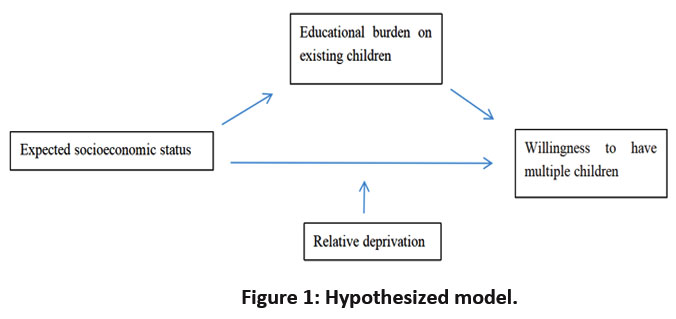 | Figure 1: Hypothesized model. |
Materials and Methods
Methods
This study used STATA software to analyze the data. The explanatory variables in this study were discrete and could not be analyzed using an ordinary linear regression model. Furthermore, the explanatory variables in this study were dichotomous, and thus, a binary logistic regression model was established to test the effect of expected socioeconomic status on the reproduction intention of people of childbearing age. In the mediation effect analysis, stepwise regression and the bootstrap method were used to test the intermediary effect. In the mediating effect analysis, interaction effects were tested by introducing interaction terms between the expected socioeconomic status and absolute economic status, as well as the expected socioeconomic status and relative economic status in the regression model.
Materials
The source of the data for this study was the Chinese Social Survey (CSS). The eighth survey (CSS2021), whose research theme was “Social Quality and Modernization”, had modules on family, employment, economic status, living conditions, social security, social values and social appraisal, social and political participation, volunteerism, etc. CSS2021 completed a survey covering 592 villages in 30 provinces, municipalities, and autonomous regions across China, where the project team collected 10,136 valid questionnaires. The project team organized the collected data and officially released the results on December 31, 2022.
This study screened the sample according to the following principles: (1) The dependent variable in this study was the intention to have another child, and the intention to have another child in the adopted data was only asked of the respondents who already had at least one child, and thus, this study did not cover the sample without children. (2) The research object of this study was the childbearing age group, and thus, the data were screened according to the definition of the childbearing age group (15-49 years old) (Song et al., 2021), while the data of the non-childbearing age group were excluded. (3) A total of 2,982 valid responses were obtained by screening for and removing “unclear” and “refused to answer” responses from the sample.
Variable Selection
Dependent Variable
In this study, willingness to have another child is used as the dependent variable, and the intention to have another child is defined as the desire to have another child among the population of childbearing age who have already had at least one child. Accordingly, the results from the question “How many more children do you intend to have?” in CSS2021 were selected, and the responses “One more”, “Two more”, and “Three or more” were considered as intending to have another child, while “Probably not”, “Definitely not”, and “Haven't thought about it yet” were considered as having no intention to have another child. A value of 1 was assigned to the intention to have another child, and a value of 0 was assigned to the lack of intention to have another child.
Independent Variable
Expected socioeconomic status was the core explanatory variable in this study. Scholars usually use the MacArthur Scale of Subjective Socioeconomic Status to measure subjective social class. This is a one-step scale, with different steps representing the social class status that respondents perceive themselves to be in (Wang et al., 2023). The CSS2021 questionnaire asked, “Where do you think your socioeconomic status will be in the next five years?” This question was used to measure the expected socioeconomic status, and thus, this question was chosen to construct the core explanatory variables. The range of values was 1-5, with larger values representing a higher expected socioeconomic status.
Mediating Variables
The educational burden due to existing children was the mediating variable in this study. It was noted that the burden of education mainly comes from education expenditure (Liu et al., 2020). Therefore, the question in CSS2021, “Have you encountered any problems in your life, such as the high cost of your children's education in the past 12 months, which is unaffordable?”, was selected for this paper. The mediating variables were constructed. A value of 1 was assigned for yes and a value of 0 was assigned for no.
Moderating Variables
The perception of relative deprivation was the moderating variable in this study. The relative deprivation of two reference groups was constructed by drawing on the practices of previous studies (Huang, 2022). The question, "How do you feel about your standard of living compared to your relatives?" From the CSS2021 questionnaire was selected. This question was used to construct a sense of relative deprivation, i.e., “near deprivation”, based on the surrounding population. The CSS2021 question, "How do you feel about your standard of living compared to people in your province?" was selected. This question was used to construct a relative sense of deprivation based on the overall members of society over a more distant range, i.e., “far deprivation”, with values ranging from 1 to 5, with larger values representing higher deprivation.
Control Variables
Based on the literature (Li et al., 2021; Feng, 2018), this study selected other factors that may have affected the reproduction intention of people of childbearing age as control variables, namely, sex, age, education level, employment status, marital status at the individual level, type of household registration, the number of existing properties in the family, household income and expenditure, the availability of old-age insurance or pension, and the availability of maternity insurance. The details are shown in Table 1.
Table 1: Variable settings
Variable Type | Variable Definition | Variable Interpretation |
Dependent variable | Willingness to have another child | Whether you intend to have more children. Yes: 1, no: 0. |
Independent variable | Expected socioeconomic status | Lower assigned to 1, lower-middle assigned to 2, middle assigned to 3, upper-middle assigned to 4, upper assigned to 5. |
Mediating variable | Educational burden on existing children | 1 for yes, 0 for no. |
Moderator variables | Near deprivation | The standard of living compared with relatives was assigned a value of 1 for much better, 2 for better, 3 for about the same, 4 for worse, and 5 for much worse. |
Far deprivation | Compared with the people in the province, a much better standard of living was assigned to 1, better was assigned to 2, about the same was assigned to 3, worse was assigned to 4, and much worse was assigned to 5. | |
Control variables | Sex | Men were assigned a value of 1, and women were assigned a value of 0. |
Age | Continuous variable. | |
Education level | Tertiary education was assigned a value of 1, while no tertiary education was assigned a value of 0. | |
Employment status | A value of 1 was assigned to working and 0 to not working. | |
Marital status | A value of 1 was assigned to a married state and 0 was assigned to a non-married state. | |
Type of household registration | A value of 1 was assigned to non-rural households and 0 to rural households[1]. | |
Number of properties already owned by the household | Continuous variable. | |
Household income and expenditure | Income less than expenditure was assigned a value of 1, equal income and expenditure was assigned a value of 2, and income higher than expenditure was assigned a value of 3. | |
Availability of old-age insurance or pension | Yes was assigned to 1, no was assigned to 0. | |
Availability of maternity insurance | Yes was assigned to 1, no was assigned to 0. |
China has adopted a household registration system, and for a long time people's hukou have been divided into two categories: agricultural hukou and non-agricultural hukou.
Results
Descriptive Statistical Analysis Results
Overall, the majority of the population of childbearing age had no desire to have another child, and only 8.8% of the population of childbearing age desired to have another child (Table 1). The expectations of the population of childbearing age with regard to socioeconomic status were, on average, at a medium level (M=2.95). A small proportion of people of childbearing age felt that any future children they had would be a burden on the education of their existing children (32.6%). The “near deprivation” of the childbearing age group averaged at a medium level (M=2.83), and the “far deprivation” averaged at a lower-middle level (M=1.996). The female sample (63%) was larger than the male sample (37%). The mean age of the reproductive age group was about 38.6 years. About 22.9% of the reproductive age group had tertiary educational experience. Most people of childbearing age were employed (67.3%). Almost all people of childbearing age were married (95.1%). The majority of people (64.5%) of childbearing age had an agricultural hukou (household registration), and a small proportion had a non-agricultural hukou (35.5%). On average, each household in the reproductive age group had approximately one property (M=1.205). The household income was, on average, higher than the expenditures (M=1.852). The proportions of people of childbearing age who had old-age or pension insurance and who had maternity insurance were 29.9% and 21.7%, respectively, indicating that the amounts of old-age or pension insurance and maternity insurance coverage among people of childbearing age were low.
Table 2: Descriptive statistics.
Variable Definition | Mean Value | Standard Deviation | Minimum Value | Maximum Value |
Willingness to have another child | 0.088 | 0.284 | 0 | 1 |
Expected socioeconomic status | 2.950 | 1.065 | 1 | 5 |
Educational burden on existing children | 0.326 | 0.469 | 0 | 1 |
Near deprivation | 2.830 | 0.895 | 1 | 3 |
Far deprivation | 1.996 | 0.950 | 1 | 5 |
Sex | 0.370 | 0.483 | 0 | 1 |
Age | 38.561 | 6.862 | 19 | 49 |
Education level | 0.229 | 0.421 | 0 | 1 |
Employment status | 0.673 | 0.469 | 0 | 1 |
Marital status | 0.951 | 0.217 | 0 | 1 |
Type of household registration | 0.355 | 0.479 | 0 | 1 |
Number of properties already owned by the household | 1.205 | 0.606 | 0 | 6 |
Household income and expenditure | 1.852 | 0.778 | 1 | 3 |
Availability of old-age insurance or pension | 0.299 | 0.458 | 0 | 1 |
Availability of maternity insurance | 0.217 | 0.412 | 0 | 1 |
Expected Socioeconomic Status and Willingness to Reproduce
Table 3 presents the regression results for models 1, 2, and 3, with the three models incorporating both individual and non-individual level variables in turn; that is, the variables at both levels were effectively controlled in turn. With the inclusion of control variables, the degree of the model fit improved from 0.0087 to 0.1686. The regression results of the core independent variables in models 1, 2, and 3 passed the 1% significance level test.
According to model 3, it was concluded that expected socio-economic status has a significant effect on the desire to have another child among people of childbearing age, and that expected socio-economic status is positively associated with the desire to have another child among people of childbearing age. Given other conditions, for every 1 unit increase in expected socioeconomic status, the rate of willingness to have another child among people of childbearing age increased by 26.5 percent (e0.235-1 ? 0.265), which supports hypothesis 1 of this study, i.e., expected socioeconomic status significantly and positively affects the willingness to have another child among people of childbearing age.
Regarding the control variables, compared with women of childbearing age, men of childbearing age had a stronger desire to have children again (coefficient =0.738, p <0.01). The older the population of childbearing age, the weaker the desire to reproduce (coefficient =-0.163, p<0.01). Compared with those who had not received tertiary education, those who had received tertiary education had a stronger desire to have children again (coefficient =0.479, p<0.01). Compared with non-married people of childbearing age, married people of childbearing age had a weaker desire to have children again (coefficient =-0.637, p<0.05). The childbearing age group with the burden of their children’s education was less willing to have children (coefficient =-0.353, p<0.01).
Table 3: Logistic regression analyses of factors that influenced the willingness to have another child in the reproductive age group.
Variable | Model 1 | Model 2 | Model 3 |
Expected socioeconomic status | 0.253*** ?0.063? | 0.188*** ?0.068? | 0.235*** ?0.072? |
Sex (reference group: female) | 0.713*** ?0.149? | 0.738*** ?0.151? | |
Age | -0.165*** ?0.012? | -0.163*** ?0.012? | |
Education level (reference group: no tertiary education) | 0.424*** ?0.150? | 0.479*** ?0.174? | |
Employment status | 0.176 ?0.166? | 0.170 ?0.173? | |
Marital status (reference group: not married) | -0.648** ?0.319? | -0.637** ?0.323? | |
Type of household registration (reference group: rural) | -0.202 ?0.154? | ||
Number of existing properties in the family | 0.023 ?0.111? | ||
Household income and expenditure | 0.055 ?0.095? | ||
Availability of old-age insurance or retirement pension | 0.042 ?0.171? | ||
Availability of maternity insurance | 0.088 ?0.188? | ||
Whether there was an educational burden due to current children (reference group: none) | -0.353*** ?0.162? | ||
Far deprivation | 0.114 ?0.082? | ||
Near deprivation | 0.172 ?0.090? | ||
?2 | 0.0087 | 0.1608 | 0.1686 |
Number of observations | 2982 | 2982 | 2982 |
Notes: (1) standard errors in parentheses; (2) *** p < 0.01 and ** p < 0.05.
Since the explanatory variable "willingness to have another child" was a dichotomous variable, this study first adopted binary logistic regression to analyze it, and after adding the control variable "expected socio-economic status", it was found to have a significant effect on the fertility intention of people of childbearing age. To test the robustness of the model, this study used the probit model for our analysis. The regression results (Table 4) were consistent with the logistic regression results (Table 3), indicating the robustness of the logistic regression results.
Table 4: Probit regression analyses of factors that influenced the willingness to have another child among people of childbearing age.
Variables | Probit Model |
Expected socioeconomic status | 0.123*** |
Other control variables | All control variables |
R2 | 0.1692 |
Number of observations | 2982 |
Notes: (1) standard errors in parentheses; (2) *** p < 0.01.
Analysis of the Mediating Effect
Stepwise Regression
The stepwise approach was used to test the mediating role of the burden of education, and the estimated correlation coefficients are presented in Table 5. First, column (a) of Table 5 shows that the expected socioeconomic status significantly and positively affected the desire of the population of childbearing age to have another child, suggesting that there was a total effect and that the argument based on the mediating effect was appropriate. Second, the results in column (b) show that the expected socioeconomic status was significantly and negatively related to the burden of the current children’s education. At the same time, after adding the burden of education to the last column, expected socio-economic status still has a significant impact on the fertility intentions of people of childbearing age, but the degree of its effect was lower than that without the inclusion of the education burden variable. The mediating effect of the education burden was found to be significant. Hypothesis 2 of this study was supported, i.e., the burden of education due to existing children plays a partial mediating role between expected socioeconomic status and willingness to have children; that is, the expected socioeconomic status not only had a direct effect on the willingness to have children in the childbearing age group but also had an indirect effect on the willingness to have children in the childbearing age group through the influence of the perceived burden of education due to existing children.
Table 5: Estimated correlation coefficients for the mediation effect test based on the stepwise regression method.
Variables | ?a?Willingness to have another child | (b) Burden of education | (c) Willingness to have another child |
Expected socioeconomic status | 0.241*** ?0.072? | -0.135*** ?0.040? | 0.235*** ?0.071? |
Educational burden | -0.353*** ?0.162? | ||
Control variables | All control variables | All control variables | All control variables |
R2 | 0.1658 | 0.0346 | 0.1686 |
Notes: (1) standard errors in parentheses; (2) *** p < 0.01.
Mediating Effect Analysis based on the Bootstrap Methodology
In addition, this study adopted the bootstrap method to test the mediating effect of education burden 1000 times, and the specific results are listed in Table 6, which shows that the 95% confidence intervals of both the direct and indirect effects did not contain 0, and the mediating effect of educational burden was significant, which is in line with the results obtained from the above stepwise regression method. The above results show that expected socio-economic status not only directly affects the reproduction intentions of people of childbearing age, but also indirectly affects the reproduction intentions of people of childbearing age by affecting the burden of education. Therefore, hypothesis 2 of this study is again supported.
Table 6: Results of mediating effect test using the bootstrap method.
Effect Type | Efficiency Value | Bootstrap Standard Error | 95% Confidence Interval |
Indirect effect | 0.00086** | 0.00041 | [0.00004,0.00167] |
Direct effect | 0.01637*** | 0.00476 | [0.00704,0.02570] |
Total effect | 0.01723*** | 0.00477 | [0.00787,0.02658] |
Note: *** p < 0.01 and ** p < 0.05.
Analysis of the Moderating Effect
The results of model 4 in Table 7 show that the regression coefficient of the expected socioeconomic status was significant at the 1 percent level, while the regression coefficient of the interaction term between the expected socioeconomic status and proximal deprivation was not significant, and the regression coefficient of the interaction term between the expected socioeconomic status and distal deprivation, namely, 1.55, was significant at the 5 percent level. The above results indicate that far deprivation exerted a negative moderating effect between the expected socioeconomic status and the reproduction intention of people of childbearing age, i.e., it weakened the positive association between the expected socioeconomic status and the reproduction intention of people of childbearing age. Hypothesis 3 of this study was partially supported, i.e., “far deprivation” moderated the effect of expected socioeconomic status on the willingness to have another child among people of childbearing age, whereas “near deprivation” did not have a moderating effect.
Table 7: Moderating effect of relative deprivation on willingness to have another child.
Variable | Model 4 | Model 5 |
Expected socioeconomic status | 0.251*** ?0.073? | 0.271*** ?0.074? |
Expected socioeconomic status × near deprivation | 0.083 ?0.070? | |
Expected socioeconomic status × far deprivation | -1.55** ?0.071? | |
Control variables | All control variables | All control variables |
Sample size | 2982 | 2982 |
R2 | 0.1666 | 0.1685 |
Note: (1) standard errors in parentheses; (2) *** p < 0.01 and ** p < 0.05.
Discussion
This study used data from the Chinese Social Survey 2021 to examine whether expected socioeconomic status affected the reproductive age group's willingness to have another child, identify the mechanism of its effect, and test the moderating effect of relative deprivation in the intervening period. The findings support hypotheses 1 and 2 proposed in this study and partially support hypothesis 3.
Similarities and Differences with the Results of Previous Studies
Expected Socioeconomic Status and the Willingness of people of Childbearing age to have another Child
Observing the willingness to have children in the reproductive age group in combination with the expected socioeconomic status provides a new perspective for us to understand the factors that influence the willingness to have children. This effect occurs because fertility is an intertemporal decision (Du et al., 2022), and decision makers tend to avoid irreversible and long-term decisions when they do not know what the future holds (Vignoliet al., 2021; Liang et al., 2011).
Mediation of the Educational Burden on Existing Children
Expected socioeconomic status not only directly affected the willingness of people of childbearing age to have another child but also influenced their willingness to have another child due to the burden of educating the children they already had. This finding further elucidated the mechanism by which expected socioeconomic status affected the reproduction intentions of people of childbearing age.
The Moderating Role of Relative Deprivation
The moderating effect of relative deprivation on the effect of expected socioeconomic status on the willingness to have another child among people of childbearing age held only when the reference object of relative deprivation was a larger population. This may have been because people develop stronger feelings of deprivation when the field is larger (Shi et al., 2023). As a result, reproductive age groups with high “far deprivation” are more likely to engage in short-term behaviors (Callan et al., 2011; Mishra et al., 2015) (e.g., solving an immediate financial dilemma) (Chen et al., 2021; Pan et al., 2023) than to consider having another child when they have higher expectations of their socioeconomic status.
Policy Implications
After analyzing the findings of this study, it was concluded that the factors that discouraged people of childbearing age from having more children were as follows: the long-term cost of childbearing that made people of childbearing age worry and the sense of relative deprivation that caused people of childbearing age to focus on short-term goals. Therefore, we propose the following policy improvements based on the above discouraging factors.
Improvements to the Supporting System for Fertility Policy
Judgments about future socio-economic status affect the wishes of people of reproductive age to have more children, which means that a sound system of supporting fertility policies should be put in place and that fertility protection should be extended from “birth” to “childbearing”. Childbearing, parenting, and education should be considered as a whole. Responding to the various reproductive needs at different stages of the childbearing process will alleviate future concerns regarding the childbearing process. For example, in the area of childbearing, a birth-friendly society should be built, and diversified and specialized post-natal care services should be provided. In the area of child-rearing, China's child-care service system still needs improvement, and the mainstream mode of child-rearing is one in which couples are self-reliant, with their parents helping to supplement their care. When a family has another child, the parents may be unable to continue providing care assistance for reasons such as health. So, a system of universal child-care services should be developed (Man et al., 2023). In the area of education, anxiety about education should be eased, and the cost of education should be reduced (Sun et al., 2022). In addition, we should promote the balanced development of educational resources and equity in education, further raise the level of universal compulsory education, urban-rural and regional equity in education, and build a diversified path for the training of human resources. The need to extend maternity protection to education is also supported by the expectation that socioeconomic status will influence the wishes of people of reproductive age to have more children by influencing their judgment of the educational burden of the children they already have.
Enhancing the Sense of Fulfillment for People of Childbearing Age
To reduce the relative deprivation of people of childbearing age, social equity should be advocated to prevent social stratification and enhance the sense of fulfillment of people of childbearing age. Targeted fertility policies can also be adopted, such as the development of policy loans dedicated to servicing fertility (Chen et al., 2021) as a means of mitigating the relative deprivation of those of childbearing age who have a stronger sense of relative deprivation to give up childbearing due to current economic distress or to develop their careers. In addition, China's fertility policy is somewhat deficient in promoting fertility equity (Yang et al., 2023). Equity in public services should be enhanced, with particular attention paid to less developed regions, special families and migrant populations. In this way, people of childbearing age will be able to reduce their sense of relative deprivation in the comparison of social life.
Limitations
The study had some limitations. First, causal inferences could not be drawn since this was a cross-sectional study. Second, due to data limitations, some factors that may be associated with the willingness to have another child (e.g., child care and anxiety disorders) among those already interviewed were not controlled for in this study.
Conclusion
This study showed that expected socioeconomic status had a significant positive effect on the reproduction intention of people of childbearing age and that expected socioeconomic status not only had a direct effect on the reproduction intention of people of childbearing age but also had an indirect effect on the reproduction intention of people of childbearing age by influencing the judgment of the burden of education due to the children they already had. In addition, the effect of expected socioeconomic status on the reproduction intention of people of childbearing age varied according to the relative deprivation of people in the same province, i.e., people of childbearing age with a high level of far deprivation had a weak effect on the expected socioeconomic status regarding their reproduction intention. These findings imply the need to improve fertility policies' supporting system and enhance accessibility for people of childbearing age.
Acknowledgment
The author thanks the staff and the participants of the CSS study.
Funding Sources
The author received no financial support for the research, authorship, and/or publication of this article.
Conflict of Interest
The author does not have any conflict of interest.
Authors’ Contribution
The author mentioned has significantly and directly contributed intellectually to the project and has given their approval for its publication.
Data Availability
The data for this research can be applied and downloaded from the Chinese Academy of Social Sciences Library Website (http://css.cssn.cn/zgshzkzhdc/, accessed on 25 May 2022).
Ethics Statement
This research did not involve human participants, animal subjects, or any material that requires ethical approval.
Informed Consent Statement
This study did not involve human participants, and therefore, informed consent was not required.
References
- Ajzen, I. (1991). The theory of planned behaviour. Organizational Behavior and Human Decision Processes, 1991, 50(2), 179–211. https://doi.org/10.1016/0749-5978(91)90020-T.
CrossRef - Armitage, C.J. & Conner, M. (2001). Efficacy of the Theory of Planned Behaviour: A Meta-Analytic Review. British Journal Of Social Psychology, 40, 471-499. https://doi.org/10.1348/014466601164939.
CrossRef - Becker, G. & Lewis, G. (1973). On the Interaction between the Quantity and Quality of Children. Journal of Political Economy, 81(2), 21973.
CrossRef - Central People's Government of the People's Republic of China. Extending maternity leave, promoting inclusive childcare services, granting maternity allowances - supporting measures for the three-child policy are being introduced one after another. Retrieved from: https://www.gov.cn/xinwen/2022-01/21/content_5669636.htm.
- Chen, W.M. & Li, X.Q. (2021) The Effect of Status Identity and Social Mobility Expectations on Fertility willingness——A Study on the Mechanism of the Low Fertility Trap. Nankai Journal (Philosophy, Literature and Social Science Edition), 69(2), 18-30.
- Callan, M.J., Shead, N.W. & Olson, J.M. (2011). Personal Relative Deprivation, Delay Discounting, and Gambling. Journal of Personality and Social Psychology, 101(5), 955-973. https://doi.org/10.1037/a0024778.
CrossRef - Daniele, V., Giacomo, B., Raffaele, G., Alessandra, M. & Elena, P. (2020). Uncertainty and Narratives of the Future: A Theoretical Framework for Contemporary Fertility. Analyzing Contemporary Fertility, 51, 25-47. https://doi.org/10.1007/978-3-030-48519-1_3.
CrossRef - Du, T.Y., Hu, X.Y., Yang, J., Li, L.Y. & Wang, T.T. (2022). Low Socioeconomic Status and inter temporal choice: The mechanism of “psychological-shift” from the perspective of threat. Advances in Psychological Science, 30(8), 1894-1904.
CrossRef - Feng, X.T. (2018). What's the Factors Influencing the Desire to Have the Second Child in the People of Childbearing age. Exploration and Free Views, 39(10), 54-61+142.
- Guo, C., Yang,P.S., & Mu, Y.H. (2023) Perspectives: Expectations of Improvement of Socioeconomic Status Throughout the Life Course as a Component for Promoting Fertility Intentions. China CDC Weekly, 5(16), 365-367.
CrossRef - Huang, Y.L. (2022). The Perception of Social Fairness of Middle-income Group in the Context of Common Prosperity: An Empirical Analysis Based on CSS2021 Data. Academia Bimestris, 34(6), 150-157. https://doi.org/10.16091/j.cnki.cn32-1308/c.2022.06.007.
- Jing, W.Z., Liu, J., Ma, Q.Y., Zhang, S.K., Li, Y.Y. & Liu, M. (2022). Fertility Intentions to Have a Second or Third Child Under China’s Three-Child Policy: A National Cross-Sectional Study. Human Reproduction, 37(8), 1907-1918. https://doi.org/10.1093/humrep/deac101.
CrossRef - Johnson-Hanks, J. (2005). When the Future Decides-Uncertainty and Intentional Action in Contemporary Cameroon. Current Anthropology, 46(3), 363-385. https://doi.org/10.1086/428799.
CrossRef - Jiang, M.M., Wu, Z.Y., He, B.B., Tu, A.X. & Wu, Y.B. (2022). Effect of Work-Family Conflict on Three-Child Fertility Intention of Working Women of Reproductive Age under the Background of Active Reproductive Support: The Moderating and Mediating Effects of Anxiety Disorders and Life Stress. Sustainability, 14(21), 14615. https://doi.org/10.3390/su142114615.
CrossRef - Kuhnt, A.K., Minkus, L. & Buhr, P. (2021). Uncertainty in Fertility Intentions From a Life Course Perspective: Which Life Course Markers Matter?. Jfr-Journal of Family Research, 33(1), 184-208. https://doi.org/10.20377/jfr-426.
CrossRef - Liu, J.d., Wang, J.h. & Tang, S.h. (2022). Bread or Baby: How does Youth Unemployment Affect Fertility Intention? Evidence from OECD Countries. Journal of Shanghai University of Finance and Economics, 24(4), 138-152. https://doi.org/10.16538/j.cnki.jsufe.2022.04.010.
- Lau, B.H.P., Huo, R., Wang, K., Shi, L., Li, R., Mu, S., Peng, H.M., Wang, Y., Chen, X.J., Ng, E.H.Y. & Chan, C.H.Y. (2018). Intention of Having a Second Child among Infertile and Fertile Women Attending Outpatient Gynecology Clinics in Three Major Cities in China: A Cross-Sectional Study. Human Reproduction Open, 4, hoy014. https://doi.org/10.1093/hropen/hoy014.
CrossRef - Liu, L.L. & Liu, H.K. (2020). China's Individual lncome Tax Reform and Family Education Expenditure: Education Burden and Educational Gap. Economic Science, 45(1), 100-112.
- Li, Y.Y. & Wang, G.X. (2021). Formation Mechanisms and Influential Factors of Fertility Intentions to Have Another Child-An Overview Based on the Theory of Planned Behavior and Evidence from the China Migrants Dynamic Survey. Henan Social Sciences, 29(10), 75-86.
- Liang, Z.Y. & Liu, H. (2011). Exploring the Nature of Intertemporal Choice. Advances in Psychological Science, 19(07), 959-966.
- Mu, H.Z. & Fan, H.M. (2015). The Influence Mechanism for the Recognition of Income Inequality: Social Structural Status and Mobility Expectation. Journal of Guangdong University of Finance & Economics, 30(1), 12-22.
- Mani, A., Mullainathan, S., Shafir, E. & Zhao, J.Y. (2013). Poverty Impedes Cognitive Function. Science, 341(6149), 976-980. https://doi.org/10.1126/science.1238041.
CrossRef - Mishra, S. & Novakowski, D. (2016). Personal Relative Deprivation and Risk: An Examination of Individual Differences in Personality, Attitudes, and Behavioral Outcomes. Personality and Individual Differences, 90, 22-26. https://doi.org/10.1016/j.paid.2015.10.031.
CrossRef - Man, X.O. & Yang, Y. (2023). Research on the Construction of China’s Birth-support Policy System Under the Background of “Three Children”: A Dual Analytical Framework Based on Policy Tools and Fertility Friendliness. Journal of Northeastern University(Social Science), 25(1), 88-95. https://doi.org/10.15936/j.cnki.1008-3758.2023.01.010.
- National Bureau of Statistics. 2022 National Economy Takes New Steps Against Pressure. Retrieved from: http://www.stats.gov.cn/xxgk/sjfb/zxfb2020/202301/t20230117_1892123.html.
- Pan, C., Xin, Z.Y., Gao, D.D. & Xing, X.L. (2023). The Effect of Upward Social Comparison on Inter temporal Decision: The Mediating Role of Relative Deprivation. Chinese Journal of Clinical Psychology, 31(1), 189-193. https://doi.org/10. 16128/j. cnki.1005-3611.2023.01.035.
- Power, S.A., Madsen, T. & Morton, T.A. (2020). Relative Deprivation and Revolt: Current and Future Directions. Current Opinion in Psychology, 35, 119-124. https://doi.org/10.1016/j.copsyc.2020.06.010.
CrossRef - Quesnel-Vallee, A. & Morgan, SP. (2003). Missing the Target? Correspondence of Fertility Intentions and Behavior in the US. Population Research Policy Review, 22(5-6), 497-525. https://doi.org/10.1023/B:POPU.0000021074.33415.c1.
CrossRef - Riley, J.W. (1949). The American soldier: Adjustment during army life. American Sociological Review, 14(4), 557-559.
CrossRef - Schoen, R., Astone, N.M., Kim, Y.J., Nathanson, C.A. & Fields, J.M. (1999). Do Fertility Intentions Affect Fertility Behavior?. Journal of Marriage and Family, 61(3), 790-799. https://doi.org/10.2307/353578.
CrossRef - Song, J., Hu, B., Jiang, C.Y. & Chen, W.Q. (2023). China's Low Fertility and Provincial Differences: Fertility Index-based Observation. Population Research, 47(05), 74-87.
- Song, J. & Alimire, A. (2021). Deviation between Fertility Desire and Fertility Behavior in China and the Effect of Family Support. Population Research, 45(4),18-35.
- Shi, S.Y., Chen, Y.C. & Yip, P.S.F. (2023). Relative Deprivation Patterns in Social and Geographical References for Health Trajectories in China: Investigations of Gender and Urban-Rural Disparities. Social Science & Medicine, 317 , 115589. https://doi.org/10.1016/j.socscimed.2022.115589.
CrossRef - Sun, X.M., Huang, Z. & Zhou, C.G. (2022) The Effect of Children's Education Costs on the Fertility Willingness. South China Population, 37(4), 24-35.
- Tian, Y.F., Lu, S.Y. & Zhang, P. (2020). Child Care and the Desire to Bear Another Child-Evidence from Shanghai. Population Journal, 42(3), 18-29. https://doi.org/10.16405/j.cnki.1004-129X.2020.03.002.
- Tao, T. (2023). Low Fertility Intention and Response under the Transmission Mechanism of Educational Anxiety. Journal of Huazhong University of Science and Technology(Social Science Edition), 37(3), 74-80. https://doi.org/10. 19648/j. cnki. jhustss1980.2023.03.08.
- Vignoli, D., Mencarini, L. & Alderotti, G. (2021). Is the Effect of Job Uncertainty on Fertility Intentions Channeled by Subjective Well-Being?. Advances in Life Course Research, 46, 100343. https://doi.org/10.1016/j.alcr.2020.100343.
CrossRef - Wang, T., Wang, C., Zhou, Y., Zhou, W. & Luo, Y. (2019). Fertility Intentions for a Second Child among Urban Working Women with One Child in Hunan Province, China: A Cross-Sectional Study. Public Health, 173, 21-28. https://doi.org/10.1016/j.puhe.2019.05.006.
CrossRef - Walker, I. & Mann, L. (1987). Unemployment, Relative Deprivation, and Social Protest. Personality and Social Psychology Bulletin, 13(2), 275-283. https://doi.org/10.1177/0146167287132012.
CrossRef - Wang, S.Y., Liu, Q.P. & Jiang, W. (2023). Measurement and Manipulation of Socioeconomic Status: Current Situation and Existing Problems—Based on Psychological Studies. Psychological Research, 16(1), 12-20. https://doi.org/10.19988/j.cnki.issn.2095-1159.2023.01.002.
- Xia, J., & Liu, L. (2021). How to Create Reproductive Welfare?——The Three-child Policy and its Supporting Measures. Journal of Guangzhou University (Social Science Edition), 20(6), 85-94.
- Yang, X.L. & Zhong, R.Y. (2023). The Effects of Household Income Level and Gender Perception on the Intention to Have Another Child. Finance & Economics, 65(04), 137-148.
- Yin, Y.Y., He, Y.H. & Liu, Y.W. (2023). Relaxation of Birth Control and Family Fertility Willingness: A Quasi-Natural Experiment Based on The Universal Two-Child Policy. Social Security Studies, 16(4), 45-56.
- Yang, Z. & Zhang, Q. (2019). Children Education and Family Consumption from Perspective of Education Expection: Causal Inference Based on a Counterfactual Framework. On Economic Problems, 45(7), 78-86. https://doi.org/10.16011/j. cnki. jjwt. 2019.07.010 .
- Yang, J.L., Wang, R.J., Chen, H.Y. & Liang, X.H. (2023) Text quantitative study of China's fertility policy: A three-dimensional analysis framework based on policy tools, policy inclusiveness, and policy strength. Chinese Journal of Health Policy, 16(9), 15-21.
- Zhang, W.Z. & Zheng, J.Y. (2021). The Willingness of Women of Childbearing Age to Have a Second Child in Lanzhou Under the “Universal Two-Child Policy”. Children and Youth Services Review, 121, 105732. https://doi.org/10.1016/j.child youth.2020.105732 .
CrossRef - Zhou, Y. (2022). Subjective Perception Patterns of Social Class Positioning: A Cognitive Model of Social Status and Empirical Test. Sociological Review of China, 10(5), 220-237.
- Zeng, Y.L. & Zhao, D. (2020). Social Stratification and the Female Decision-making of Giving Birth to A Second Child: An Analysis of Zhongshan, Guangdong Province. South China Population, 35(6), 30-39.
- Zhao, D.L. & Yuan, Y. (2019). Class Differences in People's Future Life Expectations in the New Era and the Mediating Effect of the Sense of Social Justice. Journal of Harbin Institute of Technology(Social Sciences Edition), 21(3), 54-62. https://doi.org/10.16822/j.cnki.hitskb.2019.03.029

This work is licensed under a Creative Commons Attribution 4.0 International License.